Advanced Search

Advanced Search

Current Filters

Filter your query

Publication Types

Other

to

Issue Briefs

/

Patients’ Perspectives on AI in Primary Care

“[I’m excited about] the potential of AI, because . . . with the downside also comes the upside.”
Doctor looks at computer scren in front of patient

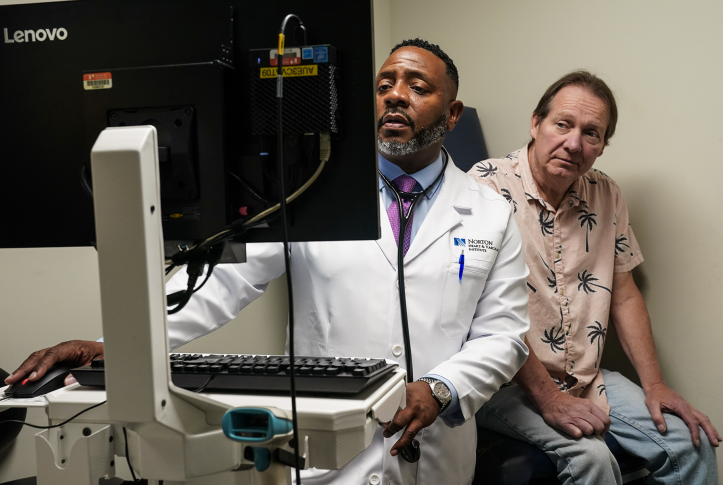
Dr. Kelly McCants, a cardiologist and head of health equity for Norton Healthcare, sees heart patient Tim McIntosh, 57, at McCants’s office in Louisville, Ky. Across 23 interviews, patients felt the integration of AI tools into primary care was inevitable, but they also described opportunities to ensure there are real benefits to their use. Photo: Jahi Chikwendiu/Washington Post via Getty Images

Dr. Kelly McCants, a cardiologist and head of health equity for Norton Healthcare, sees heart patient Tim McIntosh, 57, at McCants’s office in Louisville, Ky. Across 23 interviews, patients felt the integration of AI tools into primary care was inevitable, but they also described opportunities to ensure there are real benefits to their use. Photo: Jahi Chikwendiu/Washington Post via Getty Images

Toplines
  • Patients view the use of AI in primary care as inevitable but see opportunities for the technology to improve care and communication with their clinicians

  • To address patients’ concerns about consent and other AI-related issues, clinicians and health system leaders could establish practices to promote transparency, accountability, and fair use of the technology

Toplines
  • Patients view the use of AI in primary care as inevitable but see opportunities for the technology to improve care and communication with their clinicians

  • To address patients’ concerns about consent and other AI-related issues, clinicians and health system leaders could establish practices to promote transparency, accountability, and fair use of the technology

Introduction

Primary care clinicians spend an increasing amount of time on administrative tasks, meaning less time focusing on patients.1 This administrative burden is associated with clinician burnout and early retirement. Patients, in turn, may struggle to get appointments or adequate attention during visits.

Integrating artificial intelligence (AI) tools into primary care is one of the many options that patients, clinicians, and health system leaders are exploring to increase the availability and effectiveness of individual clinicians, and primary care generally.2

Clinicians, for example, may use AI-driven clinical decision tools to inform diagnoses or treatment, supporting their clinical work.3 Health system leaders have developed AI scheduling tools, hoping to deliver continuous care for their patients with complex needs.4 Meanwhile, patients have turned to AI chatbots in search of understandable and accessible health information.5

These tools may aim to ensure primary care is coordinated, continuous, comprehensive, accessible, and patient-centered. However, design and implementation of health technology tend to be top-down, without consideration for patients’ perspectives.6 While the goal may be to improve the care experience, without their input, patients may be distrustful or hesitant to use these tools, and the tools may create inequities.7

To understand patients’ awareness about the integration of AI tools into primary care and their perspectives and experiences, the Public Policy Lab, with support from the Commonwealth Fund, interviewed 23 patients in New York City and rural Virginia between December 2025 and January 2026. Patients’ insights and suggestions directly informed the development of recommendations for health system leaders and clinicians on how to put patients at the center of AI implementation in primary care.

While participants were not given a specific definition of AI, many mentioned specific tools and use cases. AI tools and their adoption are rapidly evolving, as well as the evidence base on their effectiveness.8 This brief reflects the knowledge and experiences of primary care patients during the study period. (For interview details, see “How We Conducted This Study.”)

Highlights

  • Across 23 interviews, patients felt the integration of AI tools into primary care was inevitable, but they also described opportunities to ensure there are real benefits to their use.
  • Patients want AI tools to extend the capacity of — but not replace — their primary care clinicians.
  • Patients feel AI tools could bridge gaps in communication and trust.
  • Health system leaders and clinicians can help ensure that when AI tools are implemented in primary care, there is transparency and accountability, as well as benefits that are meaningful and fair.

Key Findings

Patients want a voice in how AI is applied, even if they feel its use is inevitable.

Patients felt resigned to the growth of AI use in their primary care. Patients — whose names have been changed in this brief to ensure anonymity — viewed AI as part of a broader technological shift in their care, which they felt was out of their control. This shift left many to weigh its risks against the possibility it could improve their care or serve the common good. Patients described acquiescing to the growth of AI and other technology in more aspects of their daily lives, including in their primary care.

The sense of inevitability did not mean patients had no opinions. Many had clear views about when AI feels acceptable, what safeguards they want, and how these tools — and their own data — should be used in their care.

A lot of people are saying that this is taking over. . . . They’re not too keen with it, with what we’re going through today, with artificial intelligence. . . . I’m not too keen with it neither, but it’s here. . . . A lot of people worrying about that it’s going to take everybody’s jobs. It’s taking over everything. . . . And, you know, people saying that it’s going to take a lot of jobs. You know, a lot of people [are] going to lose a lot of things.

Christopher Brooklyn, N.Y.

Some patients saw an opportunity for their health data to be used for the greater good. While resigned to the use of AI tools by their primary care doctors, patients indicated an openness to their health data being used by these tools to improve their care. “I want to know where they’re sending it [data that AI uploads to a database] off to and for what purposes and how exactly that’s helping them so that in turn they can help me,” said Helen from The Bronx, N.Y.

While they believe their general data privacy is already significantly compromised, several of those included in this study are willing to share health data with AI tools on the condition that the data is deidentified and the results benefit either them directly or society more broadly.

I mean, as long as it [global database] don’t got your name and your information, your personal information, I don’t see nothing wrong with it. . . . All your health information is already uploaded in MyChart. . . . I don’t see nothing wrong with it [health information being uploaded to a worldwide database if it helps with early detection of diseases.]

Emily The Bronx, N.Y.

Patients believe AI could help bridge gaps in care and trust.

Some see AI as a means to improve the care their clinicians provide. Patients see potential for AI to improve early detection of health issues and ensure more accurate diagnoses — a reflection of experiences where a late or misdiagnosis was harmful.

I imagine doctors seeing the same condition day in, day out or similar conditions day in, day out. . . . Whereas AI may not understand the nuances of language, but it may understand the nuances of medical conditions. . . . All credit to doctors and their years of study, but they have a vast range of information they have to store in their heads and access. And AI, there’s no limit.

James Pulaski, Va.

Patients may turn to AI chatbots when there are gaps in communication and trust. When primary care clinicians provide information that is unclear or inaccessible, patients have deciphered it by using chatbots.

One patient saw AI as an informal backup to their regular doctor when they can’t get or afford another appointment. Another called AI “like a second opinion, without going to another doctor, because another doctor might cost money . . . or might not accept insurance . . . because every appointment also takes time.”

Patients who felt judged or rushed by their clinicians also turned to chatbots to research medical concerns.

James in Pulaski, Virginia, felt hopeful about the potential of AI to mitigate biases that clinicians may have toward patients: “One would hope the AI doesn’t have prejudices that people develop, the biases and prejudices.”

Experiences with technology fuel patient reservations about AI.

Patients worry about their clinicians losing their skills. Patients voiced concerns that their primary care clinicians would become overly reliant on AI tools, leading to “cognitive deskilling” among clinicians and lower-quality care.

As Ashley from The Bronx, N.Y., put it: “I’m kind of scared that, like, if I was a doctor or somebody else, it would take away me thinking from scratch.”

[Technology] also makes the doctors a little lazy too. . . . It’ll be easier, don’t get me wrong, on that technology, but I feel I’m old school.

Jennifer The Bronx, N.Y.

Patients don’t want new technology to detract from their care. While patients expressed hopes that AI tools could improve aspects of their care, they were also skeptical of AI’s efficiency, citing existing technology that introduced — rather than reduced — friction and administrative burden into their lives. “I want to say I like the way that they’re changing it to make it better for them, so things move faster,” Michelle in Brooklyn, New York, said. “But in a way, it’s not making anything move fast, and I feel like it’s distracting them when they’re on the laptop itself. . . . He’ll, like, use the laptop, but then he’ll trail off like it would be like a couple seconds or a couple of minutes until he asks me the next thing for him to write down, like, type up.”

Some patients fear they’ll be left behind. Patients who have unreliable internet, older devices, and limited digital literacy expressed concern that the digital divide between those who do and don’t benefit from health technology could worsen with the rise of AI.

I’m illiterate whenever it comes to a lot of technology. Like, I tried to fill out a form online, it was like a tax form, and I just sat there and looked at it and then I found it and then I called somebody and was like, ‘what do I do here?’

Amanda Wytheville, Va.

Patients outlined what they’d need from AI to feel informed and in control.

Patients want technology to help, not replace, their clinicians. Patients, even those with negative experiences with the health care system, said they don’t want AI tools to replace their clinicians. Though they felt AI can offer greater technical information, analytical capability, and efficiency, patients repeatedly said it cannot replicate the human compassion and empathy that are at the heart of good primary care.

I mean, as long as I don’t lose my real doctor, I’m just saying I just don’t want to lose my real doctor. I just want a real doctor to always see me, talk to me, and answer my concerns. And I think that [a] machine is not going to do that as well as a human being.

Emiily The Bronx, N.Y.

Patients value disclosure and want opportunities to consent to AI use in their care. Patients want to learn about AI tools where meaningful patient awareness and consent are feasible, regardless of whether they interact with them directly. Patients said they wanted to receive this information through multiple communication channels — such as being told during an appointment as well as receiving written notice beforehand — so they can digest the information on their own time and have the chance to ask questions. “I would want them to be like, ‘Hey, listen, I have this new tool. Let me just explain what it does, and how it’s here to help you,” said Jessica in The Bronx, New York. “I’d rather you talk to me about it first before you just stick me with something and I don’t know what’s happening.”

Patients described being informed about a “policy change at an institution,” while another said they want “something like HIPAA for generative AI.” Another patient said, “I always tell people [AI is] here, but somebody’s still got to take care of it. Somebody got to run it,” pointing toward a desire for management and accountability.

Patients want AI to create more opportunities for accountability and accuracy in their care. Patients appreciate the possibility of AI tools creating plain-language notes — or “paper trails” — on their doctor visits so they can verify information, dispute inaccuracies, prepare questions, and advocate for their health needs — potentially reflecting gaps patients experience in their primary care. “I think it [technology in health care] keeps people more up to date of what was actually said, what was done,” said Stephanie from Pulaski, Virginia. “Because in the past, before that, if I left the doctor’s office, whatever was said there and what I remembered or wrote down was all I knew. And now I can go on a portal or something and see what’s there.”

Discussion

Health systems, clinicians, and patients are turning to AI tools to address issues facing primary care. Our interviews revealed that patients want transparency about when and why AI tools are used in their care, opportunities to ask questions, and — when possible — the ability to decline without compromising the quality of their care.

Their views were shaped by whether they trusted their clinicians, previous negative experiences in health care, and everyday experiences with technology. Patients expressed hope that AI could improve care and communication, as well as concern that it could erode clinical judgment, privacy, and the human connection central to primary care. Some saw AI’s growth as inevitable and largely outside of their control, while others were actively embracing it to better understand and manage their care.

Across these perspectives, patients consistently wanted transparency and accountability, meaningful benefits, and choice where possible. Below, we highlight opportunities for clinicians and health system leaders to make improvements based on these themes.

Transparency and Consent

Because AI can shape primary care through its role in documentation, patient communication, and clinical decision support, patients viewed transparency about AI — including benefits and risks — as a prerequisite for trust and responsible use.9 Other research points in the same direction: most U.S. adults say they want to be notified when AI is used in their health care, and many report limited trust that health systems will use AI responsibly.10

Patients described consent as a conversation with their clinician before an AI tool is used, paired with plain-language written information they can review and return to later. They wanted time to think and ask questions, and the option to decline when feasible, and clarity when it isn’t. When real choice isn’t possible, patients prefer disclosure over hollow consent processes.

Recommendations: Clinicians and practice staff could explain the parameters of their AI use to patients through portal messages prior to the visit or plain-language handouts at the visit. Health systems could set rules for when patient consent is required versus when disclosure is enough.11 When clinically and operationally possible, practices could offer patients a meaningful opportunity to opt out of AI-enabled functions, such as automated note drafting, patient-facing messages, or algorithmic decision support, and offer a non-AI pathway that does not change the quality of care they receive. When opting out is not possible, practices can be transparent with patients about the benefits and risks associated with the tool.

Accountability

Patients expect their primary care clinicians to be responsible for their care, and this extends to AI use as well. Survey research suggests people are more comfortable with AI use when clinicians stay meaningfully involved in care and health systems have strong governance.12 Patients should be able to tell who makes the final clinical decision — their clinician or an AI tool — and who is responsible for safety and oversight if something goes wrong.

Our interviews reinforced why this matters. Patients wanted AI to assist, not replace, their clinicians’ judgment, and they wanted a clear path to a human who can explain decisions, correct errors, and take responsibility.

Recommendations: One option for health systems is to be clear about who is responsible for AI-supported decisions. Practices could make it easy for patients to reach a human, fix mistakes in their medical records, and appeal decisions that are directly or indirectly influenced by AI. Health systems could also train clinicians and staff to use AI as input — not a shortcut — and monitor for overreliance and harm over time.

Patient Benefit and Fairness

In our interviews, patients pointed to concrete benefits associated with AI tools like clearer visit summaries, plain-language explanations of test results and diagnoses, and easier communication between visits. Some also saw AI as a way to potentially counter dismissive or biased treatment from clinicians and difficulty getting follow-up appointments or second opinions.

At the same time, patients worried that AI could create new barriers for those without reliable internet access, newer devices, or high digital literacy, including some patients in rural communities, who are already underserved. They also worried that any gains in fairness would be undermined if AI tools are inaccurate.

Recommendations: One option for practices is to prioritize AI use cases with clear patient benefit — including better understanding, easier access to care, and preserved human connection — and test whether they reduce patient burden rather than create it. Health systems could measure outcomes that patients notice, like comprehension, perceived burden, trust, and ability to reach a human, alongside safety and efficiency metrics. Additionally, systems could vet tools for equity before rollout, including usability on older devices and with low bandwidth and different literacy levels, as well as monitor for inequitable outcomes. They could also provide nondigital options so that patients are not blocked by the digital divide.

Conclusion

These findings draw on interviews with a diverse group of primary care patients in urban and rural settings with different types of insurance coverage, spanning a range of ages and racial and ethnic identities. Together, their perspectives suggest that the future of AI in primary care will be shaped not only by what these tools can do, but also by whether patients find them understandable, trustworthy, and beneficial in their care.

For health system leaders, successful adoption of AI tools in primary care will depend on their design and whether implementation is done with patients. Primary care clinicians can help ensure that these tools are introduced clearly, used responsibly, and assessed in light of patients’ needs and concerns.


HOW WE CONDUCTED THIS STUDY

The Commonwealth Fund partnered with the Public Policy Lab (PPL) to conduct a qualitative design research study around the integration of AI technologies in primary care settings, with a particular focus on patient populations that have been historically underserved by and/or are mistrustful of the U.S. health care system. The research sought to identify how patients feel about existing integration of AI in primary care, identify language that allows individuals to best understand and consent to such integration, and envision ways that AI-supported systems might eliminate gaps in the quality of care patients receive and enable them to be active partners in their care. To explore these questions, PPL spoke with people in New York City and southwest Virginia.

PPL recruited 23 individuals who had attended at least one primary care visit in the past year. PPL sought individuals with a range of insurance coverage and familiarity with AI tools. Using semistructured interviews, the team explored three core inquiry areas and captured reactions to specific AI applications and clinical contexts. They also used design stimuli — a set of scenario cards representing potential uses of AI — to tease out participants’ perceptions and trade-offs. From these conversations, the team collected 328 data points, which were synthesized and delivered to the Commonwealth Fund for dissemination to health care system leaders, policymakers, and AI technologists.

ACKNOWLEDGMENTS

The authors would like to thank the Commonwealth Fund’s Dr. Laurie Zephyrin, Corinne Lewis, Dr. Tony Shih, and Morenike Ayo-Vaughan for their support of this grant, as well as their contributions to this report. We thank Karina Polanco for her careful review of the content. We also gratefully acknowledge the people who participated in interviews; without their insights, this work would not be possible.

Notes

Publication Details

Date

Contact

Celli Horstman, Senior Research Associate, Improving Care Delivery, The Commonwealth Fund

ceh@cmwf.org

Citation

Celli Horstman et al., Patients’ Perspectives on AI in Primary Care (Commonwealth Fund, July 2026). https://doi.org/10.26099/fzna-sr67