
Advanced Search

Advanced Search

Current Filters

Filter your query

Publication Types

Other

to

Issue Briefs

/

Fortifying Medicaid Managed Care for Postpartum Enrollees: The Clearest Path to Improving Maternal Health

Mom and baby are examined by postpartum professional

Melina Laverde, left, performs cranial sacral therapy on Sanaai Lynae, two weeks old, during a postpartum checkup on Destyni McClain in Houston, on July 25, 2025. Continuous Medicaid coverage in the critical postpartum period increases access to medication and medical care — including preventive services, mental health care, and substance use disorder treatment — and reduces families’ financial burden, such as out-of-pocket spending. Photo: Ashleigh Lucas/Houston Chronicle via Getty Images

Melina Laverde, left, performs cranial sacral therapy on Sanaai Lynae, two weeks old, during a postpartum checkup on Destyni McClain in Houston, on July 25, 2025. Continuous Medicaid coverage in the critical postpartum period increases access to medication and medical care — including preventive services, mental health care, and substance use disorder treatment — and reduces families’ financial burden, such as out-of-pocket spending. Photo: Ashleigh Lucas/Houston Chronicle via Getty Images

Toplines
  • States can seize a “window of opportunity” to strengthen and safeguard Medicaid postpartum care services in face of impending funding cuts

  • A review of 39 state contracts with Medicaid managed care organizations highlights concerning shortfalls in “core” postpartum care services

Toplines
  • States can seize a “window of opportunity” to strengthen and safeguard Medicaid postpartum care services in face of impending funding cuts

  • A review of 39 state contracts with Medicaid managed care organizations highlights concerning shortfalls in “core” postpartum care services

Abstract

Issue: Most people with Medicaid who have given birth in the past 12 months are enrolled in Medicaid managed care (MMC), underscoring the essential role state Medicaid agencies and managed care organizations play in ensuring continuous, high-quality postpartum care. Recent federal Medicaid funding cuts, however, pose challenges for postpartum enrollees.

Goal: To explore states’ requirements for postpartum care from their Medicaid managed care organizations (MCOs) and whether these requirements were expanded after states extended continuous Medicaid coverage to 12 months postpartum.

Methods: The study team reviewed MMC agreements from all states to assess whether they addressed any of 30 subdomains of postpartum best practices and clinical guidelines. Contracts from 2021–2022 were compared to those from 2024–2025 to ascertain whether states used the postpartum extension as an opportunity to strengthen postpartum care requirements.

Key Findings and Conclusions: Postpartum contractual language is highly variable across states and often applies to a specific subpopulation only. While MMC agreements tend to fall short of postpartum best practices, states appear to have strengthened their expectations for postpartum care following the postpartum extension. Strengthening the standards to which MCOs are held would likely improve access to and delivery of high-quality postpartum care.

Introduction

As of 2025, 48 states, plus Washington, D.C., provide continuous Medicaid coverage through one year postpartum.1 Without these extensions, up to 48 percent of low-income mothers covered by Medicaid would lose their coverage two months after giving birth.2

Continuous Medicaid coverage in the critical postpartum period increases access to medication and medical care — including preventive services, mental health care, and substance use treatment — and reduces families’ financial burden, such as out-of-pocket spending. It is also associated with better health outcomes, fewer hospitalizations, and fewer emergency department visits.3 Continuous access to postpartum care also has the potential to reduce maternal deaths, as most pregnancy-related deaths occur in the 12 months postpartum.4

On average, nearly half of those who are pregnant and postpartum have Medicaid coverage, and 80 percent of them are enrolled in Medicaid managed care (MMC).5 Within MMC, state Medicaid agencies purchase a package of health care services from health plans known as Medicaid managed care organizations (MCOs). In contrast with fee-for-service Medicaid, MCOs are paid a set amount upfront per enrollee. States enter into detailed contractual agreements with MCOs, with the expectation that these health plans will oversee all aspects of care delivery for their designated enrollees. This can include the provision of health services, care coordination, case management, and connection to social services and informal supports, as well as establishing robust provider networks, conducting quality improvement efforts, and overseeing network payment.

The sheer number of postpartum individuals enrolled in MMC underscores the central role that state Medicaid agencies and contracted MCOs play in ensuring access to continuous, high-quality postpartum care. States vary widely in their approach to contracting with MCOs for maternity services, and not all of them integrate recommended, evidence-based practices into contractual expectations.6

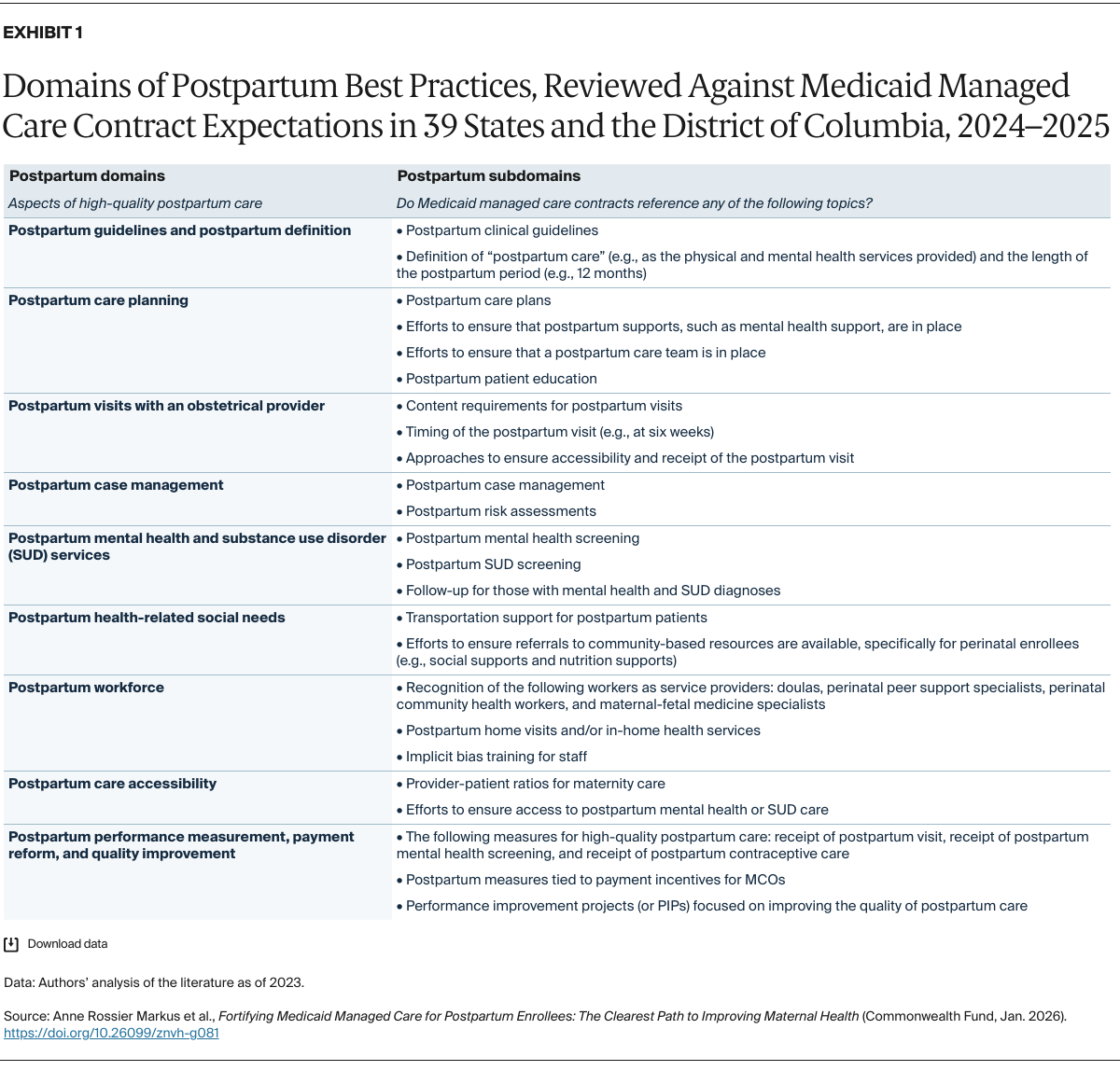
This brief examines state Medicaid postpartum care contractual expectations for MCOs before and after states extended continuous Medicaid coverage to one year postpartum. Thirty-nine states, along with the District of Columbia, used MMC in 2024, and all have extended postpartum coverage to 12 months. For each, we analyzed whether the 2024–2025 “model” MCO contract address nine domains and 30 subdomains of postpartum best practices.7 We then compared states’ 2024–2025 model contracts to those from 2021–2022 to assess whether states used the postpartum extension as an opportunity to strengthen their requirements for evidence-based, clinically recommended, and community-based postpartum services.

What Is High-Quality Postpartum Care?

The nine domains and 30 subdomains of postpartum care are drawn from the latest evidence, clinical guidelines, and best practices for maternity care for people with elevated health and social needs (Exhibit 1).8 They represent the scope of postpartum services, approaches, and standards that should be applied when providing high-quality postpartum care to low-income individuals, with the goal of improving health care access and reducing postpartum disparities.
Markus_fortifying_mmc_postpartum_enrollees_Exhibit_01

Key Findings

States strengthened their contractual expectations for postpartum care after extending continuous coverage.

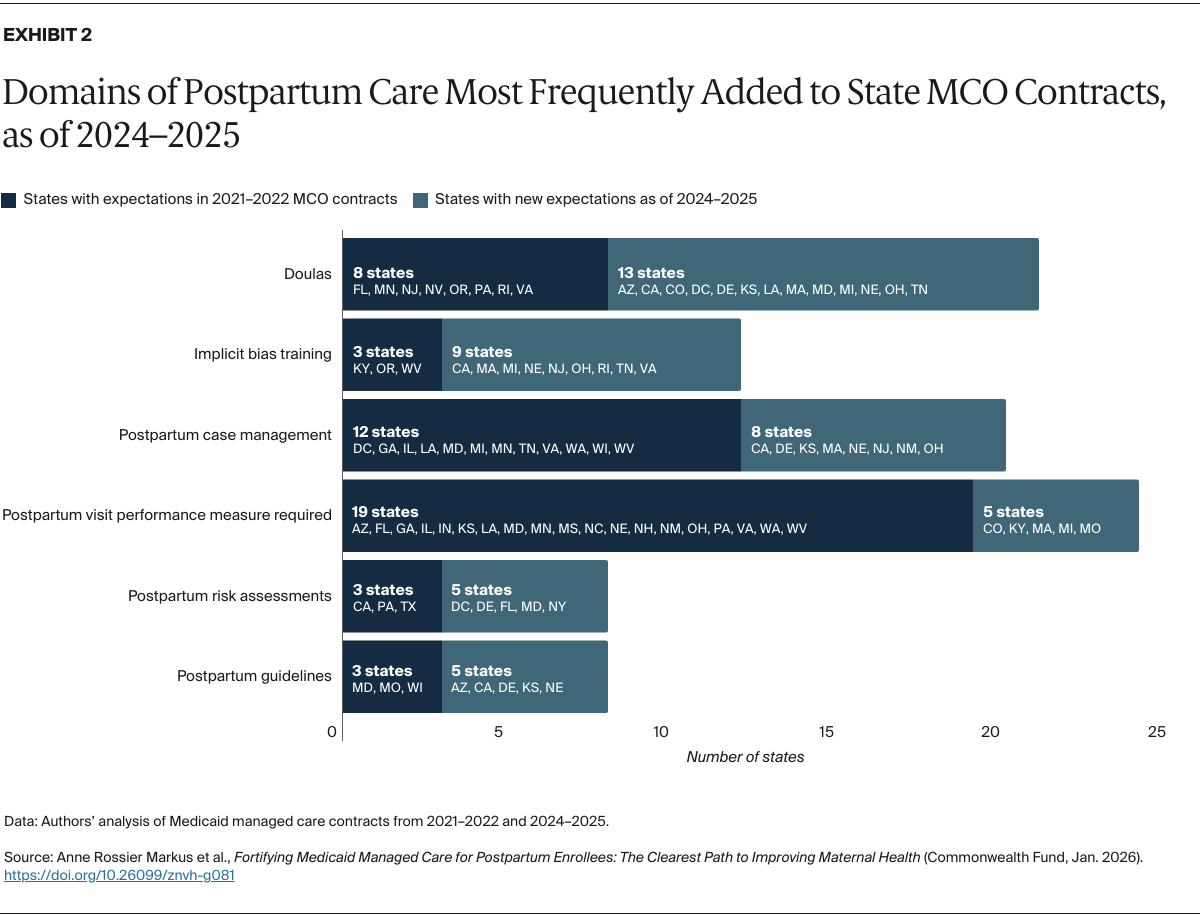
Twenty-five states and the District of Columbia included at least one new subdomain of postpartum care in their MCO contracts in 2024–2025, since the postpartum extension went into effect, compared to 2021–2022 contracts. Updated contractual expectations tended to cluster around six subdomains (Exhibit 2 and Appendix 1.) The most common new expectations across states are discussed below.

Markus_fortifying_mmc_postpartum_enrollees_Exhibit_02

Doula care. Since 2021–2022, 13 states have added doula care expectations to their contracts, including three states with new requirements to include postpartum doulas as providers (Calif., Kan., Mass.). In total, 21 states now include doula requirements, and seven states explicitly name doulas as care providers during the postpartum period (Calif., Kan., Mass., Md., Minn., N.J., Va.). This substantial uptick in doula care expectations mirrors the growth in states providing Medicaid coverage for doulas — from eight states and D.C. in late 2022 to 23 states and D.C. as of June 2025.9 Some states go even further to include doula accessibility and workforce development requirements. For example, Maryland’s MCO contracts now include a stipulation that requires urban and suburban areas to have a minimum of four doulas per area, and rural areas to have a minimum of two doulas serving each region. Tennessee now requires that MCOs cocreate doula workforce development initiatives with the state.

Postpartum case management. Eight additional states included contractual expectations for postpartum case management or care coordination since the postpartum extension. Six states added requirements for all postpartum individuals (Calif., Del., Kan., Ohio, N.J., N.M.), and two states added requirements for “high risk” postpartum populations (Mass., Neb.).

Implicit bias training. Since 2021–2022, nine additional states have required implicit bias trainings for their in-network providers and/or MCO staff (Calif., Mass., Mich. Neb., N.J., Ohio, R.I., Tenn., Va.). States may be seeking to address the well-documented impact of racism and biases on the health and well-being of Medicaid enrollees, including postpartum enrollees.10

Postpartum visit performance measure. The Centers for Medicare and Medicaid Services includes a postpartum care performance measure in its “Maternity Core Set” that tracks the percentage of mothers who receive a postpartum visit between 7 and 84 days after delivery. However, as of 2024–2025, this measure remains voluntary for state reporting.11 Since the postpartum extension, five additional states began requiring MCOs to report the postpartum visit performance measure (Colo., Ky., Mass., Mich., Mo.).

Postpartum risk assessments. Five new states included expectations for postpartum risk assessments in their MCO model contracts: D.C., Del., Fla., Md., N.Y. Two of these states have started requiring assessments of all postpartum individuals (Del., Fla.), while the remaining three require assessments for specific populations, such as those at high risk who are receiving postpartum home visits (D.C., N.Y.) and Maternal Opioid Misuse model participants (Md.).

References to postpartum care guidelines. Five additional states included references to postpartum care guidelines, including Ariz., Calif., Del., Kan., and Neb. These states now require that MCOs’ postpartum care must align with American College of Obstetrics and Gynecology (ACOG) guidelines or other nationally recognized standards for postpartum visits (Ariz., Calif., Kan.), postpartum risk assessments (Calif.), or general postpartum care (Del. and Neb.).

MCO contractual expectations fall short of best practices.

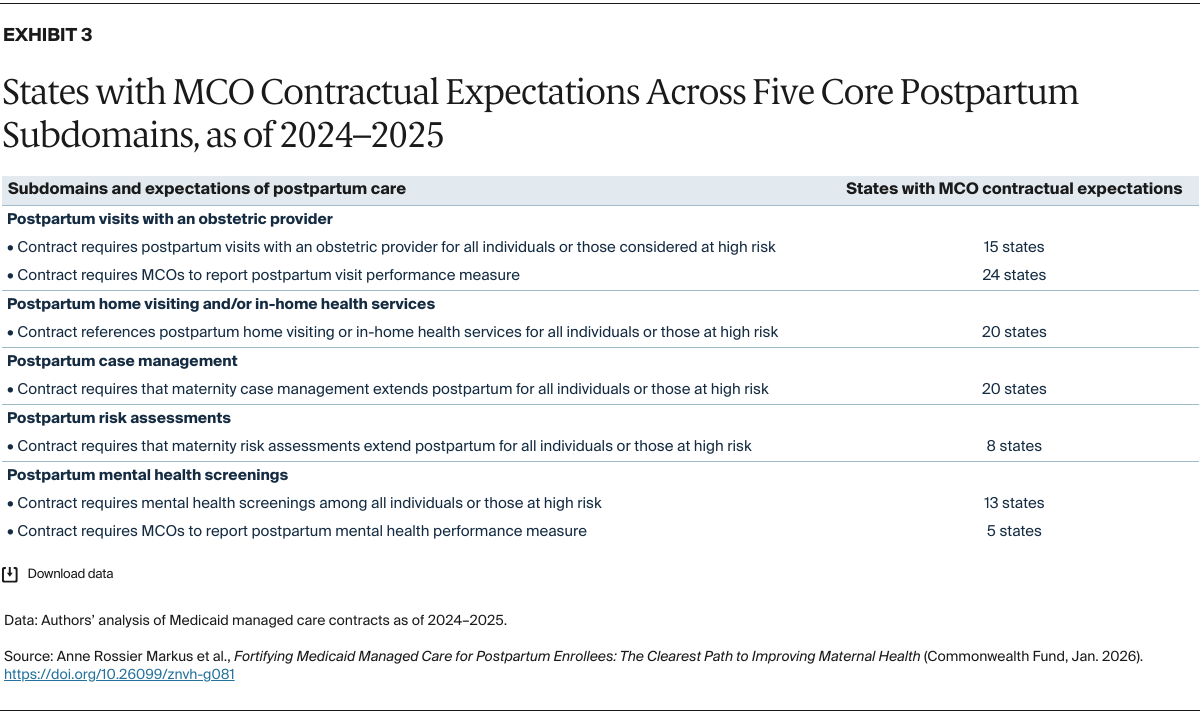
Despite improvements in postpartum contractual provisions, clear gaps remain between postpartum “best practices” and states’ expectations for MCOs delivering postpartum care. Among the states with MCO contracts in 2024 (39 states and D.C.), just half or fewer included expectations for five subdomains that are considered core elements of high-quality postpartum care, including postpartum visits, postpartum home visiting/in-home health services, postpartum case management, postpartum risk assessments, and postpartum mental health screenings (Exhibit 3). One notable exception is that 24 states require MCOs to report on the postpartum visit performance measure.

States that included requirements for services that fall under these five subdomains used highly variable contractual language, which often only applied to a specific subpopulation, such as “high risk” populations, as defined by the state or MCO. For example, among the 20 states that require postpartum case management, 11 require case management for all postpartum patients, and nine states require case management for those at high risk. High risk is defined differently in each of these nine states. Definitions can include postpartum patients with medical, social, mental health, or substance use disorder risk.

Markus_fortifying_mmc_postpartum_enrollees_Exhibit_03

The fragmentation of postpartum guidelines poses a challenge to translating postpartum expectations into MCO contracts.

Prior research indicates that postpartum guidelines are deeply fragmented across numerous government agencies and professional bodies.12 Postpartum individuals receive care from a wide variety of providers that each contribute uniquely to health and well-being, including ob/gyns, midwives, nurses, doulas, home visitors, mental health providers, maternal-fetal medicine specialists, chronic care specialists, primary care providers, lactation consultants, and pediatricians. Each provider type is governed by distinct professional bodies, each issuing its own set of guidelines.

Additionally, several well-documented postpartum “best practices” (such as prescheduling postpartum visits) have not yet risen to the level of clinical guidelines.13 The fragmentation of postpartum clinical guidelines and the absence of key elements are barriers to conveying consistent postpartum standards of care within MCO contracts.

As of 2024, most states did not reference postpartum guidelines in their MCO contracts. Thirteen states cited the ACOG guidelines for ob/gyns, but several of these states only did so in the context of prenatal care and high-risk pregnancies. Just seven states (Ariz., Calif., Kan., Md., Mo., Neb., and Wis.) referenced the use of ACOG guidelines for postpartum care.

Recommendations for Health Plans, Medicaid Agencies, and Standard-Setting Organizations

Recent federal Medicaid funding cuts are expected to lead to access challenges for postpartum enrollees.14 To manage funding gaps, states may roll back optional continuous coverage through 12 months postpartum, benefits such as doula care, and pregnancy-related coverage for people over 138 percent of the federal poverty level. A little over a quarter of women with Medicaid coverage at delivery reported having incomes over 138 percent of the federal poverty level, which is $36,777 for a family of three as of 2025.15 States may also lower payments to providers, including managed care organizations, which will likely result in hospital closures and health workers losing their jobs, further expanding “maternity care deserts.”16

Other federal policy changes, such the introduction of work requirements to access Medicaid coverage, are likely to cause significant coverage loss even for “exempt” groups, such as pregnant and postpartum enrollees.17 Gaps in coverage can lead to more severe medical and social needs once postpartum individuals reenroll in Medicaid, which will likely increase costs for states and MCOs.

As these changes are implemented, states and MCOs have a window of opportunity to prioritize, safeguard, and strengthen access to high-quality postpartum care in Medicaid in the following ways:

  1. States can clarify expectations for postpartum service access and quality in future MCO contracts. Doing so compels MCOs to provide the full range of postpartum care and supports evidenced in clinical guidelines and best practices, from postpartum visits to ongoing postpartum case management. States can also address maternity provider access requirements (Appendix 2, Table 8).
  2. Standard-setting organizations and other stakeholders can help states and MCOs establish a “comprehensive postpartum standard of care” based on existing clinical guidelines, best practices, and expert and professional opinion. Taking into consideration differing state contexts, a suggested implementation plan could accompany the recommendations.
  3. MCOs can — with clearer expectations — hold their network providers accountable for delivering quality postpartum care. MCOs also could enter into collaboratives with essential providers, such as community health centers, which have track records of improving maternal health outcomes in underresourced communities.18

The United States is entering a challenging time for maintaining health coverage gains, even for groups that have historically been eligible for Medicaid coverage. MMC will likely remain the main mechanism to deliver services to enrollees, given the country’s emphasis on privatization and reliance on competition in health care markets. Because of the disproportionate number of pregnant and postpartum individuals enrolled in MMC, strengthening the standards MCOs are held to will likely remain the clearest path to improving the quality of maternal care and reducing disparities.


How We Conducted This Study

To conduct the Medicaid managed care (MMC) contractual review, the George Washington University (GW) team applied a methodology that GW has used successfully in several past studies.19 First, the latest “model contracts” (recent as of September 2024) were pulled for 39 states and the District of Columbia using MMC in 2024 from state Medicaid agency websites. (Note: Oklahoma’s contracts were not yet available, as their Medicaid managed care program only began in April 2024. Georgia’s contracts were “drafts” that were still being reviewed by the Centers for Medicare and Medicaid Services when this study took place.)

Next, the GW team developed an “extraction tool” to pull key contractual language. This tool included nine domains and 30 subdomains of maternity care that are of high relevance to postpartum care and grounded in the evidence, clinical guidelines, and best practices that the GW team identified in an extensive literature review conducted for the Commonwealth Fund in 2023.20 Relevant contractual data were pulled into nine tables that indicate the following: 1) if the contract included provisions within a subdomain (yes/no), and 2) if “yes,” then the exact contract language was included. These Mega Tables can be found in Appendix 2.

Further analysis of the Mega Tables included “deeper” analyses of contractual language across specific topics important to the delivery of high-quality postpartum care. The GW team conducted the following additional analyses:

  • “Deep Dive” analyses: The GW team identified five postpartum topics where state contractual language was extremely variable, ranging in specificity and the populations that the contractual language applied to.
  • “Pre–Post” analyses: The GW team conducted a deep analysis to understand how states may have “strengthened” their contractual expectations for postpartum care following, or in conjunction with, the implementation of the postpartum extension. For each of the postpartum care domains in the Postpartum Summary Table (Appendix 1), the team compared preextension language (contracts current as of 2021–2022) to current contractual language (contracts current as of 2024).

Acknowledgments

The authors thank Lilli Silverston, Sara Hodgkins, and Neela Nallamothu for their work on this brief and the related appendix tables, which was integral to our research.

Notes

Publication Details

Date

Contact

Anne Rossier Markus, Professor and Chair, Department of Health Policy and Management, Milken Institute School of Public Health, George Washington University

armarkus@gwu.edu

Citation

Anne Rossier Markus et al., Fortifying Medicaid Managed Care for Postpartum Enrollees: The Clearest Path to Improving Maternal Health (Commonwealth Fund, Jan. 2026). https://doi.org/10.26099/znvh-g081