




Advanced Search

Advanced Search

Current Filters

Filter your query

Publication Types

Other

to

Blog

/

How Will Making English the Official Language of the U.S. Affect Patients with Limited English Proficiency?

Woman in lab coat and headset talks while using computer

At a Stanford Health Care call center in Palo Alto, Calif., Lily Cheung interprets for Cantonese-speaking patients and their physicians during a remote video appointment. Almost one of 10 people in the U.S. have limited English proficiency (LEP); as many as one of four people without insurance coverage and one of five people enrolled in both Medicare and Medicaid have LEP. Photo: Paul Chinn/San Francisco Chronicle via Getty Images

At a Stanford Health Care call center in Palo Alto, Calif., Lily Cheung interprets for Cantonese-speaking patients and their physicians during a remote video appointment. Almost one of 10 people in the U.S. have limited English proficiency (LEP); as many as one of four people without insurance coverage and one of five people enrolled in both Medicare and Medicaid have LEP. Photo: Paul Chinn/San Francisco Chronicle via Getty Images

Authors
  • Avni Gupta
    Avni Gupta

    Researcher, Expanding Coverage and Access, The Commonwealth Fund

  • Gretchen Jacobson
    Gretchen Jacobson

    Vice President, Medicare, Expanding Coverage and Access, The Commonwealth Fund

  • Faith Leonard
    Faith Leonard

    Senior Program Associate, Medicare, Expanding Coverage and Access, The Commonwealth Fund

  • Carson Richards
    Carson Richards

    Program Assistant, Expanding Coverage and Access, The Commonwealth Fund

  • Akeiisa Coleman
    Akeiisa Coleman

    Senior Program Officer, Medicaid, Expanding Coverage and Access, The Commonwealth Fund

Authors
  • Avni Gupta
    Avni Gupta

    Researcher, Expanding Coverage and Access, The Commonwealth Fund

  • Gretchen Jacobson
    Gretchen Jacobson

    Vice President, Medicare, Expanding Coverage and Access, The Commonwealth Fund

  • Faith Leonard
    Faith Leonard

    Senior Program Associate, Medicare, Expanding Coverage and Access, The Commonwealth Fund

  • Carson Richards
    Carson Richards

    Program Assistant, Expanding Coverage and Access, The Commonwealth Fund

  • Akeiisa Coleman
    Akeiisa Coleman

    Senior Program Officer, Medicaid, Expanding Coverage and Access, The Commonwealth Fund

Toplines
  • One in four uninsured Americans and one in five people enrolled in both Medicare and Medicaid have limited English proficiency

  • An executive order designating English as the official language for all federal operations could limit access to translated materials and interpreter services, making it harder for millions of non-English speakers to understand their health care options

On March 1, 2025, President Trump signed an executive order designating English as the official language of the United States, rescinding an earlier order that required federal agencies to make sure people with limited English proficiency (LEP) understand critical communications. Under the new order, all prior guidance that advised agencies on creating multilingual materials for people with LEP has been suspended.

The new policy will apply to federal agencies and recipients of federal funding — like hospitals and clinics — and may affect a wide range of communications, including forms, websites, notices, interpreter services, and multilingual staff. While the stated goal of the new order is to streamline federal communications and improve efficiency, scaling back multilingual resources can disrupt health care communications and create misunderstandings, impede access, increase mistrust, and worsen outcomes for LEP patients. People with LEP already face substantial barriers when navigating the health care system; the lack of information and support will likely deepen existing health disparities.

In this blog post, we used data from 2023 American Community Survey to examine the health insurance coverage of people in the U.S. with limited English proficiency.
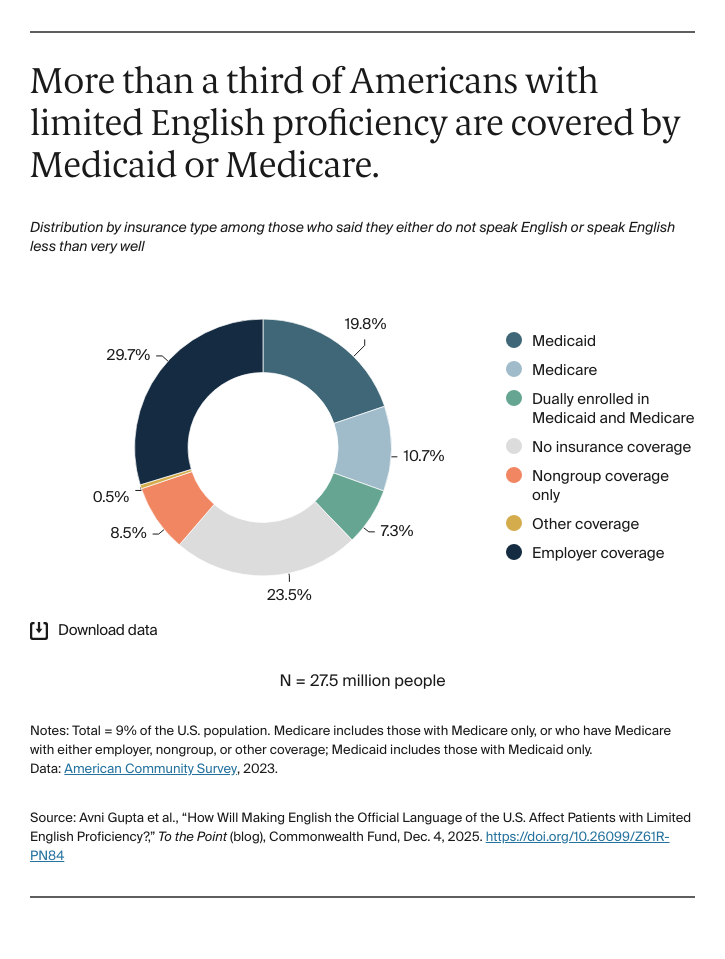
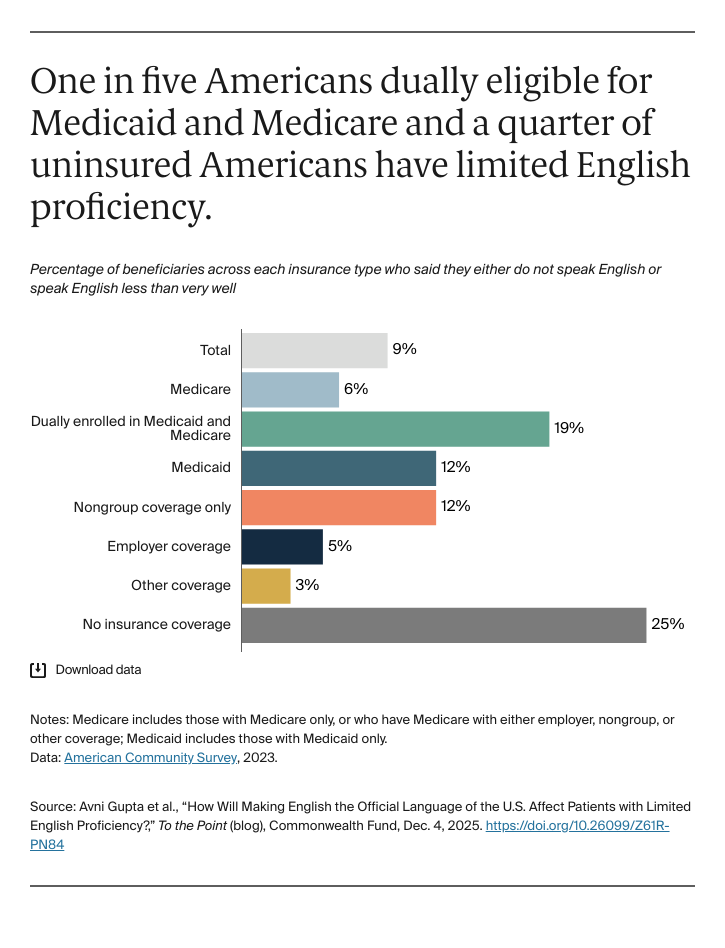
Exhibit 1: More than a third of Americans with limited English proficiency are covered by Medicaid or Medicare.

In the United States, about 27.5 million people said they do not speak English or have LEP, defined as speaking English “less than very well.” Most of the individuals with LEP were either in an employer plan (30%), enrolled in Medicaid (20%), or were uninsured (23%). About one in six people (18%) were enrolled in Medicare, including 7 percent who were dually enrolled in Medicare and Medicaid. Altogether, more than one-third of people with LEP were enrolled in Medicare and/or Medicaid, implying that policies affecting these federal and state programs can have a sizeable impact on people with LEP.

Exhibit 2: One in five Americans dually eligible for Medicaid and Medicare and a quarter of uninsured Americans have limited English proficiency.

Almost one of 10 people in the U.S. have limited English proficiency; as many as one of four people without insurance coverage and one of five people with both Medicare and Medicaid have LEP. This means that providers who take Medicaid and see patients without insurance coverage are more likely to treat people with LEP, and actions these providers take to enhance or reduce access to translated materials and services will have a disproportionate impact on people with LEP.

The executive order leaves some flexibility by allowing agency heads to make decisions to ensure that their agencies’ missions are fulfilled and also states that they are “not required to amend, remove, or otherwise stop production of documents, products, or other services prepared or offered in languages other than English.” The order includes guidelines for agencies to prioritize English and to review their multilingual communications and language access plans and states that if a federal agency decides that multilingual services are critical, the agency is allowed to use artificial intelligence and machine translation to save costs. It also notes that “English is the official language and authoritative version of all federal information.” The order directs the agencies to use the funds they save for research and programs to improve English proficiency. While technology may aid in development of multilingual communication materials, early research has found that these technologies cannot yet produce accurate materials without the help of humans.

In a recent notice, the Centers for Medicare and Medicaid Services said this year it will create only in English sample materials for Medicare Advantage and Part D plans’ communication with Medicare beneficiaries; in prior years, these sample materials were provided in multiple languages to help plans prepare documents in multiple languages. Decisions by federal agencies to eliminate or reduce communications in different languages could result in state agencies needing to step in to create these materials themselves to comply with state laws. Ultimately, reducing multilingual support may compromise the ability of non-English speakers to understand their doctors’ instructions for care at home or their insurance plans’ communications for using coverage and lead to poorer health outcomes for people and potentially higher, avoidable costs for the health care system.

Publication Details

Date

Contact

Avni Gupta, Researcher, Expanding Coverage and Access, The Commonwealth Fund

agupta@cmwf.org

Citation

Avni Gupta et al., “How Will Making English the Official Language of the U.S. Affect Patients with Limited English Proficiency?,” To the Point (blog), Commonwealth Fund, Dec. 4, 2025. https://doi.org/10.26099/Z61R-PN84