




Advanced Search

Advanced Search

Current Filters

Filter your query

Publication Types

Other

to

Blog

/

Rethinking Prior Authorization in Medicare Advantage

MRI

Katie Doble receives a PET-CT scan to determine if she remains cancer-free at UCHealth University of Colorado Hospital in Aurora, Colo., on December 5, 2024. Prior authorization can help encourage the efficient use of health care resources in Medicare Advantage, but there should be limits on when it’s required. Photo: Kevin Mohatt for the Washington Post via Getty Images

Katie Doble receives a PET-CT scan to determine if she remains cancer-free at UCHealth University of Colorado Hospital in Aurora, Colo., on December 5, 2024. Prior authorization can help encourage the efficient use of health care resources in Medicare Advantage, but there should be limits on when it’s required. Photo: Kevin Mohatt for the Washington Post via Getty Images

Authors
  • Hannah Neprash_Headshot
    Hannah Neprash

    Associate Professor of Health Policy and Management, School of Public Health, University of Minnesota

  • Aaron Schwartz headshot
    Aaron Schwartz

    Assistant Professor, Department of Medical Ethics and Health Policy and the Division of General Internal Medicine, University of Pennsylvania Perelman School of Medicine

  • Michael Ann Kyle headshot
    Michael Anne Kyle

    Assistant Professor, Department of Medical Ethics and Health Policy, University of Pennsylvania Perelman School of Medicine

  • Ezra Golberstein_headshot
    Ezra Golberstein

    Professor of Health Policy and Management, School of Public Health, University of Minnesota

Authors
  • Hannah Neprash_Headshot
    Hannah Neprash

    Associate Professor of Health Policy and Management, School of Public Health, University of Minnesota

  • Aaron Schwartz headshot
    Aaron Schwartz

    Assistant Professor, Department of Medical Ethics and Health Policy and the Division of General Internal Medicine, University of Pennsylvania Perelman School of Medicine

  • Michael Ann Kyle headshot
    Michael Anne Kyle

    Assistant Professor, Department of Medical Ethics and Health Policy, University of Pennsylvania Perelman School of Medicine

  • Ezra Golberstein_headshot
    Ezra Golberstein

    Professor of Health Policy and Management, School of Public Health, University of Minnesota

Toplines
  • Prior authorization can help encourage the efficient use of health care resources but too often, it delays treatment patients urgently need. A new framework offers a middle path: applying prior authorization only when evidence shows it’s warranted.

  • Services in the “green light” category are well-suited to prior authorization and may include treatment with high rates of fraud and low-value care.

Policymakers are increasingly interested in reforming how commercial insurers use prior authorization (i.e., requirements that clinicians seek approval from insurers before providing treatment). Some states have enacted or proposed legislation limiting the use of prior authorization across broad categories of services, such as mental health care and cancer treatment. At the federal level, legislators have introduced measures to regulate prior authorization processes in Medicare Advantage plans. And recently, a group of large health insurers announced a commitment to streamline and simplify prior authorization and to reduce its use across a range of medical services.

Prior authorization is widely disliked by patients and clinicians, many of whom believe it delays care and has a negative effect on clinical outcomes. But managed care tools, like prior authorization, can help encourage the efficient use of health care resources. This is particularly important in the United States, which has persistently high health care spending, some of which is spent on low-value or wasteful care. Prior authorization has some advantages over other managed care tools. Unlike claims denials, prior authorization occurs before a service is rendered, thereby helping avoid nonpayment when it is too late to change a treatment plan. And unlike patient cost sharing, prior authorization is targeted to specific services and clinical coverage rules. Perhaps for these reasons, traditional Medicare recently announced a new demonstration model to incorporate more prior authorization into Medicare Part B.

But there should be thoughtful limits on how prior authorization is required. For legislators, regulators, and plans considering ways to reduce its use, the guiding principle should be whether services align with clinical evidence, rather than whether doctors and patients are willing to overcome burdensome administrative hurdles. With this in mind, we propose a traffic-light framework that is informed by insights from clinical practice and health economics.
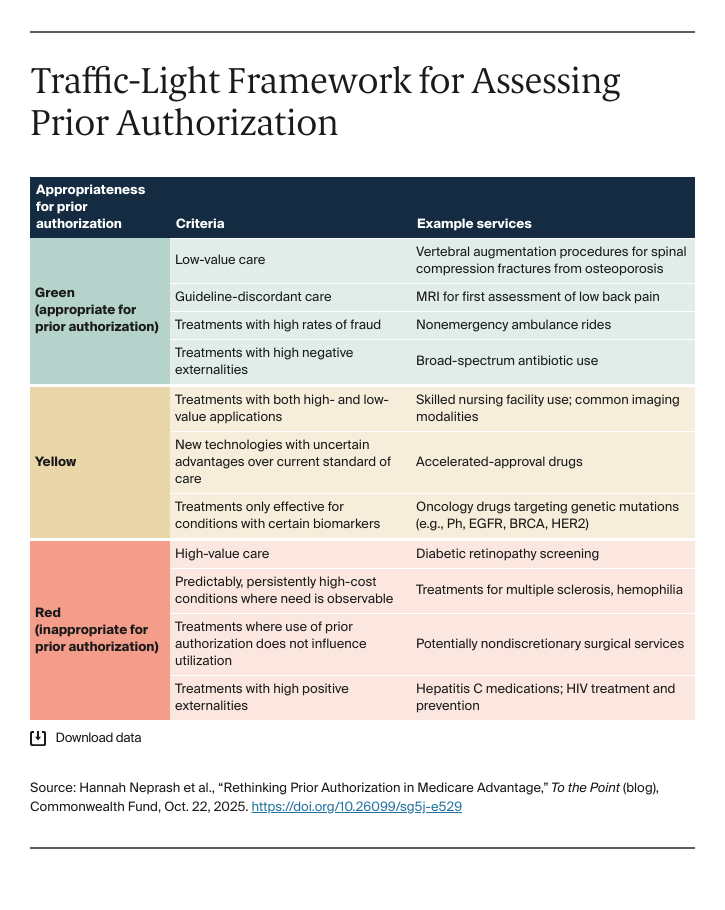
table

Services in the green light category are considered well-suited for prior authorization. These include low-value services, guideline-discordant care, and services with high rates of fraudulent use. In the past, voluntary efforts to reduce overuse and unnecessary services (e.g., the Choosing Wisely campaign) have failed to produce meaningful changes in practice patterns. Payers may be unable or hesitant to outright refuse coverage for particular services, especially if appropriateness varies depending on clinical circumstances. Well-applied prior authorization and other utilization management tools strike a middle ground: they can constrain service use but be flexible enough to accommodate clinical circumstances and physician decision-making.

Most services fall into the yellow light category, where further evidence is required to establish whether prior authorization is appropriate. This includes existing technologies or services applied to a wide range of clinical scenarios including high- and low-value applications, new technologies with uncertain benefits relative to the existing standard of care, and treatments that are only effective for conditions with certain biomarkers (e.g., oncology drugs that target particular genetic mutations).

Services in the red light category are considered inappropriate for prior authorization requirements. We envision three groups in this category. The first group includes services that clinical guidelines identify as of particularly high value. The second includes treatments that are disproportionately used by enrollees with predictably high costs from insurers’ perspectives. The goal of prior authorization is to avoid low-value or inappropriate services, not to avoid enrolling individuals with high-cost conditions.

The third group includes any service or treatment where prior authorization does not change utilization. If prior authorization does not change utilization, then it is merely an administrative hassle that does not improve care. Researchers can help to identify such services. For instance, we are currently studying the Prior Authorization Reduction Pilot to examine what happened when UnitedHealth Medicare Advantage plans lifted prior authorization requirements from hundreds of services across nine states from 2017 to 2018. Undoubtedly, more natural experiments exist and could provide valuable insights, particularly if Medicare Advantage encounter data were expanded to include information on prior authorization.

Finally, we highlight something absent from our proposed traffic-light schema: prior authorization denial or appeal rates, which have been a recent area of interest for policymakers. These may help quantify the burden of prior authorization requirements for patients, clinicians, and payers, but they provide little information on the appropriateness of the prior authorization requirement itself. For example, a prior authorization policy with a 100 percent approval rate might either be very permissive (i.e., a wasteful prior authorization administrative ordeal without any effect on utilization) or simply a very effective deterrent to inappropriate service use (i.e., an excellent use of prior authorization).

Current discussions and debates over prior authorization go beyond which services should have prior authorization applied. Other important facets include standardization, speed, medical criteria and the expertise of those making determinations, and increasingly, the use of automation and artificial intelligence in prior authorization processes. Innovations in these dimensions may hold promise for improving health care delivery and refine our framework for appropriate implementation of prior authorization.

Publication Details

Date

Contact

Hannah Neprash, Associate Professor of Health Policy and Management, School of Public Health, University of Minnesota

Citation

Hannah Neprash et al., “Rethinking Prior Authorization in Medicare Advantage,” To the Point (blog), Commonwealth Fund, Oct. 22, 2025. https://doi.org/10.26099/sg5j-e529