Advanced Search

Advanced Search

Current Filters

Filter your query

Publication Types

Other

to

Blog

/

What Does the Decline in Medicare Part D Plan Availability Mean for Beneficiaries?

A pharmacist talks to a customer at a Miami Beach CVS Pharmacy. Drug prices are a top concern for Medicare beneficiaries. In 2022, 14 percent of Medicare beneficiaries age 65 and older did not fill a prescription due to costs. Photo: Jeffrey Greenberg/Universal Images Group via Getty Images

A pharmacist talks to a customer at a Miami Beach CVS Pharmacy. Drug prices are a top concern for Medicare beneficiaries. In 2022, 14 percent of Medicare beneficiaries age 65 and older did not fill a prescription due to costs. Photo: Jeffrey Greenberg/Universal Images Group via Getty Images

Authors
  • Faith Leonard
    Faith Leonard

    Senior Program Associate, Medicare, Expanding Coverage and Access, The Commonwealth Fund

  • Gretchen Jacobson
    Gretchen Jacobson

    Vice President, Medicare, Expanding Coverage and Access, The Commonwealth Fund

Authors
  • Faith Leonard
    Faith Leonard

    Senior Program Associate, Medicare, Expanding Coverage and Access, The Commonwealth Fund

  • Gretchen Jacobson
    Gretchen Jacobson

    Vice President, Medicare, Expanding Coverage and Access, The Commonwealth Fund

Toplines
  • The number of standalone prescription drug plans for traditional Medicare beneficiaries has declined in recent years, raising questions about whether beneficiaries are able to find plans that meet their needs

  • Drug prices continue to be a top concern for Medicare beneficiaries, with one of five saying they use discount websites like GoodRx or Amazon, instead of their prescription drug plan

Every fall, Medicare beneficiaries can review and change how they receive their Medicare benefits, including their prescription drug coverage — also known as Part D. Since the introduction of Medicare Part D, beneficiaries have been able to choose from many private prescription drug plans. Beneficiaries with traditional Medicare can enroll in a separate, standalone prescription drug plan (PDP) while those in Medicare Advantage typically receive their prescription drug benefits through their Medicare Advantage plan, known as an MA-PD.

Beneficiaries choose prescription drug plans based on factors including which drugs are covered under the plans’ formularies, the affordability of covered and uncovered drugs, and the convenience of in-network pharmacies. In recent years, the number of available standalone PDPs has declined, raising questions about whether beneficiaries in traditional Medicare will continue to have choices that align with their health care needs and household budgets. Using data from the Centers for Medicare and Medicaid Services (CMS), this blog post examines the changing availability of PDPs.

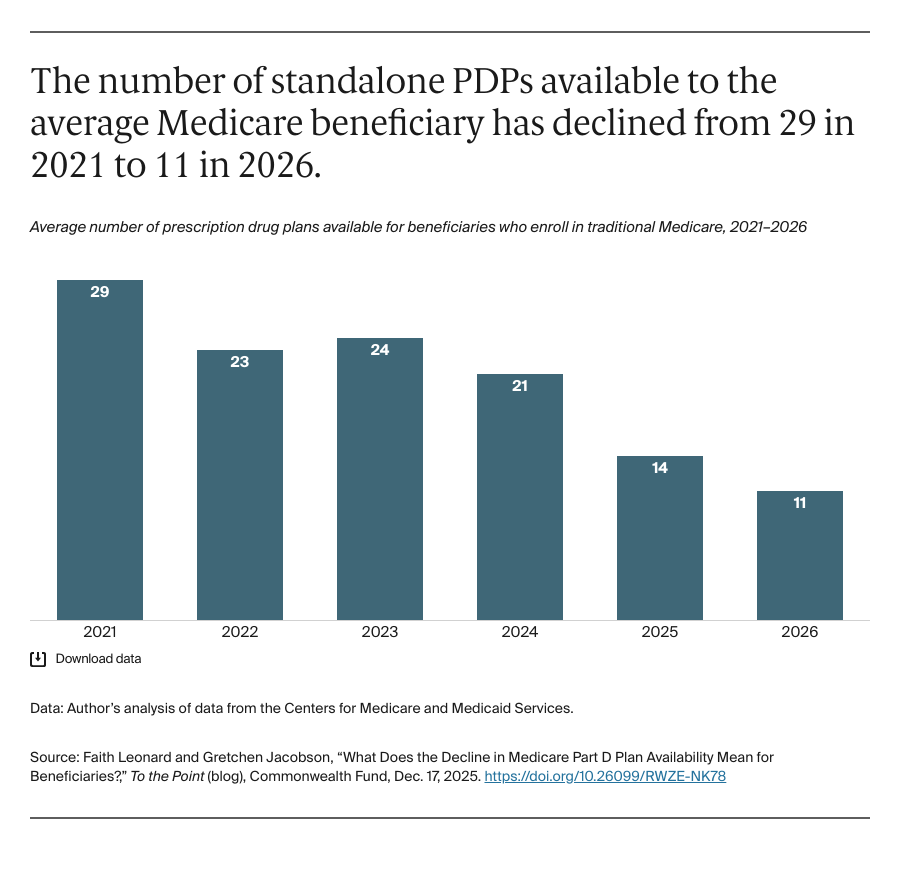
Bar chart: The number of standalone PDPs available to the average Medicare beneficiary has declined from 29 in 2021 to 11 in 2026.

The average number of standalone prescription drug plans has declined by nearly two-thirds since 2021. The average has declined by three plans year over year from 14 in 2025 to 11 in 2026.

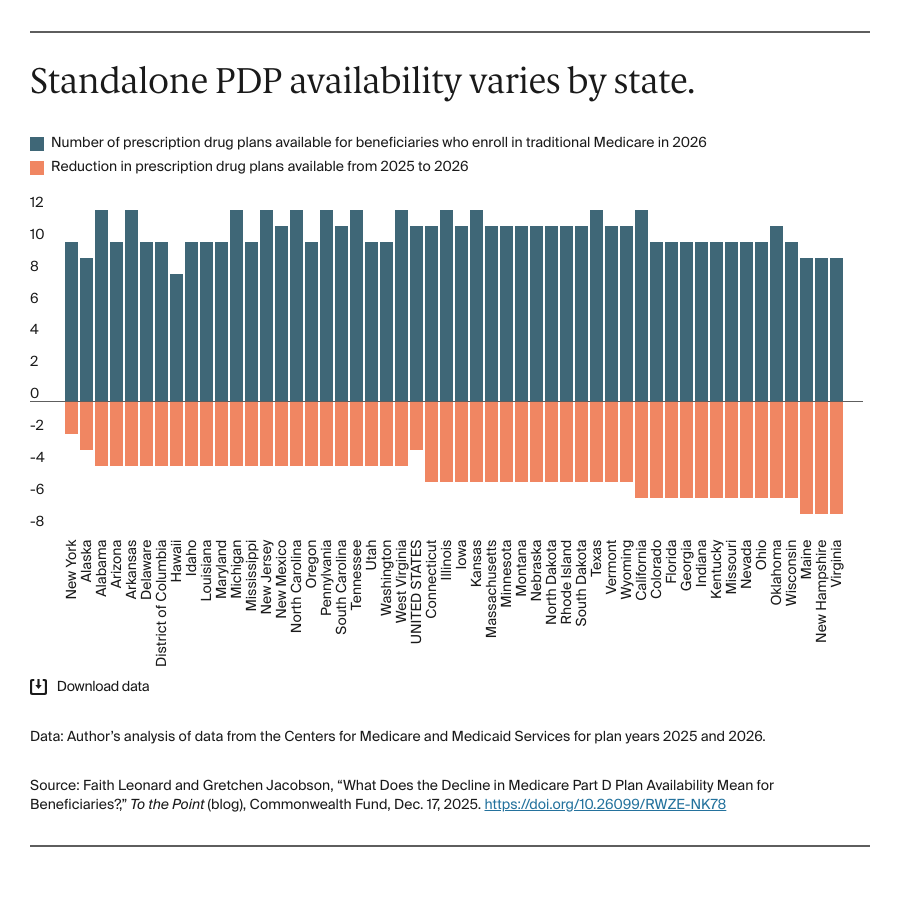
Bar chart: Standalone PDP availability varies by state.

Availability varies across states. Hawaii has eight standalone PDPs available in 2026, compared to 12 plans in Alabama, Arkansas, California, Illinois, Kansas, Michigan, New Jersey, North Carolina, Pennsylvania, Tennessee, Texas, and West Virginia.

Overall, the average number of plans available (weighted by the number of Medicare beneficiaries in each state) declined by three plans. The number of available plans dropped by nearly half in Maine, New Hampshire, and Virginia.

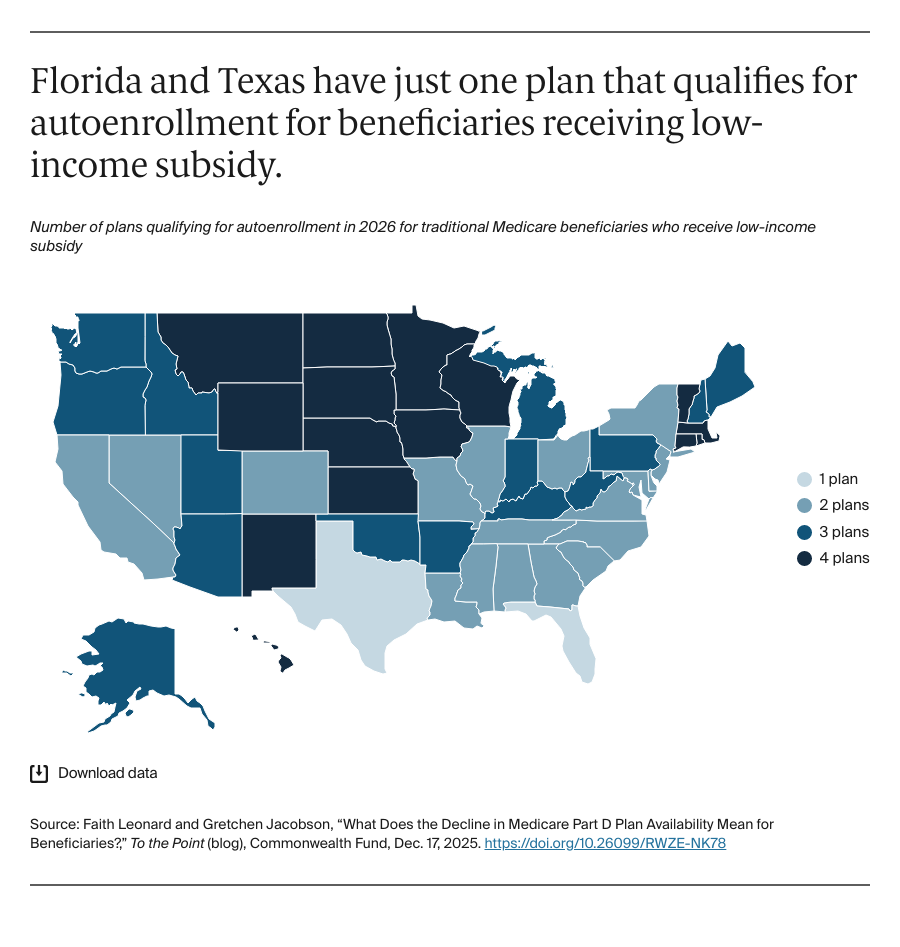
Map: Florida and Texas have just one plan that qualifies for autoenrollment for beneficiaries receiving low-income subsidy.

Beneficiaries who qualify for the Medicare low-income subsidy (LIS) program may find even fewer available options in 2026. LIS covers Part D plan premiums and cost sharing for beneficiaries with low incomes. In 2025, qualifying beneficiaries had annual incomes below $23,475. Beneficiaries who qualify for LIS will be autoenrolled in coverage with premiums at or below CMS regional benchmarks, unless they choose a plan or have chosen one in prior years. LIS-qualifying beneficiaries also may enroll in Medicare Advantage plans and access prescription drug coverage that way.

In 2026, every state will have four or fewer PDPs that qualify for LIS autoenrollment, down from nine or fewer in 2022. In Texas and Florida, only one PDP will qualify for LIS autoenrollment; all LIS beneficiaries who did not previously choose a plan will be enrolled in this plan. In both Texas and Florida, LIS enrollees will be limited to the formularies and pharmacy networks offered by the one available plan.

Discussion

Medicare beneficiaries have choices for prescription drug coverage, but the reduction in options raises questions. How many choices is too few? Why are there fewer PDPs now than in prior years? Are beneficiaries able to enroll in plans that cover all of their prescriptions, or do they need to change their prescriptions, use discount websites, or find other workarounds? With fewer options available, are low-income beneficiaries who are autoenrolled into qualifying plans able to afford and access their prescriptions at convenient pharmacies?

Drug prices continue to be a top concern for beneficiaries. In 2022, 14 percent of beneficiaries age 65 and older reported they did not fill a prescription due to costs, in both Medicare Advantage and traditional Medicare. One in five beneficiaries in traditional Medicare reported purchasing prescription drugs through discount websites, like GoodRx, CostPlus, or Amazon, rather than using their Part D drug coverage. Most of these beneficiaries (85%) said they used discount websites because their out-of-pocket costs were lower than with their Part D plans, suggesting that Part D markets may not be providing sufficient competition to meet beneficiaries’ needs. Provisions from the Inflation Reduction Act intended to help lower drug costs for beneficiaries are still being implemented, including the second round of drug price negotiations. In addition, all beneficiaries’ out-of-pocket costs for drugs covered by their Part D plan are now capped (at $2,100 for 2026).

While a similar share of beneficiaries in Medicare Advantage versus traditional Medicare report challenges affording needed health care, one study found that beneficiaries are paying more for drugs in PDPs than in MA-PDs. Medicare Advantage enrollment growth persists, but many Medicare beneficiaries continue to choose traditional Medicare and rely on PDPs for their drug coverage. Regardless of whether beneficiaries choose to enroll in Medicare Advantage or traditional Medicare, it is important that the Medicare markets provide coverage that is affordable for beneficiaries and the federal government and that allows beneficiaries to get the health care they need.


Publication Details

Date

Contact

Faith Leonard, Senior Program Associate, Medicare, Expanding Coverage and Access, The Commonwealth Fund

fleonard@cmwf.org

Citation

Faith Leonard and Gretchen Jacobson, “What Does the Decline in Medicare Part D Plan Availability Mean for Beneficiaries?,” To the Point (blog), Commonwealth Fund, Dec. 17, 2025. https://doi.org/10.26099/RWZE-NK78