


Abstract
- Issue: Despite comprehensive managed care contracts and state oversight, Medicaid plans may still perform poorly, whether in their financial performance, in the provision of quality care, or in members’ access to covered services.
- Goal: This brief provides states, especially state staff responsible for oversight of Medicaid managed care entities (MCEs), with practical strategies and contractual tools to hold MCEs accountable and incentivize improved performance.
- Methods: Insights gained from development and review of Medicaid managed care contracts; lessons learned from authors’ experiences; and discussions with state Medicaid leaders and managed care staff.
- Key Findings and Conclusions: Given the scope and complexity of managed care and related contracts, states must ensure that Medicaid staff understand their roles and responsibilities, receive appropriate training on contract requirements, and are aligned with the state’s vision, goals, and priorities. Effective MCE oversight requires both a range of contractual levers and staff actively managing and prioritizing what is most important to the state, Medicaid members, and providers. When an MCE is struggling — whether financially or in its ability to provide access to covered services and quality care — the state must act decisively and collaboratively across agencies, maintain communication with MCE leaders, and implement contract levers to drive improvement and protect Medicaid members.
Introduction
With three out of four Medicaid enrollees nationwide receiving most or all covered services from comprehensive managed care plans,1 the oversight of Medicaid managed care entity (MCE)2 performance is among the most important roles of a state Medicaid agency. The Medicaid Managed Care Oversight Toolkit3 is one resource designed to assist state agencies with implementing a comprehensive oversight approach and ensuring that MCEs are meeting their contractual obligations. Despite strong managed care contracts, Medicaid plans may still perform poorly — whether financially, in the provision of quality care, or in members’ access to covered services.4
This brief provides state staff with an overview of strategies and contractual tools to hold underperforming Medicaid plans accountable and incentivize improved performance. While this brief is primarily intended for Medicaid staff responsible for MCE oversight, it offers insights into managed care programs that may be of interest to state insurance departments, health departments, governors’ offices, and state legislative partners. These insights are informed by the authors’ firsthand experience managing MCE contracts and supporting states in their Medicaid managed care oversight responsibilities, as well as by discussions with current and former state officials about accountability approaches.
Holding Medicaid Plans Accountable: Oversight, Management, and Enforcement
To effectively manage any MCE, whether it is high-performing or not, it is important for a state to actively use a strong, clear managed care contract as a roadmap for comprehensive oversight. Together, the contract and the state oversight approach set expectations and enable the state to track MCE performance through defined requirements, reports, and performance incentives. Effective MCE contract management begins with a robust agency approach — one that promotes data sharing and collaboration across subject matter experts (SMEs) and all aspects of the contract. State staff must develop and maintain strong, collaborative relationships with MCEs at all levels of the organization to capitalize on opportunities for improved performance. To achieve this, Medicaid agencies must actively monitor and manage MCEs and hold them to high standards of performance and accountability. State agencies should develop a collaborative yet demanding partnership with plans to deliver value and advance the state’s managed care objectives. Meeting regularly with plans, sharing data, and fostering an atmosphere of clear expectations enable state staff to provide direction and informal support to MCEs to address challenges before formal enforcement becomes necessary.
At some point, things may go wrong. States and MCEs may face substantive challenges that directly affect members and providers, including inadequate provider networks, difficulties ensuring timely and efficient access, and inaccuracies in claims processing or prior authorization. In addition, both states and MCEs may experience challenges related to staff turnover. Having the right staff engaged within the Medicaid agency and relevant sister state agencies, along with strong working relationships with contracted MCEs, strengthens the state’s ability to respond effectively. Open lines of communication and monitoring of MCE performance data at multiple levels enable state staff and MCEs to promptly identify and implement solutions. It is therefore essential to continuously train state staff and engage SMEs so they are ready to address issues as they arise.
When problems persist, the state needs to act decisively within the framework of its MCE contract. The sections below describe principal contractual enforcement tools available to states, listed in Exhibit 1, in order of escalating severity. While some tools are federally defined, others are determined by the state and described within their Medicaid managed care contracts.
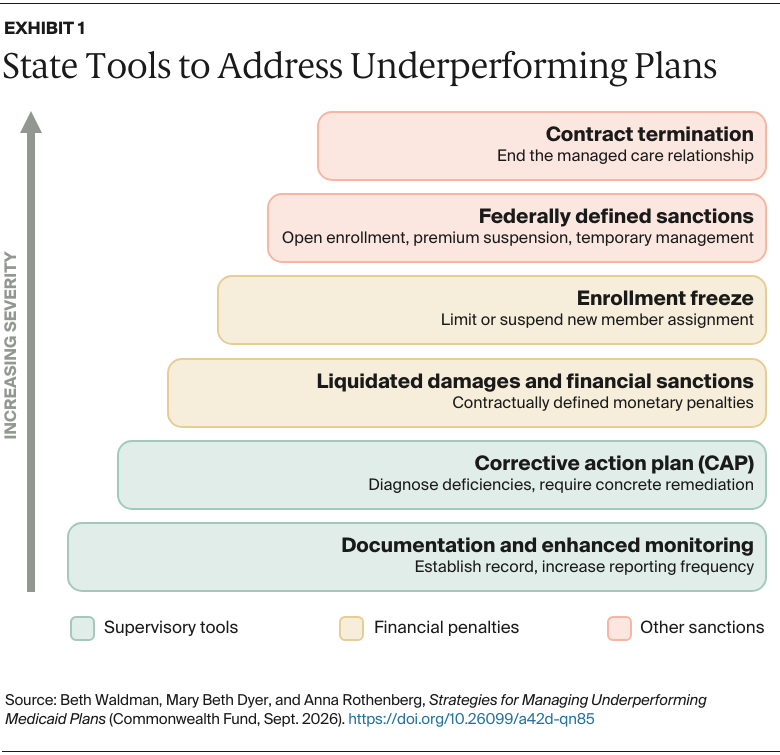
Comprehensive MCE contracts detail performance incentives and penalties, providing state agencies with a range of tools to sanction underperformance and incentivize improvement. While these tools generally escalate from documentation and corrective measures to financial penalties and, ultimately, to contract termination, states do not need to implement enforcement tools in a stepwise manner. For example, a state could require an underperforming MCE to implement a CAP while simultaneously assessing liquidated damages as authorized in the MCE contract. Similarly, a state may limit new member enrollment to an MCE that is struggling financially while the MCE implements a CAP designed to improve financial stability. Medicaid officials should keep their governor’s office, relevant state agencies, and key state legislators informed throughout any substantial enforcement action.
Use of Supervisory Tools and Financial Penalties
When a managed care entity is performing poorly compared to other MCEs or is out of compliance with significant provisions of the contract, Medicaid officials should consider implementing supervisory tools. These could include corrective action plans (CAPs) or financial penalties, as specified in the contracts. Examples of MCE performance likely to trigger the use of supervisory tools and penalties include: poor or unknown financial performance, such as reporting a relatively high medical loss ratio or failing to share timely, required financial reports with the Medicaid agency. States should also take action when network adequacy reports, data, and complaints suggest problems with access or claims payment, including inappropriate use of prior authorizations and denials. The Medicaid agency’s timely implementation of these tools is important to reflect the urgency of addressing the MCE’s performance issues. Even if the Medicaid agency decides not to impose a penalty, state officials should still formally document the issue to establish a record to support future enforcement action with the MCE, if needed.
When the state requires an MCE to develop a CAP, state staff should work closely with MCE staff to understand how the MCE intends to address identified deficiencies or shortcomings and ensure the CAP includes concrete steps toward compliance. The state should review the MCE’s proposed CAP workplan and deliverables to ensure reporting at appropriate intervals, effectively monitor MCE performance, and take action if deficiencies are not corrected. Regular meetings — daily or even multiple times a day when warranted — should be scheduled to track MCE CAP progress and promptly resolve issues.
States should consider whether and how to involve their External Quality Review Organization (EQRO) in the CAP process to facilitate an MCE compliance audit or provide recommendations for improving quality, or to involve their actuary if the MCE’s issues are financial in nature.5 In reviewing the MCE’s written plan of action and progress as part of a CAP, the state should consider what corrective steps may be necessary, including activities the plan should undertake to improve performance, whether system improvements might be needed to meet contract requirements, and whether changes to the MCE’s staffing and/or organizational structure are warranted. Addressing staffing and/or organizational structure in CAPs and remedies is important to ensure that competent leaders and staff are managing areas of weak performance and that the MCE is deploying all necessary technical assistance and resources to support contractual compliance and improved performance.
State-defined sanctions and liquidated damages are contractually defined monetary payments made by an MCE to the state for failure to meet specified contractual requirements. The potential for specific monetary penalties focuses MCE attention on areas the state deems high priority. However, if the cost of complying with the specific contract requirement exceeds the cost of paying the penalty, an MCE may choose to absorb the penalty rather than invest in changes necessary to achieve full compliance. States can further pressure underperforming MCEs monetarily by freezing new enrollment until specific shortcomings are corrected. Depending on contract language, the state may limit or eliminate new member enrollment through autoassignment, limit new members in certain aid categories if underperformance is concentrated in a particular population, or suspend all new member assignments to the MCE.6
Use of Federally Defined Sanctions
When no practical or immediate resolution is available for a significantly underperforming MCE, a state can take additional enforcement measures pursuant to its MCE contract and federal regulations.7 Federally defined sanctions include allowing members to switch plan enrollment without cause, suspending MCE premiums for members enrolled after the date of sanctions, referring an MCE to the state insurance department for investigation, appointing temporary management of the MCE, and, as a last resort, terminating an MCE’s contract.


