



Advanced Search

Advanced Search

Current Filters

Filter your query

Publication Types

Other

to

Blog

/

How Medicaid State-Directed Payments Support Critical Health Care Providers

backs of people seen through waiting room door

Patients wait to be seen in the emergency room at Valley Health Hampshire Memorial Hospital on June 17, 2025, in Romney, W.V. State-directed payments play a key role for hospitals and other providers that serve Medicaid patients, bridging the gap between base Medicaid rates and the actual cost of care. Photo: Ricky Carioti/Washington Post via Getty Images

Patients wait to be seen in the emergency room at Valley Health Hampshire Memorial Hospital on June 17, 2025, in Romney, W.V. State-directed payments play a key role for hospitals and other providers that serve Medicaid patients, bridging the gap between base Medicaid rates and the actual cost of care. Photo: Ricky Carioti/Washington Post via Getty Images

Authors
Authors
Toplines
  • State-directed payments help close the gap between low Medicaid reimbursement rates and the actual cost of care — providing a critical financial lifeline to hospitals serving high numbers of Medicaid patients

  • Cuts in the Senate-passed budget bill would slash Medicaid funding, threatening the financial survival of safety-net providers and putting patients’ access to care at risk

Medicaid serves as a lifeline for nearly 80 million people nationwide, yet the payments that providers receive for treating Medicaid patients often fall below the cost of delivering care. Because of chronic underfunding, many providers who treat large shares of Medicaid patients struggle to survive, with limited ability to invest in innovations to strengthen care quality and improve efficiency.

Historically, states that contract with health insurance plans to deliver services to Medicaid beneficiaries have been limited in their ability to direct plans on how they pay providers. Over the past decade, subject to federal guardrails, the Centers for Medicare and Medicaid Services has permitted states to establish state-directed payments (SDPs) that direct Medicaid managed care plans to enhance rates (up to average commercial rates) for hospitals and other providers; support systemwide, value-based payment reforms; and enhance care quality. In Arizona, for example, SDPs for hospitals are tied to efforts to reduce unnecessary hospital readmissions. As with other Medicaid spending, states and the federal government share in the cost of SDPs.

Over the years, SDPs have become a foundational tool to boost low Medicaid payments, and improve access and quality, accounting for $110.2 billion in annual Medicaid spending. However, the growth in the size of SDPs and number of states using them has attracted considerable attention, making SDPs a target for cuts in House and Senate reconciliation bills. Often lost in this debate is the critical role SDPs play for safety-net providers, including children’s hospitals, which serve many people enrolled in Medicaid, and rural providers.

State-Directed Payments Are at Risk

The budget reconciliation bill passed by the House in May would allow existing SDPs to stay in place but would freeze the annual amounts paid and limit the level of all new SDPs to 100 percent of Medicare rates (or 110% of Medicare rates for states that haven’t expanded Medicaid), a payment level that is often a half or even a third of average commercial rates (ACR). The Senate, which recently passed its version of the reconciliation bill, would deepen the cuts by unraveling the freeze on current SDPs. The Senate version would reduce SDPs already in place by 10 percentage points until they reach 100 percent or 110 percent of Medicare rates, for Medicaid expansion and nonexpansion states, respectively. According to the Congressional Budget Office estimates, the Senate provisions would reduce SDP payments nationwide by $149 billion over 10 years. The final form of congressionally mandated SDP policy changes is yet to be seen.

While this policy would affect providers across the nation, it hits hospitals, pediatric providers, and rural providers particularly hard. These providers serve a relatively high number of Medicaid patients, and many have relatively little commercial revenue to rely on. Under the proposals, states and providers will face a twofold problem: the value of existing SDPs will erode quickly, with the gap between payments and costs growing each year, and states that have not yet increased payments to the ACR (or any rate above Medicare) would be prevented from doing so.

Impact of State-Directed Payment Cuts

We analyzed the amount Medicaid payments to hospitals would be reduced if the 100 percent of Medicare limit were applied across any state with hospital SDPs. In 19 of the 25 states for which data are publicly available, total Medicaid payments to hospitals would drop by at least 20 percent.
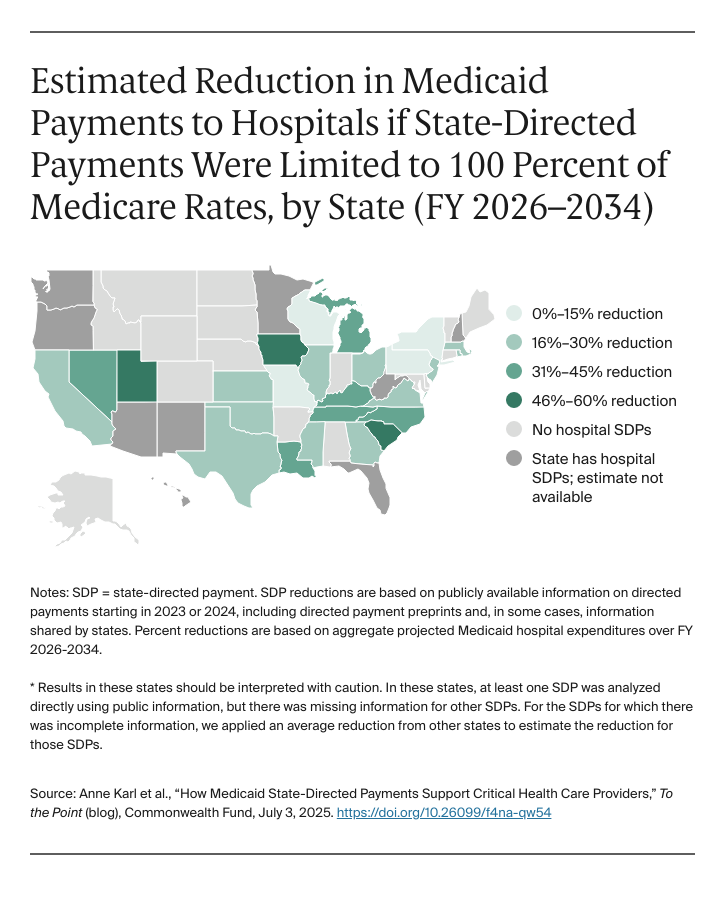
Karl_medicaid_state_directed_payments_map

These figures aggregate payments to hospitals in each state; however, the impact would be felt differently by different hospitals. In particular, SDP cuts would hurt hospitals that serve a disproportionate number of Medicaid patients and have little revenue from commercial insurance. For these facilities, SDPs serve as a financial lifeline, offsetting shortfalls and helping to sustain vital services in communities with scarce health care options.

To better understand the impact, we explored how critical health care providers put their SDPs to work.

  • In Kansas, SDPs are a critical tool to close the gap between costs and Medicaid base payments for rural hospitals. Even after receiving SDPs, 87 percent of hospitals in Kansas’s rural communities are operating in the red, with 47 vulnerable to closure. If SDPs in Kansas were reduced to 100 percent of Medicare rates, hospitals would see up to a 21-percent decline in Medicaid payments, threatening the sustainability of rural hospitals and the services they provide.
  • Georgia’s largest provider of Medicaid services, Grady Memorial Hospital in Atlanta, has used SDPs to expand and improve service delivery for its patients, by expanding home visits, increasing cancer screenings, and opening new outpatient clinics. Cuts would likely paralyze these initiatives.
  • Further, in Georgia, rural hospitals have indirectly benefited from SDPs. SDPs have reduced or eliminated the need for disproportionate share hospital (DSH) payments for certain hospitals. DSH payments help to offset the uncompensated care costs associated with serving a high number of Medicaid and uninsured patients. SDPs have allowed the state to reallocate DSH funds to small rural and critical access hospitals. The Georgia Hospital Association estimates that SDP cuts would lead to a loss of $89.1 million in annual DSH funding for these rural hospitals.
  • In Arizona, an SDP program was developed for Phoenix Children’s Hospital, which provides 60 percent of specialized care to pediatric patients covered by Medicaid statewide. More than half of the system’s revenue comes from Medicaid; SDPs have helped to ensure the hospital provides high-quality children’s health care. If SDPs were capped at Medicare rates, Phoenix Children’s would lose up to 85 percent of the SDPs it receives — representing up to $172 million >out of the $202 million it received in 2023–24.

State-directed payments play a key role for hospitals and other providers that serve Medicaid patients, bridging the gap between base Medicaid rates and the actual cost of care. If enacted, these financing limits will put access for individuals at risk, lead to job losses, and threaten the financial stability and operational capacity of health providers, including safety-net hospitals, children’s hospitals, and hospitals in rural communities that care for a high number of Medicaid patients. As Congress debates Medicaid spending reductions, the future stability of America’s most vulnerable hospitals — and the communities they serve — hangs in the balance.

Publication Details

Date

Contact

Anne Karl, Partner, Manatt Health

akarl@manatt.com

Citation

Anne Karl et al., “How Medicaid State-Directed Payments Support Critical Health Care Providers,” To the Point (blog), Commonwealth Fund, July 3, 2025. https://doi.org/10.26099/f4na-qw54