Advanced Search

Advanced Search

Current Filters

Filter your query

Publication Types

Other

to

Surveys

/

How Medical Bills and Debt Impact Americans with Private Insurance

Findings from the Commonwealth Fund 2025 Affordability Survey and Focus Groups
Man sits with papers next to laptop

Photo: Getty Images

Photo: Getty Images

Compared to people in many other high-income nations, Americans are the most likely to have problems paying for their medical care.1 Unlike these countries, the United States doesn’t have universal coverage. Millions in the U.S. currently lack health insurance, and millions more are expected to lose their coverage as a result of congressional and Trump administration policy changes.

Even for insured Americans, high out-of-pocket costs and plan deductibles can make health care difficult to afford.2 People with private insurance are often frustrated in their attempts to get and pay for care through their health plan, leaving them with bills they didn’t expect. For many, the fear of incurring high bills is a deterrent to getting needed medical care. Recent federal policies are also exacerbating those problems.

In this brief, we report on the ability of U.S. patients and their families to pay their medical bills. Our findings are based on responses to the Commonwealth Fund’s 2025 Affordability Survey, which interviewed a nationally representative sample of 6,353 U.S. adults ages 19 to 64 from July 22 to October 27, 2025. Our analysis focuses on the 4,121 survey respondents who had private insurance coverage, either through an employer, the Affordable Care Act (ACA) marketplaces, or the individual insurance market, and were continuously insured with this coverage for the prior 12 months.

To gain a deeper understanding of people’s experiences with their health plans, we also conducted eight online focus groups on coverage denials, medical debt, and billing errors with 45 adults with private insurance. Some of their stories are included here.

To learn more about the survey and the focus groups, see “How We Conducted This Survey.”

Highlights

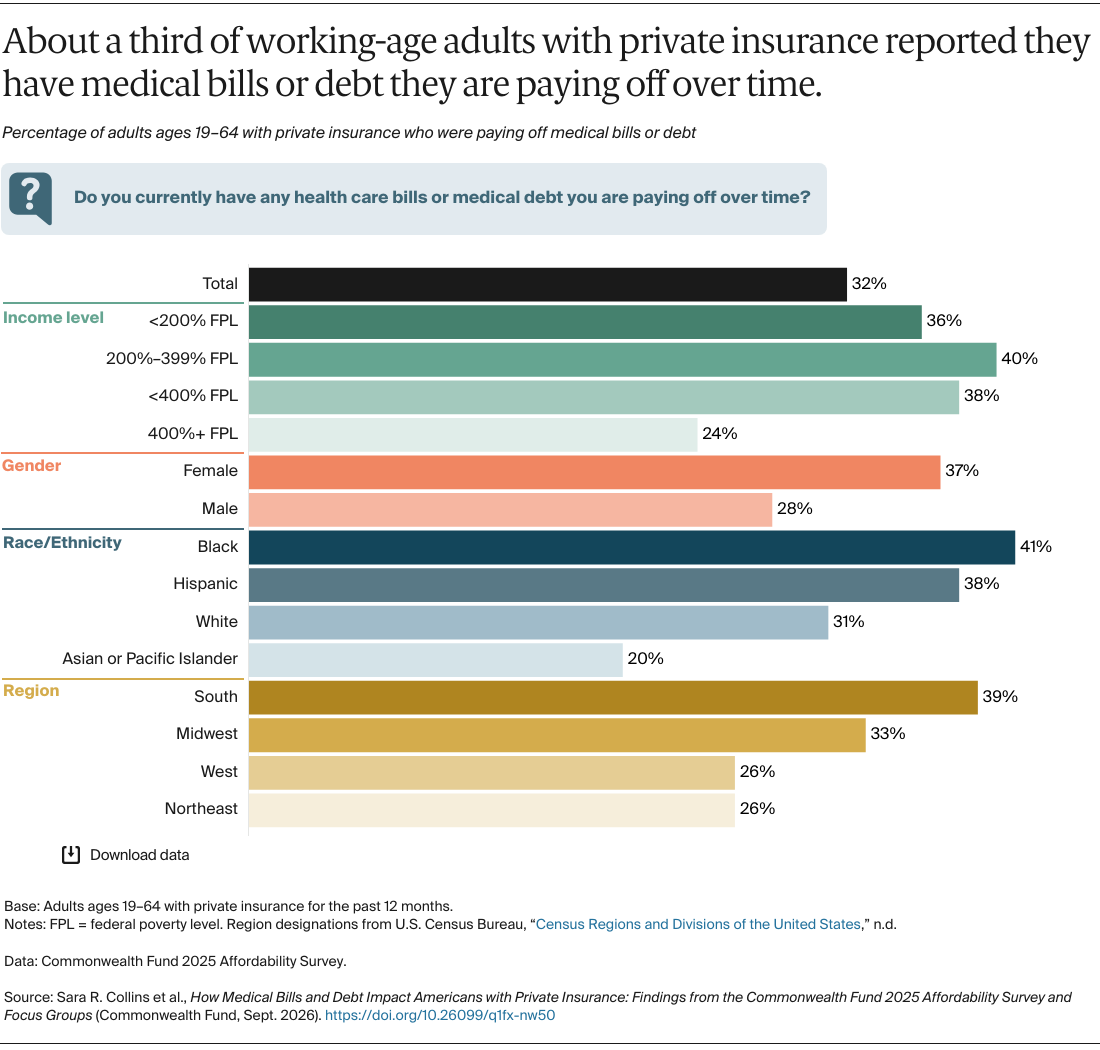
  • About one-third (32%) of working-age adults with private insurance are paying off medical bills or debt over time. Rates are highest for people with low or moderate incomes (38%), women (37%), people who are Black (41%) or Hispanic (38%), and people living in the South (39%).
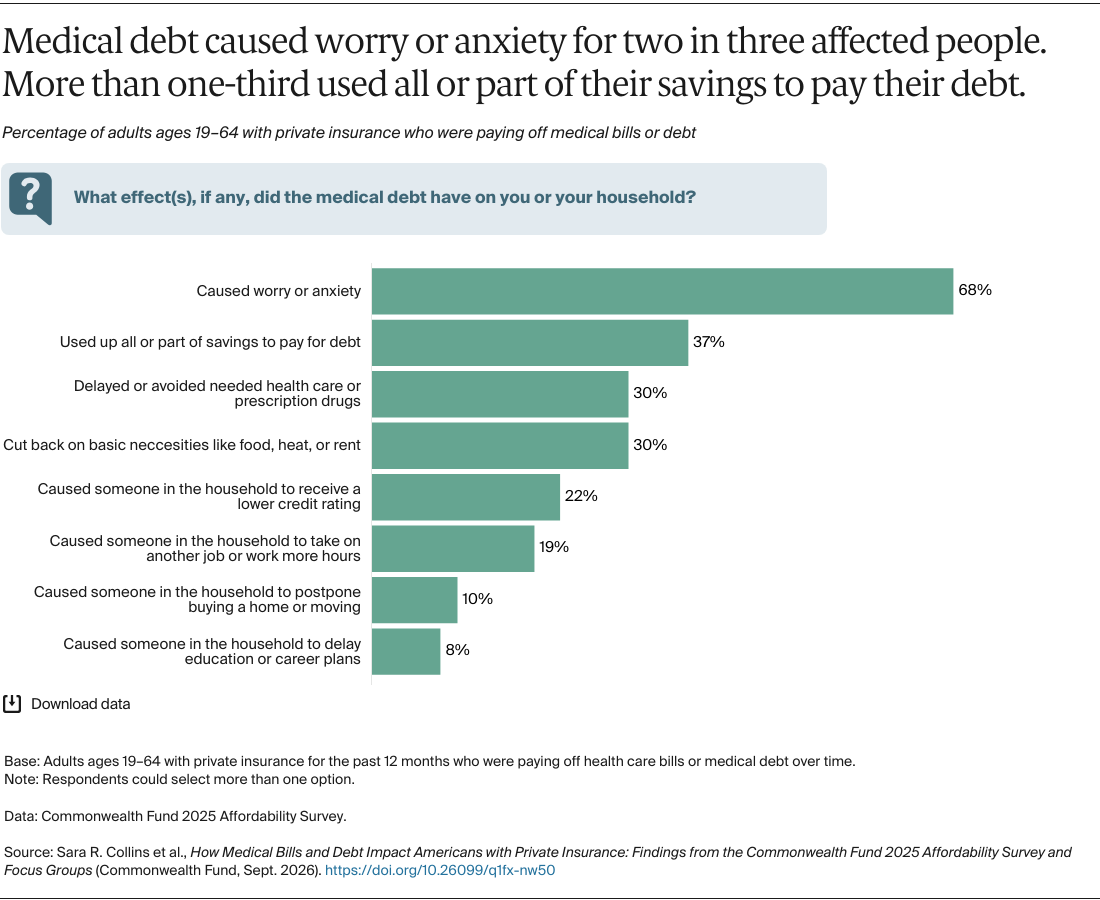
  • Families experiencing medical debt suffer emotionally and financially, with some forgoing needed health care: 68 percent said their unpaid medical bills caused worry and anxiety; 37 percent said they used up all or part of their savings to pay their bills; and 30 percent delayed or avoided needed health care.
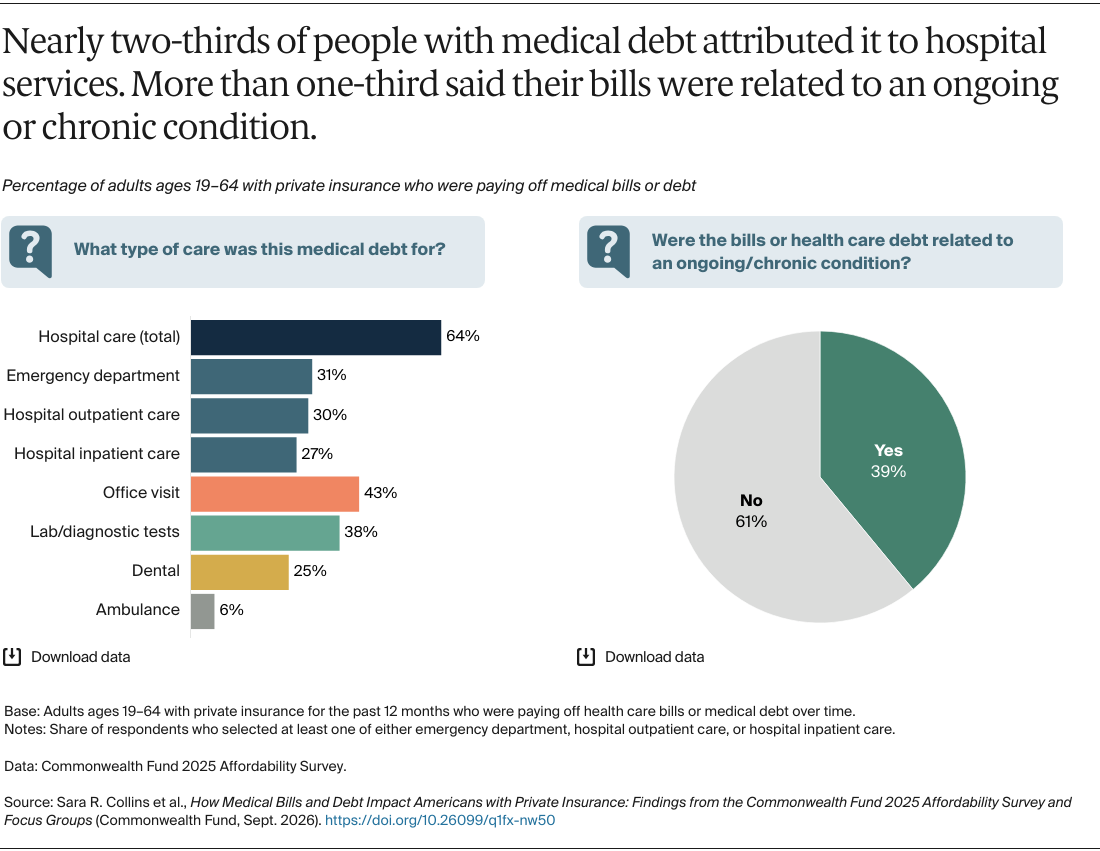
  • Nearly two-thirds (64%) of people paying off medical balances said the debt was from hospital services, either inpatient or outpatient care or emergency room care. But debt also resulted from more routine care, including doctor’s office visits (43%) and lab work or diagnostic tests (38%).
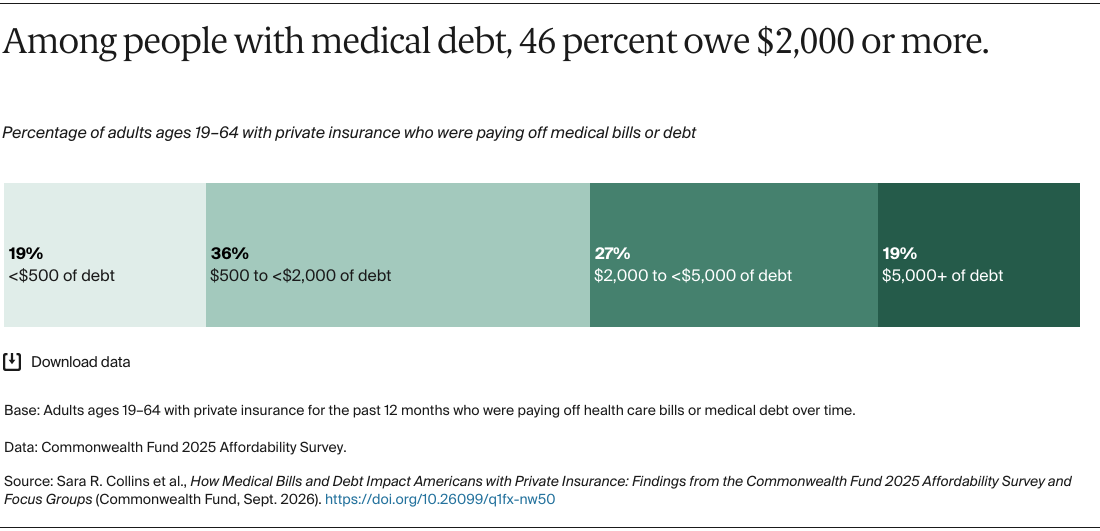
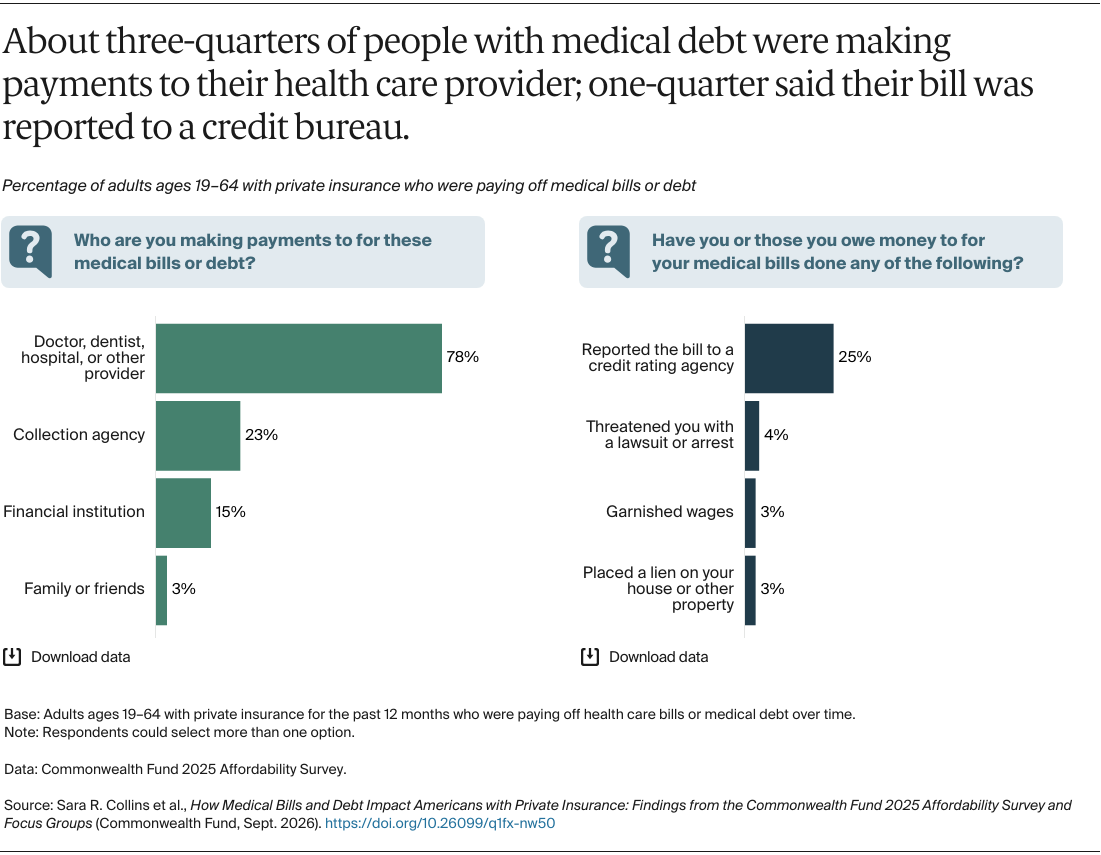
  • Forty-six percent of people with medical debt had unpaid bills totaling $2,000 or more. About one in four adults with debt were making payments to a collection agency, and a similar share said that their bills or debt had been reported to a credit rating agency.
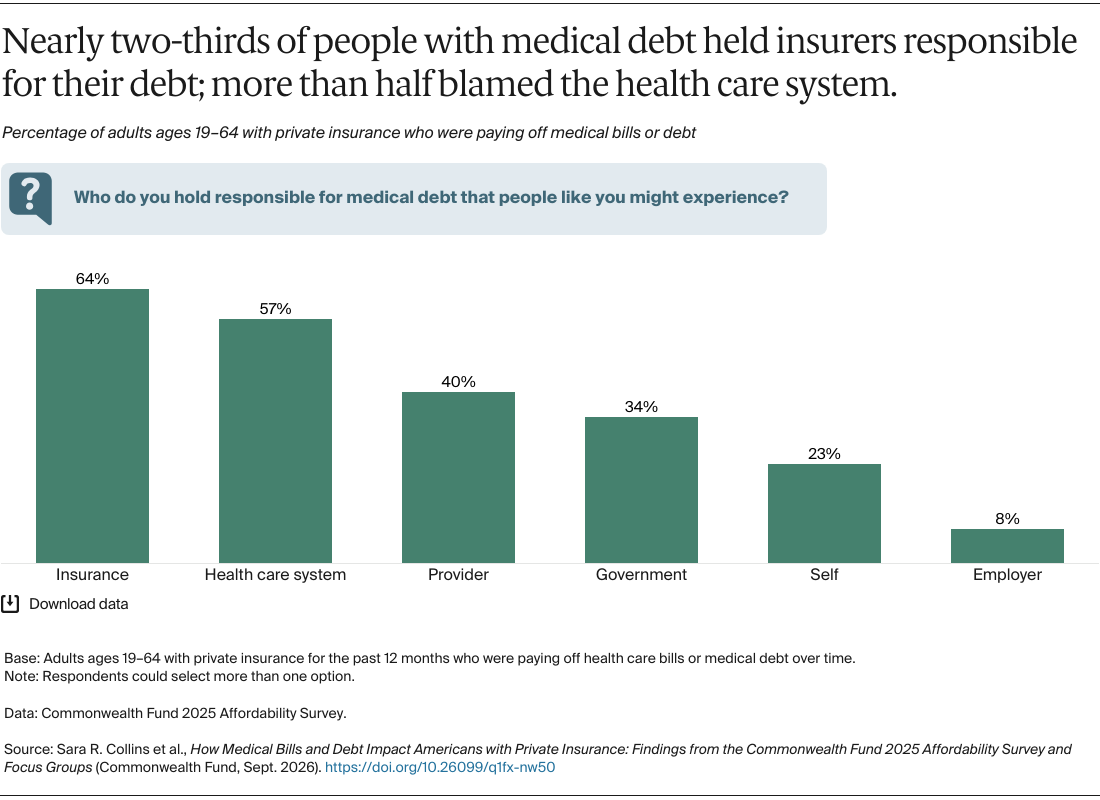
  • Majorities of people paying off bills blamed insurance companies (64%) and/or the broader health care system (57%) for their experience.

Key Findings

Collins_medical_bills_debt_americans_private_insurance_Exhibit_01

About a third of working-age adults with private insurance said that they were paying off medical bills or debt over time. Rates were highest among people with moderate or low income, women, Black and Hispanic people, and residents of southern states.3

About four of 10 adults in southern states reported having medical debt, compared to about a quarter of those in northeastern and western states. Prior studies have also found a higher concentration of medical debt in the South. This was generally attributed to the region’s higher uninsured rates and the choice made by about half of southern states not to expand Medicaid eligibility.4 However, in this study, we found a higher burden of medical debt in the South even among privately insured adults with continuous coverage.

There could be a number of factors at play: the less-generous employer plans that are available in southern states; lower median incomes, particularly relative to plan deductibles, than in other parts of the U.S.; less wealth; fewer states with consumer protections against medical debt; and structural racism, which could contribute to the race-based differences seen in debt collection practices.5

Collins_medical_bills_debt_americans_private_insurance_Exhibit_02

Most people who have medical debt carry a lot of it: 46 percent of working-age adults paying off health care bills or medical debt over time reported loads of $2,000 or more. This means an estimated 15 percent of all U.S. working-age adults with private insurance are carrying medical debt of more than $2,000.

The insurance covers a certain amount, but the [intravenous] infusions are so expensive that our portion is nuts. I mean, we try to go to financial aid [at our hospital], and they never got back to us and send collection letters all the time. . . . [The debt] is way into the six figures. . . . I don’t know anybody who has hundreds of thousands of dollars to pay, you know? We are still trying to figure that out.

Sam a man in his 40s with household medical debt from expensive therapies

Focus group participants reported debt ranging from several hundred dollars to hundreds of thousands of dollars. Several people attributed their debt to an insurance claim denial for care recommended by their health care provider.

One patient expressed her frustration with several different providers who requested expensive imaging, leading to claim denials and subsequent medical debt. But coverage denials were just one piece of problem: many people were simply struggling to pay the high cost of their care.

You’re choosing between paying a greater cost of enduring financial burdens or health burdens.

Javier a man in his 20s with medical debt from emergency and chiropractor care after his sister’s car accident

Regardless of the actual amount of debt, people were overwhelmed by aggressive practices of providers and collection agencies trying to obtain payment. Many were unaware of payment plans or debt assistance. Even with payment plans, some participants worry their medical debt would take “a lifetime” to pay off.

Collins_medical_bills_debt_americans_private_insurance_Exhibit_03

Families dealing with medical debt suffer emotionally and financially, and many avoid getting needed health care after their experience. In our survey, two-thirds (68%) of people with unpaid medical bills said it caused worry and anxiety, 30 percent delayed or avoided needed health care, and 30 percent cut back on basic living necessities, including food, heat, or rent.

The economic ramifications of paying off accumulated medical bills had long-lasting effects for many, including the depletion of savings and lower credit ratings. More than a third of people used up all or part of their savings to pay for medical bills or debt. When health care providers refer medical debt to collection agencies, it may be reported to credit bureaus and can negatively affect people’s credit scores.6

In our focus groups, participants commonly cited stress as a major consequence of their medical bills. They described how debt affected their access to needed medical care, depleted their savings, and caused financial hardship.

Medical debt seriously impacted many people’s quality of life. Several participants said they delayed or avoided seeking medical care because they were worried about having coverage denied and taking on additional debt. Some people turned to the internet for medical advice, instead of consulting their provider.

I have to have surgery on both my arms, and I’m putting if off because I don’t want any more debt. I’m waiting until I get [the diagnostic testing] paid off.

Leila a woman in her 50s with medical debt due to diagnostic testing and treatment for neuropathy

I debate whether or not I should go to the doctor for something. . . . I go on the internet and look up information, and [then] make a decision of how bad of a problem it is, and what the risk is not seeing a doctor.

Luke a man in his early 60s with medical debt related to diagnostic tests and care for long COVID

Several people worried about the financial impact of medical debt on their savings or credit score. Some told of picking up additional jobs or side gigs to pay their medical bills and household expenses.

Many said that medical debt changed how they thought about everyday spending decisions. One participant said the cost of prenatal care and the financial shock of childbirth is making her rethink family planning.

[Medical debt] causes you to rethink family planning, because after I had this baby, I’m like, ‘Wow, it’s so expensive just to have a baby.’ And then on top of that, my deductible went up a lot; my out-of-pocket maximum went up too. So it’s like I can’t even afford to have another child.

Ashley a woman in her 20s with medical debt from prenatal care and testing related to high-risk pregnancy

Collins_medical_bills_debt_americans_private_insurance_Exhibit_04

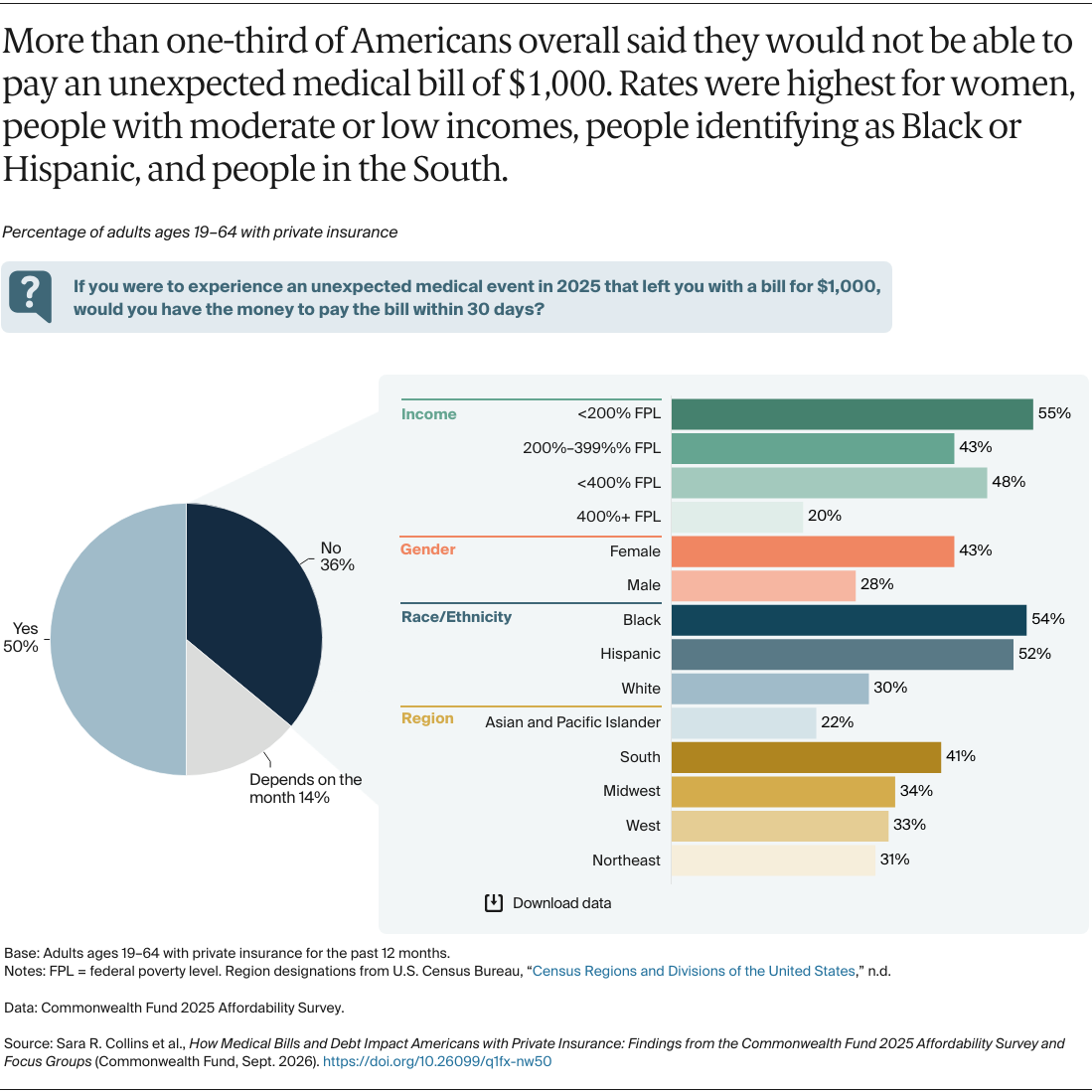
Unexpected medical expenses can push households into medical debt, particularly those with limited savings or unstable income. When asked whether they would be able to pay a $1,000 bill within 30 days for an unexpected medical expense, more than a third (36%) of adults with any type of private insurance said no. This rose to more than half for people with incomes under 200 percent of the federal poverty level ($31,300 for an individual, $64,300 for a family of four) and for Black and Hispanic adults.7

Many of our focus group participants said they were caught off guard by unexpected bills for emergency department visits or acute health issues, with amounts ranging from $1,000 to $5,000. Confronted with such costs, several people wondered how it was possible that their insurance left them so unprotected when they have paid so much in premiums.

A couple of days pass by . . . a couple of weeks, and then you get a bill. And it’s like, ‘Oh my God’ . . . it came out to almost $5,000. I was like, ‘Do they want to give me another heart attack?’ . . . Of course I have insurance from my employer and everything. I said to myself, ‘What did they even cover here?’

Harold a man in his 40s with medical debt due to an emergency department visit for a heart attack

Collins_medical_bills_debt_americans_private_insurance_Exhibit_05

Hospital care is one of the primary drivers of health care cost growth in the U.S.8 It is also the primary source of Americans’ medical debt. Nearly two-thirds of adults with medical debt cited care received in hospitals, whether on an inpatient or outpatient basis or through the emergency department, as the source of their medical debt.

However, medical debt also results from more routine care provided in other settings, including doctor’s office visits (43%), lab work or diagnostic tests (38%), and dental care (25%). Some people also cited more than one type of care for their medical debt balances. Two of five people with medical debt said it was for care they received for a chronic or ongoing health condition.

Many in our focus groups explained that their debt was due to the accumulation of bills for services like ongoing diagnostic testing or an expensive hospital visit, rather than a single high-cost service like surgery.

It’s like every time you see a new specialist, they want a new MRI or CAT scan. I say, ‘I’ve already had so many done, can you not use these?’ And then they want their own facility. [They say], ‘You need to go to this specialist; it’s a nerve thing.’ So you go to the nerve doctor and he wants his own [testing], and then it’s, ‘No, it’s bone.’ So you go to the bone doctor, and then they want their own testing done. And then I’m playing catch up on all the bills.

Leila a woman in her 50s with medical debt due to diagnostic testing and treatment for neuropathy

Many people voiced frustration with unexpected bills from care they thought was partially or fully covered. Worries over further coverage denials or debt not only caused people to postpone or avoid care, but it also deterred them from asking their providers questions during their appointments.

If I’m going for an annual physical, I’ll be cautious of sticking to [the physical] and not bringing up other issues, because I know they’ll bill me. Like once, I brought up that [my daughter] was coughing a lot. And they literally billed me for that specific reason. . . . It was supposed to be a wellness visit, which are usually 100 percent covered with my insurance. And they said it’s because I brought up the topic of her coughing more.

Ashley a woman in her 20s with medical debt from prenatal care and testing related to high-risk pregnancy

Collins_medical_bills_debt_americans_private_insurance_Exhibit_06

The vast majority of adults with unpaid bill balances said they were making payments directly to doctors, dentists, hospitals, or other providers (78%). In about a quarter of cases, patients or their families were making payments to debt collectors. One-quarter said their unpaid bills had been reported to a credit bureau.

Most focus group members said they owed their debt to a health care provider or facility, or a debt collector working on behalf of a provider. Multiple people said health care providers were “relentless” in pursuing payments, contacting people by email, phone, and mail. “They’re calling you 20 times a day or leaving you messages until you handle it,” said one person.

Stress is almost as bad as the bill itself. And if you ignore it, you feel better in the moment. Then, when the next bill comes in, there’s late fees, or you’re getting texts, or phone calls. . . . You wish you had at least made a phone call, or answered the texts, or taken care of the bill.

Luke a man in his early 60s with medical debt related to diagnostic tests and care for long COVID

Many people dreaded trying to contest parts of their bill or setting up a payment plan, saying they found it difficult to reach people who would help them. One participant described the appeals process as a “tug of war,” with the patient stuck between health care and insurance providers.

Several participants said they paid their bill simply because it would be futile to ask for financial assistance or contest a coverage denial. One reflected on the enormous effort providers expend to recoup their payments, while patients are offered relatively little help.

When you go through this, I don’t want to say that you don’t have help, but you can tell that people are kind of after you. To see the amount of energy [insurance or health care providers expend] to receive their money but not have opportunities to be assisted in the process was kind of a reality check.

Javier a man in his 20s with medical debt from emergency and chiropractor care after his sister’s car accident

Collins_medical_bills_debt_americans_private_insurance_Exhibit_07

When asked who they hold responsible for the fact that they are paying off health care bills or medical debt over time, a majority said they blamed their insurance company. More than half blamed the health care system in general. Others viewed their providers as responsible, and more than one-third blamed the government for their experience.

While many focus group participants blame insurance companies for their medical debt, people also said they are frustrated that employers “take so much out of our paycheck for insurance” — but that necessary care still wasn’t covered.

It’s like you have to have insurance, but sometimes I think, ‘What’s the point of having it?’ Because it doesn’t seem that they cover enough — or cover anything.

Audrey a woman in her 50s with medical debt due to undiagnosed GI issues

Thinking about the health system overall, focus group members agreed that incentives between patients, health care providers, and insurers are misaligned. One person described the health care system as “predatory,” and several felt they were “taken advantage of.”

It shouldn’t be like, we have to see how much money we can get from this person, right? How many procedures, tests, and lab calls can we run? It would be better for a doctor to say, ‘Do you know how I can help this person? And how can I document it properly to ensure that the patient will leave, if not cured, helped, but without a ton of debt?’

Viva a woman in her 30s with coverage denial, billing error, and medical debt for her husband’s diabetes care

Despite blaming insurance companies for their debt, many cited health care affordability overall as a major concern. Many felt that providers “set these high prices that people can’t pay.” People were also frustrated with the lack of clarity around options for debt assistance. While some said their health care providers negotiated payment plans for them, others said payment was demanded in full.

Collins_medical_bills_debt_americans_private_insurance_Exhibit_08

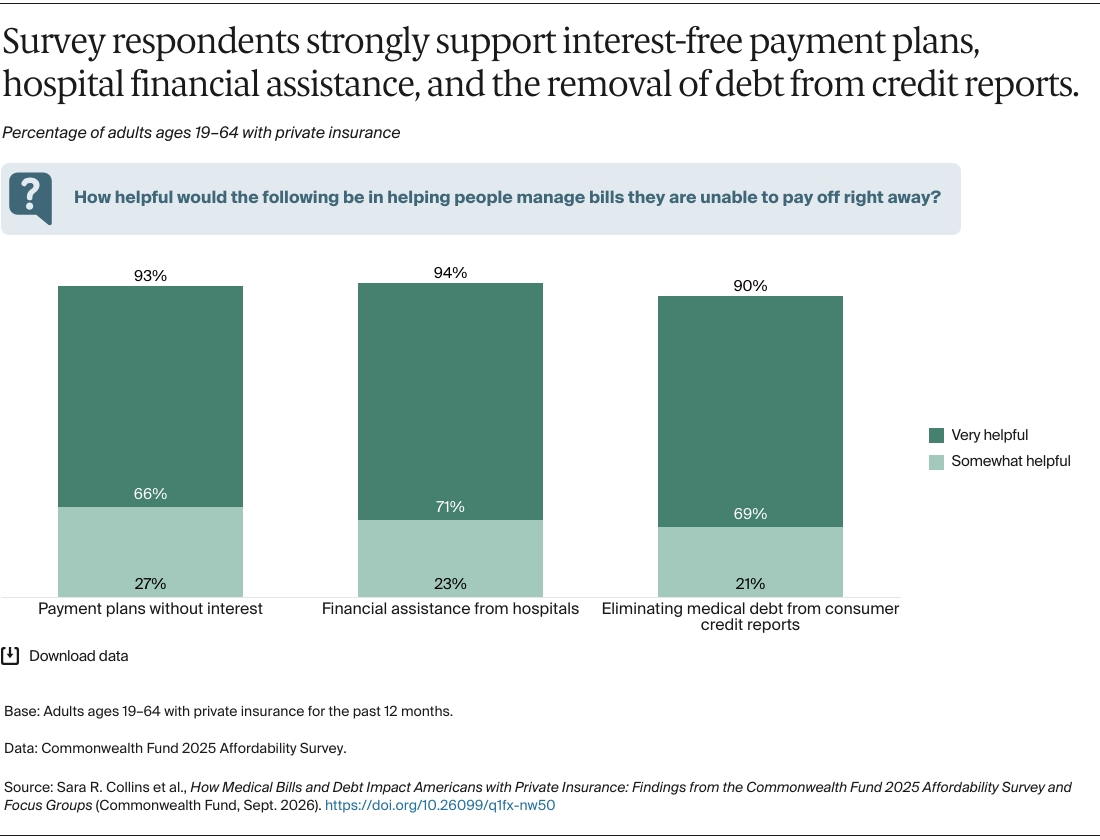
When asked which specific policies or measures could help people, nearly everyone in the survey expressed support for interest-free payment plans, financial assistance from hospitals, and removing medical debt from consumer credit reports. Such policies either don’t exist or are extremely limited at the federal level.9 Several states have passed laws in these areas, but they vary widely in scope and enforcement.

While many in our focus groups felt that payment plans might help them pay off their debt, several people said they were so overwhelmed with debt that a payment plan wouldn’t meaningfully help. One person said it would take “a lifetime” — even with payment plans — to pay off their debt.

Many focus group participants vehemently opposed allowing credit agencies to report medical debt. Several participants wished for more debt forgiveness programs or programs to assist with expensive treatments.

Currently, most states allow credit reporting under certain conditions or have no credit reporting limits. Only two states (Illinois and Minnesota) require hospitals to offer a payment plan before sending a bill to collections.10

I don’t think medical debt should be on your credit report . . . because it’s not like a credit card where you willingly take out the credit card and you run up the bill. It’s medical — I mean, everybody has unforeseen things that are going to happen.

Adam a man in his 50s with medical debt from IVF services

What Can Be Done to Address and Prevent Medical Debt?

Millions of Americans are saddled with medical bills they are struggling to pay off over time, and many of them have health insurance. Sweeping reductions in insurance coverage and even higher out-of-pocket costs resulting from actions taken by Congress and the Trump administration are expected to only increase the number of Americans who struggle to pay for health care.11

Federal and state policymakers have options to reduce people’s medical debt and its impact. These options can be grouped into three broad categories: 

  • Downstream: Alleviate medical debt after people incur it.
  • Upstream: Prevent the accumulation of medical debt.
  • At the source: Address the central flaws in our health system that make the U.S. a medical debt outlier among peer nations.

Alleviating Existing Medical Debt

Congress could pass legislation to ban all medical debt from all credit reports. About 15 million people have medical bills on their credit reports, totaling an estimated $49 billion. They are the largest source of debt on credit reports.12 However, medical debt has been found to have little predictive value for credit underwriting purposes: people whose credit scores were hurt by medical debt are as likely to repay loans as those with higher credit scores.13 Moreover, medical debt can result from billing errors or claims denials, making it even less relevant for assessing credit risk.14 Because of this, the credit and lending industries have reduced their reliance on medical debt to assess people’s creditworthiness. The three major credit agencies removed medical debt under $500 from consumer credit reports in 2023. Credit scorers have adjusted their models to reflect the lower likelihood of people with medical debt to default on future credit accounts compared to those with other types of debt.15

Sixteen states prohibit or restrict the inclusion of medical debt on credit reports.16 However, the Trump administration blocked a federal rule finalized by the Biden administration that would have banned all credit rating agencies from including medical debt on most consumer credit reports and prohibited lenders from considering medical debt in lending decisions.

Preventing Medical Debt

The federal government and states could strengthen and enforce financial assistance requirements for hospitals. Financial assistance could keep people from becoming buried in medical debt after a hospital stay. But federal law requires only nonprofit hospitals to establish a written financial assistance policy, and it doesn’t specify any minimum eligibility requirements.17 Twenty-one states have gone beyond federal law by requiring hospitals to provide financial assistance with minimum eligibility standards; all but three also include for-profit hospitals.18 But the amount of financial assistance required and the income groups eligible for such assistance vary widely, as does enforcement.19

States could go further by making it easier for patients to access financial assistance, for example, by establishing centralized online portals.20 However, federal intervention is needed to establish nationwide standards for financial assistance and eligibility and to tie compliance to licensure, community benefit requirements, or other enforcement mechanisms.

Addressing the Primary Drivers of Medical Debt

Eliminate deductibles in commercial insurance plans and cap provider payment rates. Originally envisioned as incentives for consumers to shop for high-value care, deductibles have instead acted as barriers to obtaining all care, including high-value services.21 In effect, they function as a tax on people with chronic health problems, who are much more likely to meet their deductible in a given year than people with variable health needs, and consequently have become a vector for medical debt. Four in 10 people in our survey said their medical debt stemmed from care for a chronic health problem.22

Deductibles have also enabled insurers, employers, and policymakers to lower premium costs by shifting costs to consumers. This avoids the need to address the root cause of premium growth — the overall growth in U.S. health care spending. A principal driver of this spending growth is the prices that insurers pay to providers.23

Congress could fix these perverse incentives and outcomes. For example, one recent proposal would change the marketplace benchmark plan from silver to gold and eliminate deductibles for those plans. Premium increases would be offset by requiring insurers to pay providers a percentage of Medicare rates.24 Similarly, Congress could set new standards for employer plans. These could include eliminating deductibles and enabling employers to cap hospital rates and the other provider prices that insurers pay.

Cover the remaining uninsured. Congress and the Trump administration have substantially reduced Americans’ access to Medicaid and the ACA marketplaces through new enrollment barriers, deep cuts in eligibility, and a doubling of premium costs. The Congressional Budget Office projects the number of uninsured people in the U.S. to jump to 37 million in 10 years as a result.25 This will only exacerbate the medical debt problem and shift more of the cost of care to local hospitals and health systems.

To head off this impending crisis, Congress will need to reverse the policy changes of the last year, fill the gaps in the ACA, and once again place the United States on a path to universal coverage.

HOW WE CONDUCTED THIS SURVEY

The Survey

The Commonwealth Fund 2025 Affordability Survey was administered by SSRS from July 22 to October 27, 2025. The survey, which consisted of telephone and online interviews in English and in Spanish, was conducted among a random, nationally representative sample of 6,353 adults ages 19 to 64 years living in the United States. The survey interviews were conducted using a multiframe approach that included address-based samples (ABS), prepaid cell phone samples, and the SSRS Opinion Panel. In total, 1,794 interviews were completed online or on the phone via ABS, 328 interviews were conducted on prepaid cell phones, and 4,231 interviews were conducted online via the SSRS Opinion Panel.

The sample was designed to exclude anyone age 65 and older, while also allowing for a sufficient sample of people anticipated to experience more health care affordability challenges (such as coverage denials, billing errors, or medical debt). Statistical results were weighted in stages to compensate for sample designs and patterns of nonresponse that might bias results. In the first stage of weighting, base weights were applied to account for sampling probabilities and were computed separately for each of the three sample frames. The base-weighted samples were combined using a compositing adjustment. Finally, the combined sample was calibrated to match target population benchmarks.

The resulting weighted sample is representative of the approximately 196 million U.S. adults ages 19 to 64. The survey’s margin of sampling error is +/− 1.5 percentage points at the 95 percent confidence level. Survey response rates were as follows: ABS, 14.4 percent; prepaid cell phone, 1.5 percent; SSRS Opinion panel, 2.5 percent.

This brief focuses on the 4,121 adults with private insurance at the time of survey and for the previous 12 months. The resulting weighted sample is representative of approximately 115.2 million adults ages 19 to 64 with private insurance over the past 12 months. The margin of sampling error for this group is +/– 1.8 percentage points at the 95 percent confidence level.

The Focus Groups

SSRS conducted eight online focus groups in April 2025, prior to fielding the survey. Six focus groups were in English and two were in Spanish, with a total of 45 participants. The focus groups informed the development of survey questions designed to capture people’s experience with coverage denials, billing errors, and medical debt. This brief highlights the experiences of the 25 focus group participants who had medical debt or unpaid medical bills.

ACKNOWLEDGMENTS

The authors thank the SSRS team of Darby Steiger, Melissa Silesky, and Robyn Rapoport for conducting and summarizing findings from the focus groups, and Paula Armendariz, Elizabeth Sciupac, Rob Manley, and Ms. Rapoport for their work on the survey. They also thank Chris Hollander, Paul Frame, Jen Wilson, Tony Shih, Arnav Shah, Kristen Kolb, Jess Maksut, and Claire Coen, all of the Commonwealth Fund.

Notes

Publication Details

Date

Contact

Sara R. Collins, Senior Scholar, Expanding Coverage and Access and Tracking Health System Performance, The Commonwealth Fund

src@cmwf.org

Citation

Sara R. Collins et al., How Medical Bills and Debt Impact Americans with Private Insurance: Findings from the Commonwealth Fund 2025 Affordability Survey and Focus Groups (Commonwealth Fund, Sept. 2026). https://doi.org/10.26099/q1fx-nw50