

Advanced Search

Advanced Search

Current Filters

Filter your query

Publication Types

Other

to

Issue Briefs

/

Medicare Alternative Payment Models That Support Improved Primary Care

Elderly woman sits on exam table

Katherine Baumann is examined by Ken Kilkenny, a licensed practical nurse, at Northwell Health’s Age Friendly Center of Excellence, which specializes in geriatric care, in Oyster Bay, N.Y. Compared to other high-income countries, U.S. patients are less likely to have a regular provider, after-hour services, or a longstanding relationship with a clinician. Photo: Howard Schnapp/Newsday RM via Getty Images

Katherine Baumann is examined by Ken Kilkenny, a licensed practical nurse, at Northwell Health’s Age Friendly Center of Excellence, which specializes in geriatric care, in Oyster Bay, N.Y. Compared to other high-income countries, U.S. patients are less likely to have a regular provider, after-hour services, or a longstanding relationship with a clinician. Photo: Howard Schnapp/Newsday RM via Getty Images

Toplines
  • Participation in alternative payment models is associated with improvements in at least one measure across the four core features of primary care: accessibility, comprehensiveness, continuity, and coordination

  • Enhanced payments or program support will likely be necessary, especially for practices serving patients with greater social risks and resource constraints

Toplines
  • Participation in alternative payment models is associated with improvements in at least one measure across the four core features of primary care: accessibility, comprehensiveness, continuity, and coordination

  • Enhanced payments or program support will likely be necessary, especially for practices serving patients with greater social risks and resource constraints

Downloads

Abstract

  • Issue: Accessible, comprehensive, continuous, and coordinated primary care benefits patients, yet is not supported well by Medicare’s current payment system.
  • Goals: To identify which types of alternative payment models (APMs) being tested in traditional Medicare have been associated with improvements in the four core primary care features of access, comprehensiveness, continuity, and coordination.
  • Methods: We conducted difference-in-differences analyses of claims data to identify which APM types were associated with improvements in measures of the key features of primary care.
  • Key Findings: APM participation was associated with improvements in at least one measure for each key feature of primary care. APMs that pay primary care practices (rather than larger entities) achieved greater improvements for measures of access and comprehensiveness. Primary care practices in “hybrid” APMs without financial risk improved on all measures, while findings were mixed for other reform models.
  • Conclusion: Disentangling primary care practices’ finances and rewards from those of other providers and larger organizations may be essential to future success in restoring primary care to its core role in health care delivery. Payment models that provide hybrid payments to these practices without adding financial risk appear effective at supporting the essential features of primary care.

Introduction

Primary care is critical for population health, health equity, and the overall efficiency of the health care system.1 It also has been consistently associated with improved life expectancy and reduced health care disparities. The four defining features of high-functioning primary care are:

  • accessibility
  • comprehensive care for most patient problems
  • continuity of care over time
  • coordination of care with the broader health care delivery system.2

Though extensive research has demonstrated the value to patients and the wider community when primary care practitioners (PCPs) deliver care defined by these key elements, they are often lacking in the United States.3 Compared to other high-income countries, U.S. patients are less likely to have a usual source of care, after-hours access to primary care, or a longstanding relationship with a provider of comprehensive primary care.4 One reason is Medicare’s physician fee schedule, which does not adequately incentivize primary care practices to provide accessible, comprehensive, continuous, or coordinated care.5 For example, fee schedule payments do not support the additional costs of providing care outside regular business hours, which can limit accessibility for people with caregiving responsibilities, multiple jobs, or jobs with irregular hours.6 PCPs are also providing less comprehensive care, increasingly referring patients to specialists for in-depth management after documenting their concerns.7

While the Medicare fee schedule recently added codes for time spent coordinating care outside the face-to-face visit, barriers such as administrative costs to the practices and copayments for patients mean few PCPs utilize them.8 PCP continuity is also inadequately supported by current fee-for-service payments: practices that rely on revenue from visits lose money when there are unused appointment slots held to accommodate last-minute visits from established patients.9

Recognizing the limitations of the Medicare fee schedule in supporting primary care, the Centers for Medicare and Medicaid Services (CMS) has designed and tested alternative payment models (APMs) for primary care providers serving patients in the traditional Medicare program. We recently assessed 14 of these APMs to evaluate whether they improve delivery of the four defining features of primary care.10

To group these models and better understand which reforms might be associated with improvements, we adapted a framework advanced by the National Academies of Sciences, Engineering, and Medicine (NASEM) in its 2021 consensus study.11 In this issue brief, we use our findings to explore lessons learned for the design of payment models to enhance the provision of the core features of primary care.

Key Findings

Options for Improving Payment for Primary Care

The NASEM framework of options for improving primary care charts three possible paths for reform:

  • Option 1: Revisions to the physician fee schedule “to value primary care services more accurately.”
  • Option 2: Hybrid payment models which blend fixed, per-patient payments that give providers greater flexibility to deliver the right care at the right time, with fee-for-service for critical preventive services like immunizations.
  • Option 3: Broad risk-sharing models where “. . . practices can assume risk accountability in their own contracts, form new entities to participate in risk-sharing models, or participate as part of a larger medical group or integrated delivery system.”

Of the 14 traditional Medicare APMs that CMS put forward, none aligned with the description for enhanced fee schedule payments to primary care (option 1).12 This is not surprising, since increasing fee schedule payments for PCPs would be beyond the statutory scope for developing Medicare APMs unless other requirements were imposed.13

As shown in Exhibit 1, some providers participating in the largest PCP-oriented APM, Comprehensive Primary Care Plus (CPC+), operated under a hybrid payment model (option 2) that blends fee-for-service and fixed, per-patient payments without adding downside financial risk.14 PCPs participating in this model included the subset of CPC+ participants not in a Medicare Shared Savings Program (MSSP) Accountable Care Organization (ACO), as well as those within one of the ACO tracks that did not include downside financial risk to the participating practices.15
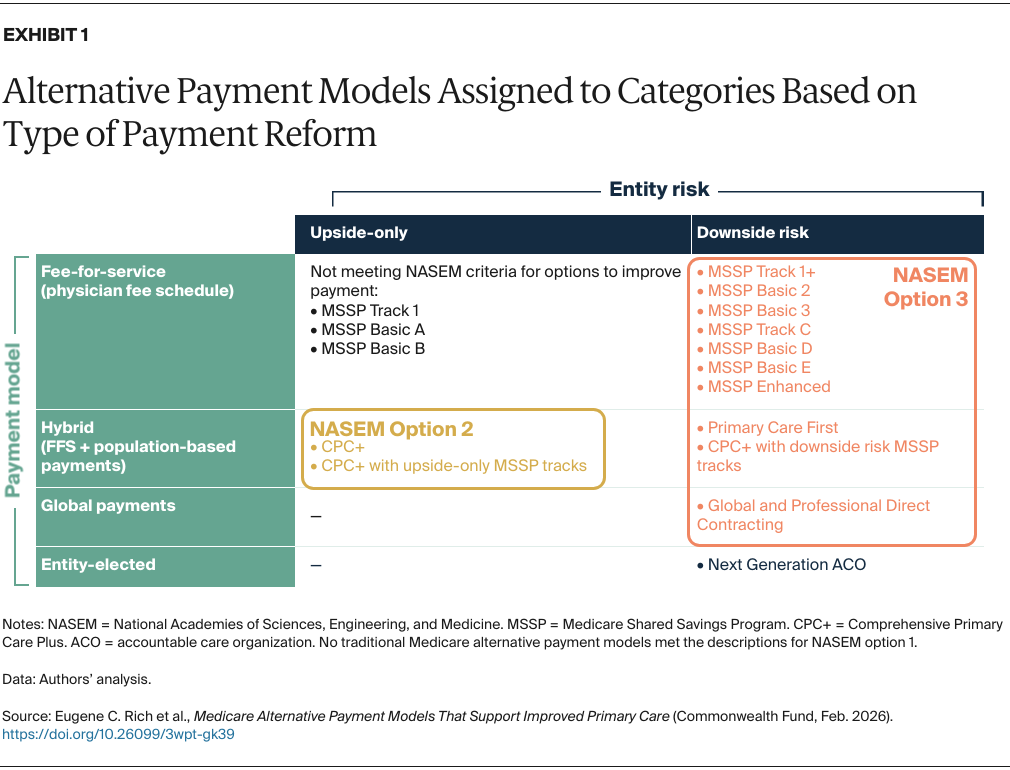
Rich_medicare_APMs_Exhibit_01_Feb_2026

Several of the traditional Medicare APMs involve population-based payments for primary care combined with financial risk (option 3). These include APMs with hybrid payments and downside risk (when a provider is financially responsible for costs exceeding an agreed-upon budget), such as Primary Care First, and APMs with global payments, such as the Global and Professional Direct Contracting model.16 They also include a subset of MSSP ACO tracks that operate within the framework of fee schedule payments but focus provider organizations on care of a population of patients and impose organizational financial risk for the costs of this care.

Exhibit 1 places the Next Generation ACO model in its own payment reform category, since these entities could choose the form of payment they receive.17

Association of NASEM Primary Care Payment Options with Core Features of Primary Care

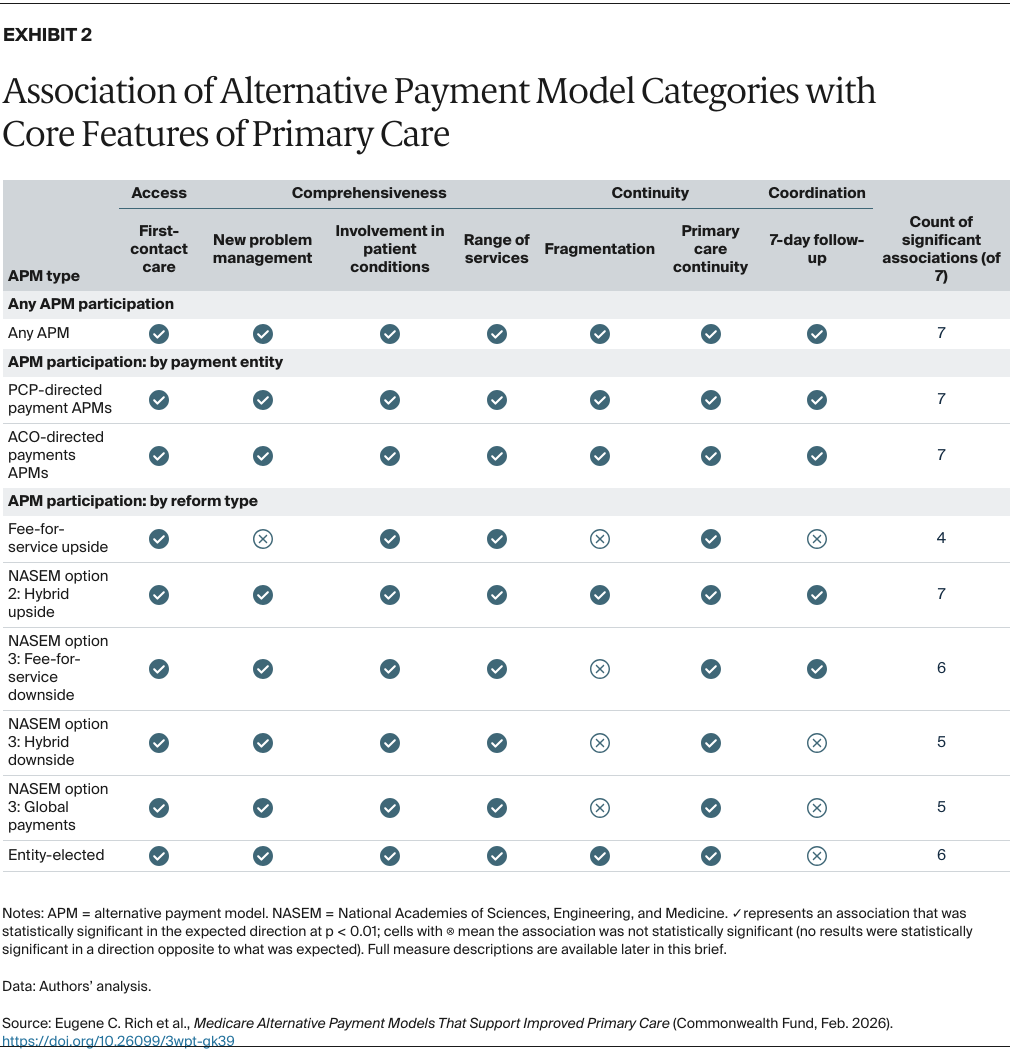
As shown in Exhibit 2, we found that participation in any APM was associated with improvements in at least one measure for each of the four key elements of a high-functioning primary care system. However, some types of APMs were more consistently associated with improvements in specific measures. The NASEM report urged that policymakers “pay for primary care teams to care for people, not doctors to deliver services.”

Our analyses found PCPs who participate in APMs that direct payments to primary care practices experienced significantly greater improvements in measures of accessibility, comprehensiveness, and continuity of care compared to those who participated in APMs that direct payments to larger entities. PCPs benefiting from direct payments to their practices also showed less fragmentation and greater coordination of care, but the changes were not statistically different from those observed for PCPs in ACO-directed payment models.18

Rich_medicare_APMs_Exhibit_02_Feb_2026

Primary care practices participating in alternative payment models categorized as hybrid with no downside risk — option 2 of the NASEM framework — showed significant improvement in all measures of accessibility, comprehensiveness, continuity, and coordination of care.19

We had more nuanced findings for models under option 3, involving population-based payments for primary care combined with financial risk. For PCPs in the downside-risk ACO models that relied in part on traditional physician fee schedule payments, we saw significant improvements in measures of access, comprehensiveness, and coordination, as well as the most direct measure of PCP continuity. However, care fragmentation did not significantly improve. Participation in hybrid payment APMs with downside risk and global payment APMs was also not associated with improvement in our care coordination measure.20

Finally, outside the NASEM framework, the Next Generation ACO model (the entity-elected payment option in Exhibit 1) had no significant link to improvements in coordination of care, and fee-for-service, upside-risk-only models were not significantly associated with improvements in new-problem management (an aspect of comprehensiveness), fragmentation, or coordination.21

Discussion

Our findings are consistent with the NASEM report’s recommendation to pay small primary care teams to care for patients rather than providing visit-based payments to individual primary care practitioners. But who to pay to support these teams and how to do so remain in question. In a companion paper, we found inconsistent associations between PCP health system affiliation and the core features of primary care.22 Prior work has found PCPs affiliated with health systems had lower comprehensiveness and continuity of care.23 Data from the Agency for Healthcare Research and Quality Compendium of U.S. Health Systems show that from 2016 to 2022, the proportion of primary care physicians in these systems has grown from 43 percent to 53 percent.24 There also has been rapid growth of primary care practice ownership by larger organizations, such as health plans and other investor-owned corporations.25 In recent interviews on payment reform, PCPs emphasize the importance of directing payments and related resources to the primary care practices responsible for delivering care.26

PCPs participating in the subset of Medicare APMs that relied on hybrid payment without introducing financial risk had significant improvements in all measures of the four key features of primary care. This is compatible with arguments by some primary care payment policy leaders that effective payment reform need not be (and perhaps should not be) tied to downside financial risk.27 In our analysis, other payment model categories had less consistent associations with PCPs’ achievement of all the core features of primary care. Of course, many of these models engage primary care practices affiliated with larger organizations, which could compromise the effective allocation of resources to enhance the provision of high-quality primary care.

The NASEM report also called out the potential importance of enhancing fee-for-service payments to primary care and increasing the proportion of health care spending devoted to primary care. Unfortunately, we could not assess any payment models focused solely on increasing fee-schedule payments for PCPs, as such reforms would be beyond the statutory scope of traditional Medicare APM. Likewise, we did not observe any models that reliably enhanced the total amount of payment to PCPs; the Center for Medicare and Medicaid Innovation has faced statutory constraints developing such models and has only recently begun to test targeted examples (for example, ACO REACH).28

PCPs serving a higher proportion of Medicare beneficiaries with greater social risk were less likely to participate in the traditional Medicare APMs we studied. The numbers were too small to investigate the potential benefits — to practices and patients — of the various NASEM report categories of primary care payment reform.

Like all observational studies, ours had methodological limitations. We attempted to account for selection bias by controlling for observable PCP, practice, beneficiary, and community characteristics, but we cannot control for unobserved characteristics, such as a practice’s predisposition to improve performance on primary care features. Our forthcoming article29 notes various efforts to address these limitations, but we acknowledge these methodological concerns preclude confirming a causal relationship between specific APM participation and improvements in these essential features of primary care.

Conclusion

We find overall that traditional Medicare alternative payment models are associated with improvements in PCP accessibility, comprehensiveness, continuity, and coordination. Applying a framework derived from NASEM recommendations, we find that the most consistent benefits were observed for hybrid payment models that do not subject PCPs to downside financial risk. It is possible that reforming PCP payment to enhance delivery of the essential features of primary care may not be compatible with holding PCPs at risk for costs of care.

We also find signals that models are more effective at improving primary care when the resources are directed to primary care practices instead of larger entities like ACOs. Indeed, disentangling PCP finances and rewards from those of other providers and larger organizations may be essential to restoring primary care to its core role in health care delivery. Increasing payments or program supports to primary care practices will also likely be needed, especially to those who serve patient populations with greater social risks and resource constraints.


How We Conducted This Study

Classifying Traditional Medicare Alternative Payment Models

We reviewed the Centers for Medicare and Medicaid Services (CMS) descriptions of each of the 14 traditional Medicare alternative payment models (APMs) studied and classified them according to the options for primary care payment reform presented in the 2021 National Academies of Sciences, Engineering, and Medicine (NASEM) report.

Analyzing PCP Participation in APMs

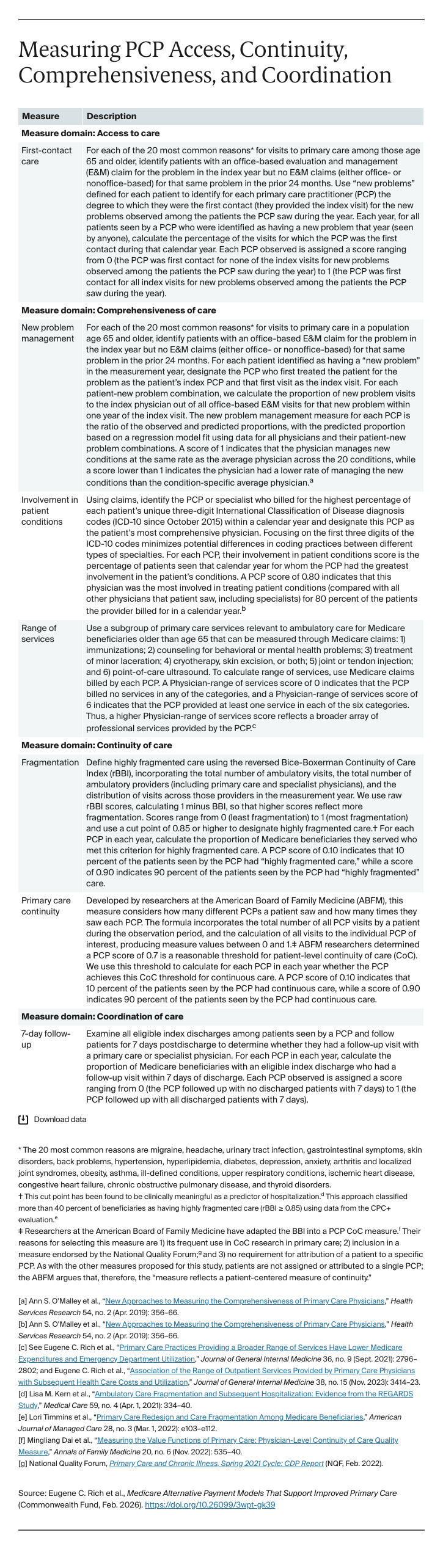
Through our access to the CMS Virtual Research Data Center (VRDC), we used Medicare Data on Provider Practice and Specialty (MD-PPAS) to identify physicians with primary care specialties during 2016–2022; Medicare fee-for-service claims and enrollment data to create claims-based outcome measures and obtain beneficiary characteristics for beneficiaries seen by those primary care practitioners (PCPs); and data on physician participation in various CMS initiatives. We relied on additional publicly available secondary data sources to obtain physician practice and area characteristics. For outcome measures, we used previously validated claims-based outcomes of PCP comprehensiveness of care, PCP continuity of care, and PCP care coordination and examined the extent of PCPs’ first-contact care for common problems as a measure of PCP access.30 We examined outcomes across the full range of traditional Medicare patients served by a PCP in each year.

Assessing the Association Between APM Participation and PCP Outcomes

We used combinations of Taxpayer Identification Numbers (TINs) and National Provider Identifiers (NPIs) to determine traditional Medicare APM participation in the 2016 baseline year as well as during the period 2017 to 2022. Using a sample of PCPs (TIN-NPI combinations) not participating in any traditional Medicare APM in 2016, we employed a difference-in-differences analysis to compare changes from baseline to the intervention period in PCP-level outcomes among PCPs who began participating in traditional Medicare APMs during 2017–2022 versus those who did not.

To account for potential differences in characteristics between PCPs who participated in specific APMs versus those who did not, we controlled for physicians’ characteristics, including their participation in other Center for Medicare and Medicaid Innovation models, attributes of their beneficiaries, affiliation with a health system, and area-level characteristics. Tests of parallel trends showed that PCPs entering APMs in 2019 were differentially improving on two measures of comprehensiveness and both continuity measures, so we avoid drawing causal conclusions. To further mitigate unmeasured confounding, we used practice-level fixed effects in all models. Additional details can be found in our full article.31

Rich_medicare_APMs_Table_Feb_2026
NOTES
  1. Barbara Starfield, Leiyu Shi, and James Macinko, “Contribution of Primary Care to Health Systems and Health,” Milbank Quarterly 83, no. 3 (Sept. 2005): 457–502; and Leiyu Shi, “The Impact of Primary Care: A Focused Review,” Scientifica (Dec. 31, 2012): 432892.
  2. Institute of Medicine, Committee on the Future of Primary Care, Molla S. Donaldson et al., eds., Primary Care: America’s Health in a New Era (National Academies Press, 1996).
  3. See, for example, Barbara Starfield, Primary Care: Balancing Health Needs, Services, and Technology (Oxford University Press, 1998); Ann S. O’Malley et al., “Disentangling the Linkage of Primary Care Features to Patient Outcomes: A Review of Current Literature, Data Sources, and Measurement Needs,” Journal of General Internal Medicine 30, Suppl. 3 (Aug. 2015): S576–S585; Sanjay Basu et al., “Estimated Effect on Life Expectancy of Alleviating Primary Care Shortages in the United States,” Annals of Internal Medicine 174, no. 7 (July 2021): 920–26; Ann S. O’Malley et al., “Medicare Beneficiaries with More Comprehensive Primary Care Physicians Report Better Primary Care,” Health Services Research 58, no. 2 (Apr. 2023): 264–70; Ann S. O’Malley et al., “New Approaches to Measuring the Comprehensiveness of Primary Care Physicians,” Health Services Research 54, no. 2 (Apr. 2019): 356–66; Eugene C. Rich et al., “Association of the Range of Outpatient Services Provided by Primary Care Physicians with Subsequent Health Care Costs and Utilization,” Journal of General Internal Medicine 38, no. 15 (Nov. 2023): 3414–23; Mingliang Dai et al., “Measuring the Value Functions of Primary Care: Physician-Level Continuity of Care Quality Measure,” Annals of Family Medicine 20, no. 6 (Nov. 2022): 535–40; John S. Wasson et al., “Continuity of Outpatient Medical Care in Elderly Men: A Randomized Trial,” JAMA 252, no. 17 (Nov. 2, 1984): 2413–17; and Lisa M. Kern et al., “Ambulatory Care Fragmentation and Subsequent Hospitalization: Evidence from the REGARDS Study,” Medical Care 59, no. 4 (Apr. 1, 2021): 334–40.
  4. Evan D. Gumas et al., Finger on the Pulse: The State of Primary Care in the U.S. and Nine Other Countries (Commonwealth Fund, Mar. 2024).
  5. See Robert A. Berenson and Eugene C. Rich, “U.S. Approaches to Physician Payment: The Deconstruction of Primary Care,” Journal of General Internal Medicine 25, no. 6 (June 2010): 613–18; and Robert A. Berenson and Kevin J. Hayes, “The Road to Value Can’t Be Paved with a Broken Medicare Physician Fee Schedule,” Health Affairs 43, no. 7 (July 2024): 950–58.
  6. Ann S. O’Malley, “After-Hours Access to Primary Care Practices Linked with Lower Emergency Department Use and Less Unmet Medical Need,” Health Affairs 32, no. 1 (Jan. 2013): 175–83.
  7. Michael L. Barnett, Zirui Song, and Bruce E. Landon, “Trends in Physician Referrals in the United States, 1999–2009,” Archives of Internal Medicine 172, no. 2 (Jan. 23, 2012): 163–70.
  8. Ann S. O’Malley et al., “Provider Experiences with Chronic Care Management (CCM) Services and Fees: A Qualitative Research Study,” Journal of General Internal Medicine 32, no. 12 (Dec. 2017): 1294–1300.
  9. Zhou Yang et al., “Physician‐ Versus Practice‐Level Primary Care Continuity and Association with Outcomes in Medicare Beneficiaries,” Health Services Research 57, no. 4 (Aug. 2022): 914–29.
  10. Emily L. Hague, Arkadipta Ghosh, and Eugene C. Rich, “The Role of Medicare Alternative Payment Models in Supporting the Essential Features of Primary Care,” Journal of the American Board of Family Medicine 38, no. 6 (Nov.–Dec. 2025): 1091–1100.
  11. National Academies of Sciences, Engineering, and Medicine, Linda McCauley et al., eds, Implementing High-Quality Primary Care: Rebuilding the Foundation of Health Care (National Academies Press, 2021).
  12. Quality Payment Program, “APMs Overview,” Centers for Medicare and Medicaid Services, n.d.
  13. Deborah Peikes et al., “The Changing Landscape of Primary Care: Effects of the ACA and Other Efforts over the Past Decade,” Health Affairs 39, no. 3 (Mar. 2020): 421–28.
  14. Centers for Medicare and Medicaid Services, “Comprehensive Primary Care Plus,” n.d.
  15. Centers for Medicare and Medicaid Services, “Shared Savings Program,” last updated Sept. 29, 2025.
  16. Centers for Medicare and Medicaid Services, “Primary Care First Model Options,” n.d.; and Centers for Medicare and Medicaid Services, “Global and Professional Direct Contracting (GPDC) Model,” n.d.
  17. Centers for Medicare and Medicaid Services, “Next Generation ACO Model,” n.d.
  18. Emily L. Hague, Arkadipta Ghosh, and Eugene C. Rich, “The Role of Medicare Alternative Payment Models in Supporting the Essential Features of Primary Care,” Journal of the American Board of Family Medicine (in press).
  19. Emily L. Hague, Arkadipta Ghosh, and Eugene C. Rich, “The Role of Medicare Alternative Payment Models in Supporting the Essential Features of Primary Care,” Journal of the American Board of Family Medicine (in press).
  20. Emily L. Hague, Arkadipta Ghosh, and Eugene C. Rich, “The Role of Medicare Alternative Payment Models in Supporting the Essential Features of Primary Care,” Journal of the American Board of Family Medicine (in press).
  21. Emily L. Hague, Arkadipta Ghosh, and Eugene C. Rich, “The Role of Medicare Alternative Payment Models in Supporting the Essential Features of Primary Care,” Journal of the American Board of Family Medicine (in press).
  22. Emily L. Hague, Arkadipta Ghosh, and Eugene C. Rich, “The Role of Medicare Alternative Payment Models in Supporting the Essential Features of Primary Care,” Journal of the American Board of Family Medicine (in press).
  23. See Eugene C. Rich et al., “Association of the Range of Outpatient Services Provided by Primary Care Physicians with Subsequent Health Care Costs and Utilization,” Journal of General Internal Medicine 38, no. 15 (Nov. 2023): 3414–23; Eugene C. Rich et al., “Primary Care Practices Providing a Broader Range of Services Have Lower Medicare Expenditures and Emergency Department Utilization,” Journal of General Internal Medicine 36, no. 9 (Sept. 2021): 2796–2802; and Lori Timmins et al., “Primary Care Redesign and Care Fragmentation Among Medicare Beneficiaries,” American Journal of Managed Care 28, no. 3 (Mar. 1, 2022): e103–e112.
  24. Data from the Agency for Healthcare Research and Quality, Comparative Health System Performance Initiative, “Compendium of U.S. Health Systems,” last updated Sept. 2025.
  25. See Agency for Healthcare Research and Quality, Comparative Health System Performance Initiative, “Compendium of U.S. Health Systems, 2022,” Outpatient Linkage File; and American Medical Association, “AMA Examines Decade of Change in Physician Practice Ownership and Organization,” news release, July 12, 2023.
  26. Ann S. O’Malley et al., Why Primary Care Practitioners Aren’t Joining Value-Based Payment Models: Reasons and Potential Solutions (Commonwealth Fund, July 2024).
  27. Howard Mark Haft and Robert A. Berenson, “Enhancing Primary Care Payments Without Adding Financial Risk,” Journal of General Internal Medicine 38, no. 7 (May 2023): 1747–50.
  28. CMS.gov, “ACO REACH Model,” last updated Sept. 24, 2025.
  29. Emily L. Hague, Arkadipta Ghosh, and Eugene C. Rich, “The Role of Medicare Alternative Payment Models in Supporting the Essential Features of Primary Care,” Journal of the American Board of Family Medicine (in press).
  30. See, for example, Ann S. O’Malley et al., “New Approaches to Measuring the Comprehensiveness of Primary Care Physicians,” Health Services Research 54, no. 2 (Apr. 2019): 356–66; Eugene C. Rich et al., “Association of the Range of Outpatient Services Provided by Primary Care Physicians with Subsequent Health Care Costs and Utilization,” Journal of General Internal Medicine 38, no. 15 (Nov. 2023): 3414–23; Eugene C. Rich et al., “Primary Care Practices Providing a Broader Range of Services Have Lower Medicare Expenditures and Emergency Department Utilization,” Journal of General Internal Medicine 36, no. 9 (Sept. 2021): 2796–2802; Mingliang Dai et al., “Measuring the Value Functions of Primary Care: Physician-Level Continuity of Care Quality Measure,” Annals of Family Medicine 20, no. 6 (Nov. 2022): 535–40; Lori Timmins et al., “Primary Care Redesign and Care Fragmentation Among Medicare Beneficiaries,” American Journal of Managed Care 28, no. 3 (Mar. 1, 2022): e103–e112; Adora N. Moneme et al., “Primary Care Physician Follow-Up and 30-Day Readmission After Emergency General Surgery Admissions,” JAMA Surgery 158, no. 12 (Dec. 1, 2023): 1293–1301; and Ann S. O’Malley et al., Independent Evaluation of Comprehensive Primary Care Plus (CPC+): Final Report (Mathematica, Dec. 2023).
  31. Emily L. Hague, Arkadipta Ghosh, and Eugene C. Rich, “The Role of Medicare Alternative Payment Models in Supporting the Essential Features of Primary Care,” Journal of the American Board of Family Medicine (in press).

Publication Details

Date

Contact

Eugene C. Rich, Senior Fellow, Mathematica Policy Research

ERich@mathematica-mpr.com

Citation

Eugene C. Rich et al., Medicare Alternative Payment Models That Support Improved Primary Care (Commonwealth Fund, Feb. 2026). https://doi.org/10.26099/3wpt-gk39