

Advanced Search

Advanced Search

Current Filters

Filter your query

Publication Types

Other

to

Issue Briefs

/

Lessons from the ACA: Simplifying Choices to Optimize Health Coverage

Woman helps woman on laptop

Kelley Mui helps a client sign up for a health insurance program under the Affordable Care Act at the Midwest Asian Health Association in the Chinatown neighborhood of Chicago on December 15, 2017. Although the ACA simplified health care coverage choices, policy changes from 2010 to 2025 have eroded those gains. Photo: Scott Olson via Getty Images

Kelley Mui helps a client sign up for a health insurance program under the Affordable Care Act at the Midwest Asian Health Association in the Chinatown neighborhood of Chicago on December 15, 2017. Although the ACA simplified health care coverage choices, policy changes from 2010 to 2025 have eroded those gains. Photo: Scott Olson via Getty Images

Toplines
  • Although the Affordable Care Act simplified health care coverage choices, policy changes from 2010 to 2025 have eroded those gains

  • To make plan selection less complex and improve consumer satisfaction, policymakers have several options

Abstract

  • Issue: Although the Affordable Care Act (ACA) aimed to standardize coverage while maintaining plan choice, selecting a health plan remains a complex process for enrollees.
  • Goals: To review the ACA’s policies to simplify the ways health plans vary and improve the plan selection process. We also assess subsequent changes to those policies as well as major proposals that could either improve them or increase complexity and potential dissatisfaction with private health plan coverage.
  • Methods: Analysis of research, government data, proposals, final rules, and laws.
  • Key Findings and Conclusion: While gains were made in structuring individual market health plan choices in the ACA, additional standards for plan design, marketing, and enrollment could improve consumer satisfaction and health care affordability. However, progress toward these goals could be undermined by future administrative or congressional changes, such as allowing alternative plan types or rolling back regulations that promote standardization.

Introduction

In the 15 years since the Affordable Care Act (ACA) was enacted, more Americans have gained health coverage through private health plans.1 In addition to offering insurance premium tax credits, the law limited variation in private health plan design and structured the plan information and selection processes. These simplifications have prevented many consumers from enrolling in plans that have unexpected coverage gaps or excessive cost-sharing obligations, or that roll back, or rescind, coverage for needed care.2 Research continues to demonstrate that consumer welfare is enhanced through standardization of health plans and improved presentation of information or “choice architecture.”3

Yet the goal of simplifying health plan choices was challenged from the start of the ACA’s implementation and is not shared by the current administration. Today, the complexity of health insurance choices, while less than in 2010, persists, contributing to high prices and dissatisfaction.4

This brief reviews the ACA’s policies for structuring and simplifying private insurance choices along with potential options for optimizing choices and lowering costs. We offer the perspectives of individuals involved in the development and subsequent evolution of the ACA over the past 15 years.

The ACA’S High-Wire Act: Simplifying Coverage While Maintaining Choice

The Affordable Care Act came to be when few federal rules governed private health insurance, which made it difficult for many individuals and employers to determine which products met their needs.5 The designers of the law aimed to simultaneously improve consumer protections and insurer competition on price and quality while minimizing disruption.

Two types of ACA policies were intended to optimize health plan choices:

  • Minimum standards for health plan comparability. Such standards limit cost-sharing exposure for families and ensure that all health plans provide a minimum value. These include policies that cap total out-of-pocket costs, prohibit annual and lifetime limits on coverage, and require coverage with no cost sharing for preventive services. The ACA also requires (or incentivizes, depending on the market) plans to cover at least 60 percent of average costs of medical care.
  • Support for informed consumer choice. All health plans are required to provide a standardized “summary of benefits and coverage” outlining their terms. The law also requires standardized outreach and assistance to support consumer selection. For the individual and small-group markets, the ACA created marketplaces (also known as exchanges) to enable consumers to compare standardized plans when shopping for coverage. It also established a risk-adjustment mechanism to prevent insurers from designing their coverage in a way that enables them to cherry-pick the youngest, healthiest enrollees in a bid to boost profits.

The ACA phased in these insurance reforms to spread out the impact on premiums and to minimize disruption.6 It also created “grandfathered plans” that exempted insurers from ACA rules until they made significant changes to the plans. The ACA also recognized that large firms’ employer-sponsored insurance tended to pay for a large percentage of costs and cover a wide array of benefits, so it focused certain insurance reforms on plans in the individual and small-group markets. In other words, it limited — rather than eliminated — variation in health plan design.

While the ACA statute offered broad guardrails on insurance reform, the rules implementing it contain more details. This includes how strict or flexible the standards for plans are, as well as whether they maximize consumer protections versus consumer choices.7 Such rules have changed over time, including in 2025.

ACA Implementation, Policy Changes, and Complexity “Creep”

Soon after the ACA’s enactment in 2010, public opinion of the law was low, and the tension between improving versus maintaining health plans was high.8 To address this tension, policymakers implemented regulations that eased in reforms. For example, the law included a provision that allows insurers to delay the adoption of ACA changes for individuals continuously enrolled in their plans until the insurers make other changes.

However, the rules defining so-called grandfathered plans were considered overly permissive compared to the legislative intent.9 This loophole was widened in 2013 when the administration allowed the renewal of plans that would have been cancelled had they been compelled to meet all ACA rules (nicknamed grandmothered plans).10 While designed to be temporary, such plans persist: some individual-market enrollees remain in grandmothered plans, and, in 2020, employers reported that 14 percent of covered workers were enrolled in a grandfathered plan.11

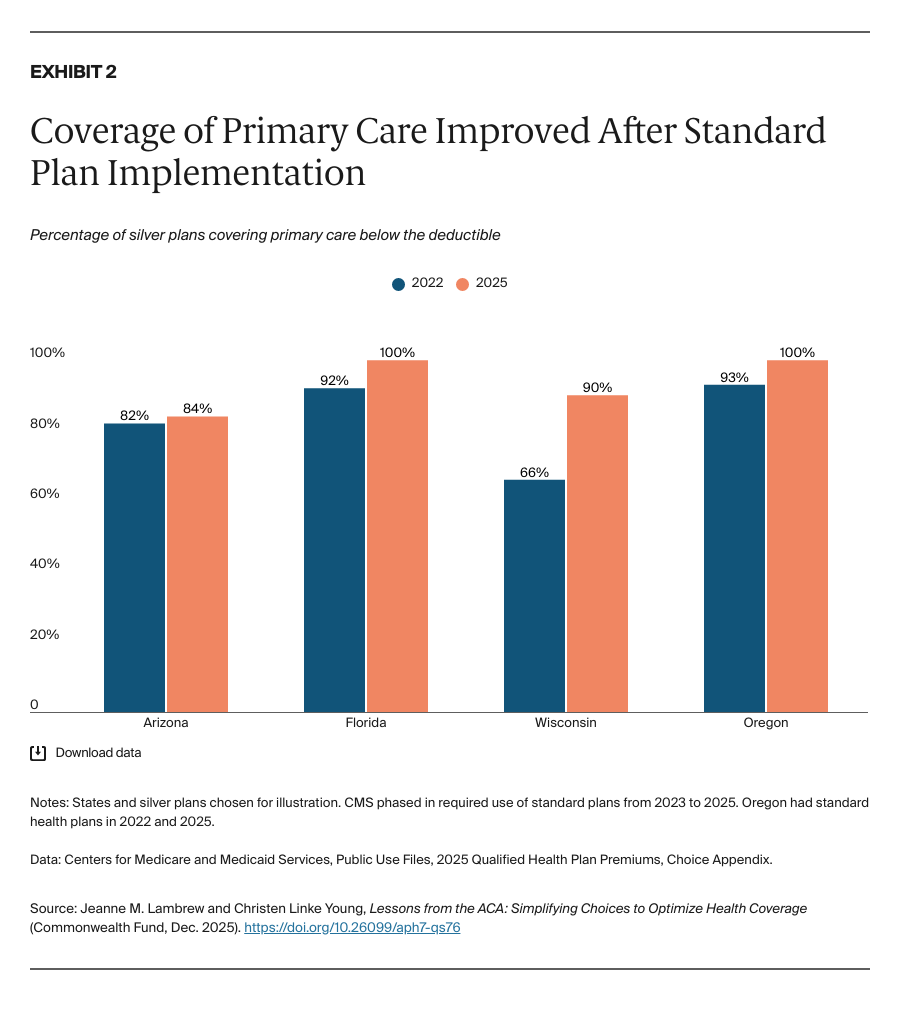
During the ACA’s implementation, other variations in health plan design, marketing, and retention practices were permitted. In response to criticism that limiting this variation would reduce the number of plan choices, the federal government took a gradual approach to standardizing cost-sharing design in the federal marketplace, piloting voluntary arrangements in 2016 and not requiring standardized offerings nationwide until 2023. After implementation, the experience of certain states suggests that concerns about fewer choices were not realized, while coverage of primary care below the deductible increased (Exhibits 1 and 2).12 Some state-based marketplaces have also limited the number of plan offerings in the interest of providing enrollees with meaningful differences in plan choices.13
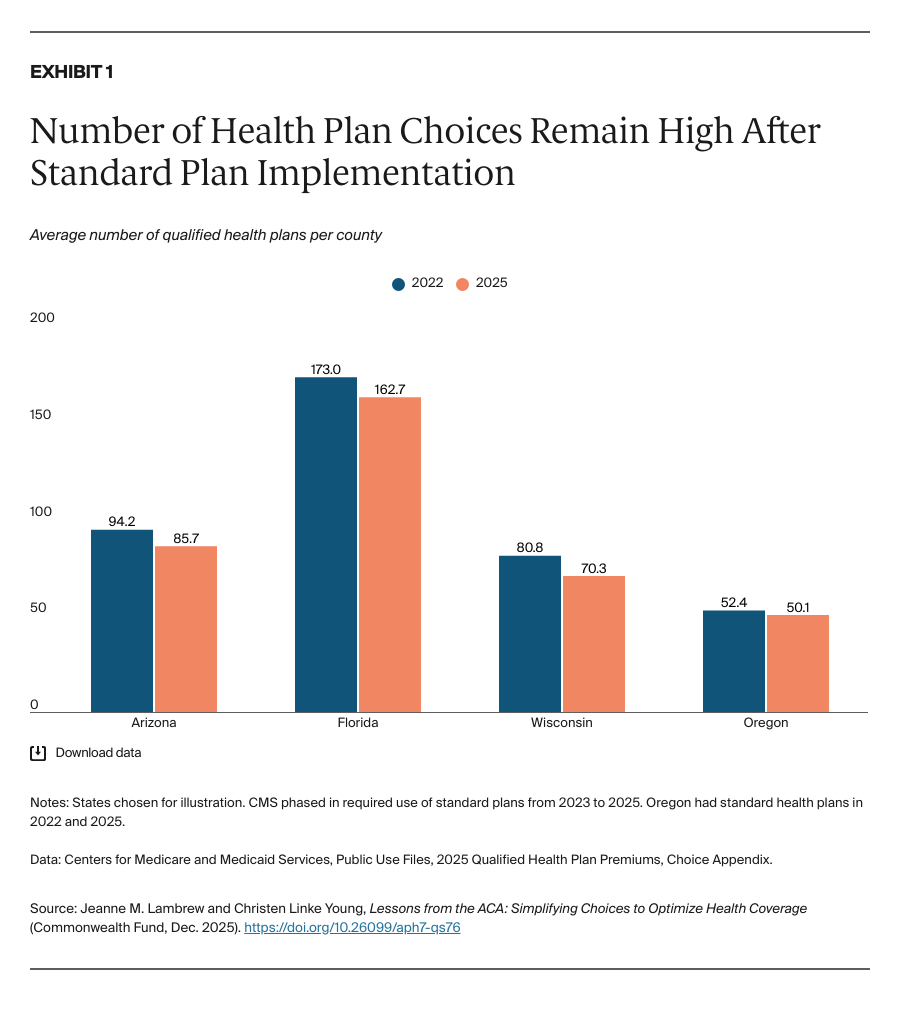
Number of Health Plan Choices Remain High After Standard Plan Implementation
Coverage of Primary Care Improved After Standard Plan Implementation

Meanwhile, there has been limited federal oversight of plan marketing in the marketplace, including the use of agents and brokers who enroll about half of all marketplace enrollees.14 Essential health benefits — 10 categories of services (such as hospitalization and prescription drugs) that nongroup and small-group plans must cover under the ACA — remain benchmarks open for plan specification by states, rather than a specific list of covered services, as is used in Medicare.15

Further, the first Trump administration implemented a number of administrative changes that expanded less regulated choices and made it harder for people to compare their coverage options.16 These included:

  • Promoting association health plans and short-term, limited-duration insurance, two options that typically provide less comprehensive coverage.17
  • Undermining consumer support by reducing funding for navigators by 40 percent and advertisements that directed consumers to official enrollment channels, relying instead on insurer-paid agents and brokers.
  • Allowing greater state flexibility on essential health benefits and cost-sharing standards.

The Biden administration reversed virtually all these changes.18 However, the second Trump administration has already revived some of these policies, such as reducing navigator funding by 90 percent.19 The budget reconciliation legislation (P.L. 119-21), signed on July 4, 2025, also alters the structure of choosing marketplace health plans by requiring annual reenrollment rather than automatic reenrollment for those who want to keep their plans, among other changes.20 And the administration stated that it will not enforce a 2024 rule applying ACA standards to short-term, limited-duration plans.21

Cost of Complexity

In recent years, health coverage in the United States has hit record highs, and access to health care has improved.22 However, satisfaction and frustration with plans is high. People think the health system is too complex, with one-third reporting they do not understand what costs their plan covers or what costs they will owe.23

In fact, the complexity of health plan choices adds to the overall cost of health care. Rather than competing for enrollees based on the price of their coverage, insurer “flexibility” in plan design creates an opportunity for them to profit by offering coverage and cost sharing that attracts healthy, low-cost individuals (such as low copayments for primary care) and discourages enrollment of people with significant health needs and costs (such as a separate high deductible for prescription drugs). Profiting from risk selection decreases insurers’ motivation to compete on price and quality, as can be seen when comparing prices between marketplace plans and the less regulated small-group plans.24 Research has found that competition in the health insurance marketplaces can reduce prices, with that effect greater in states with more standardized cost-sharing design for their plans.25

The proliferation of complexity and choices also adds administrative costs. Without plan standardization and decision support that includes in-person assistance, consumers are more likely to require help from paid agents and brokers. Research has found that insurers pay higher broker commissions for high-premium plans and for plans not regulated by the ACA, which tend to be more profitable and offer consumers less value than other plans.26 Additionally, the risk of making economically irrational decisions when faced with a complex set of choices increases when there are few standards for marketing.27

Simplifying Choice to Improve Satisfaction and Competition

Experience with the ACA suggests ways to structure health plan choices for optimal outcomes. The first step could be to reinstate standards for plan design and support for plan selection that were removed in 2025.

Applying ACA standards to all health plans. Bringing all types of health plans, including employer-sponsored insurance, under the same ACA standards would likely improve both consumer understanding and satisfaction with plan choices and competition.28 Doing so would help end regulatory loopholes, such as the definitions of grandfathered plans and short-term, limited duration plans, which allow unregulated plans to proliferate.

Tightening standards for benefits and cost sharing, allowing only meaningful differences. States that have fully standardized their benefit designs have higher marketplace enrollment and consumer satisfaction than states that have not done so.29 Congress and regulators at the state and federal levels could consistently and clearly define covered benefits, copayments and deductibles, and allowable differences in health plans offered by a single issuer, permitting variation only when it is meaningful.30

Reshaping the role of agents and brokers for the marketplaces and increasing consumer-centric marketing. Agents and brokers help many marketplace consumers enroll, but disparate agent and broker commissions for different insurance products can distort consumer choices. Further, unscrupulous brokers can take advantage of consumers and promote non-ACA-compliant products that are not in a consumer’s best interest but result in higher commissions.31 More comprehensive regulation of issuer compensation to agents and brokers — and tighter oversight of agents and brokers themselves — could address these concerns. There is also a critical need for robust, marketplace-funded enrollment, outreach, and marketing, which can have a compelling impact on enrollment.32 As a complement, policymakers could ensure adequate support for call centers and navigators, as some enrollees require in-person assistance.33

Changes That Would Likely Create Greater Complexity and Cost

Recent regulatory and legislative proposals could further complicate health choices, undermining consumer protections and competition. These include:

Authorizing alternative types of plans. Congressional Republicans are contemplating legislation that would effectively allow some businesses and self-employed individuals to enroll in association health plans, which are subject to weaker regulations.34 This could lead to gap-ridden coverage for those in association health plans — and higher prices for enrollees in businesses left behind.35

Weakening standards on benefits and cost sharing. The first Trump administration rolled back regulations that advanced standardized benefits and cost sharing.36 The second Trump administration could follow suit.37 These actions would likely make it more challenging for consumers to navigate plan choices, potentially resulting in higher costs.

Allowing for unregulated marketing content and channels. The first Trump administration prioritized enrollment in the marketplace by insurance agents, brokers, and alternatives to federal and state-based marketplace platforms.38 Relying on these channels could favor private corporations, which may benefit from signing people up erroneously, misleadingly, and fraudulently.39

Conclusion

Americans value choice in health coverage.40 Their needs and preferences likely change at various points in their lives. Policymakers could honor such preferences by establishing plan standards that allow for consumer-informed distinctions while eliminating small and low-priority differences. Policymakers also could fund initiatives to help people learn about, enroll in, and change plans, rather than allow consumers’ plan choices to be driven by private corporations that may tilt plan design, marketing, and enrollment methods to their benefit.

These lessons drawn from the Affordable Care Act marketplace parallel those learned from similar markets like Medicare private plans.41 Over time, the federal government could align consumer choice protections across all types of taxpayer-funded health coverage, including the marketplaces, Medicare Advantage, Medicare drug plans, and the federal employees’ health benefit plans. This could improve plan satisfaction and affordability in the U.S. health system.

Notes

Publication Details

Date

Contact

Jeanne M. Lambrew, Director of Health Care Reform and Senior Fellow, Century Foundation

lambrew@tcf.org

Citation

Jeanne M. Lambrew and Christen Linke Young, Lessons from the ACA: Simplifying Choices to Optimize Health Coverage (Commonwealth Fund, Dec. 2025). https://doi.org/10.26099/aph7-qs76