States with Strong Standards Continue Their Efforts
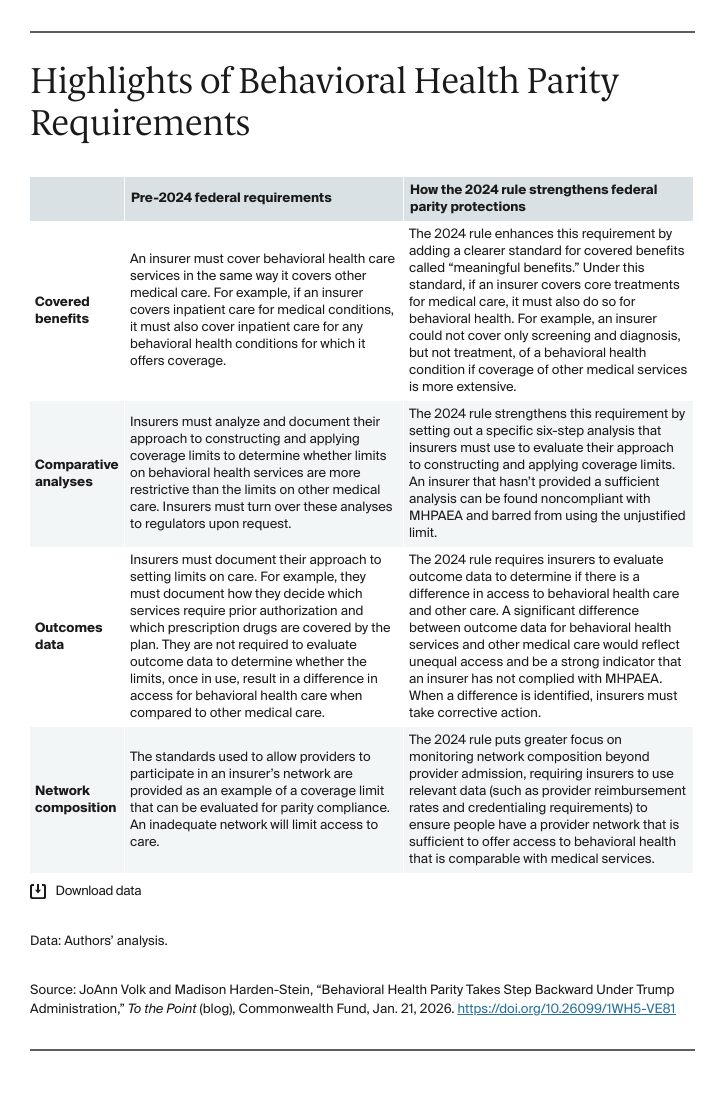
Many states have continued their parity enforcement efforts since the federal announcement, drawing on a range of oversight tools that include using outcome data to assess compliance. One strong indicator of unequal access to services is a difference in outcome data between behavioral health and other care. This could include, for instance, data that show a higher number of denied claims and greater use of out-of-network providers for behavioral health services than for other medical care. The 2024 rule gives significant weight to outcome data, but some states already had similar requirements to guide oversight and enforcement. Those efforts continue, despite the federal pause. West Virginia issued a request for insurers to report data such as number of denied claims and the outcome of prior authorization requests. Oregon issued its fourth annual parity report, noting disparities in claims denials, provider reimbursement, and documentation required for prior authorization and utilization review of behavioral health services. Georgia took enforcement action against insurers based on outcome data regularly collected under state law.
Some States Have Incorporated the Contested Federal Rule in State Law or Have Established Stricter Standards
A few states have adopted the 2024 federal rule into state law. For example, Washington enacted legislation that requires insurers to comply with the federal rule as published in 2024. This approach anchors state law to a strong set of parity protections (the 2024 version of the federal rule) that will remain in place even if the federal rule itself is subsequently weakened or rescinded. Colorado similarly leveraged the 2024 federal rule to add state protections through legislation.
Other states are developing their own parity requirements independent of the 2024 federal rule. Maryland, for example, has adopted stricter standards regarding insurers’ analyses of their behavioral health coverage limits. Under the Maryland rule, an insurer’s failure to submit a complete analysis constitutes a parity violation, authorizing the Commissioner to take enforcement action against the insurer. This is a stronger response than would be required under the federal rule.
Federal Retreat on Parity Puts Some States in Limbo
In response to the administration’s decision to stop enforcing the 2024 rule, some states are stopping work on strengthening their own parity standards. For example, Arizona had begun updating its parity standards to reflect the 2024 federal rule, but policymakers there decided to put those efforts on hold until the legal challenge is resolved or the rule is rewritten. This hesitancy reflects a trend among states that are wary of moving forward without federal support.
Indeed, federal pullback appears to have emboldened opponents of stricter coverage standards. In November 2025, an insurer trade association sued California, seeking to invalidate state regulations that incorporate the 2024 rule. The industry group’s legal complaint makes much of the federal nonenforcement announcement and takes California to task for declining to follow the administration’s lead.
Looking Forward
Access to behavioral health services is a persistent problem. People are far more likely to use out-of-network behavioral health care than they use other out-of-network care. Federal regulators have reported some improvement in health plans’ compliance efforts, but noncompliance remains widespread. The Trump administration’s failure to defend or enforce the 2024 rule undermines the progress made in federal enforcement efforts and has thwarted some states’ plans to move forward.