




Advanced Search

Advanced Search

Current Filters

Filter your query

Publication Types

Other

to

Blog

/

States Are Using Creative Strategies to Help Older Adults and Individuals with Disabilities Live Independently

Woman sits at kitchen table looking out the window

Diane Shields, 77, sits at her kitchen table and looks out the window in Fort Worth, Texas, on March 20, 2026. Despite significant progress in helping people remain in their homes and communities, home and community-based service programs continue to face vulnerabilities. Photo: Angela Piazza/Dallas Morning News via Getty Images

Diane Shields, 77, sits at her kitchen table and looks out the window in Fort Worth, Texas, on March 20, 2026. Despite significant progress in helping people remain in their homes and communities, home and community-based service programs continue to face vulnerabilities. Photo: Angela Piazza/Dallas Morning News via Getty Images

Authors
Authors
Toplines
  • Despite significant progress in helping people remain in their homes and communities, home and community-based services (HCBS) continue to face vulnerabilities

  • State Medicaid programs can safeguard HCBS access by leveraging state plan benefits and adopting proven strategies from other states — protecting approximately 8.4 million individuals across the U.S.

Downloads

Medicaid is the largest payer of long-term services and supports (LTSS), which includes care in nursing facilities and for home and community-based services (HCBS) like adult day programs and home health aides. While care in institutional settings is a mandatory Medicaid benefit, coverage of HCBS is most commonly offered through mechanisms that are optional for states. Specifically, section 1915(c) waivers allow states to waive certain Medicaid requirements to offer HCBS to targeted populations as an alternative to institutional care and are the primary mechanism through which HCBS are delivered in Medicaid. Most HCBS are offered through these or other types of waivers rather than required through a Medicaid State Plan.

Over the past four decades, states have made intentional efforts to rebalance or shift LTSS away from institutions and toward HCBS, which is the preferred setting for care for most eligible individuals. The Centers for Medicare and Medicaid Services reports that 9.7 million people nationwide rely on Medicaid‑funded LTSS, the vast majority (87%, or 8.4 million people) of whom received HCBS. In 1981, HCBS accounted for just 1 percent of all national Medicaid LTSS spending. By 2023 that share had grown to nearly 64 percent. This transformation reflects a sustained commitment to person-centered care and the use of creative policy tools — particularly section 1915(c) waivers — to meet the needs of diverse populations, from older adults and people with physical disabilities to individuals with autism, brain injuries, and HIV/AIDS.

Landscape Analysis of HCBS Waivers

NORC at the University of Chicago conducted a comprehensive review of the national HCBS waiver landscape, analyzing 262 active section 1915(c) waivers across 46 states and the District of Columbia with the goal of identifying how these services vary across states and populations. In addition, NORC conducted case studies of Colorado and Florida, which have taken different paths but have both been successful in expanding access to HCBS. We explored states’ successes in increasing access to HCBS and sought to uncover disparities in access — particularly in rural areas — and highlight populations that may be excluded or underserved.
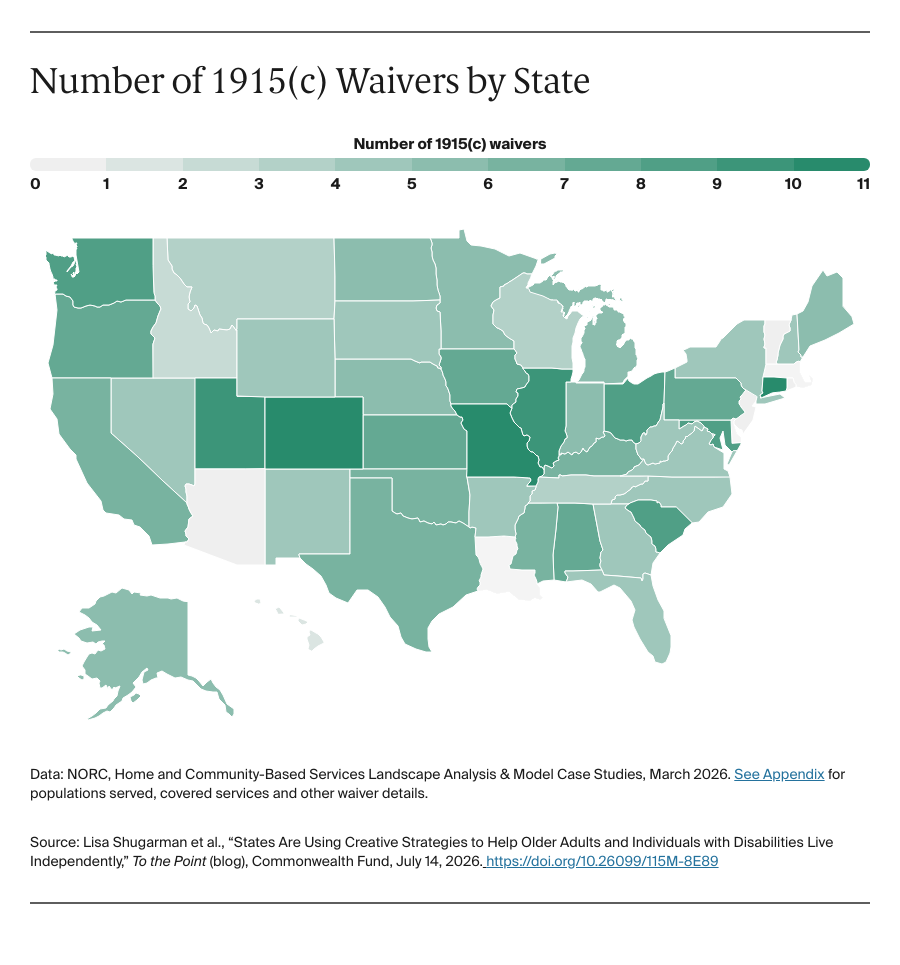
Map: Number of 1915(c) Waivers by State

This analysis revealed several important trends:

  • Broad adoption and diversity. Nearly all states use HCBS waivers, tailoring services to specific populations and geographies. These waivers have enabled states to innovate — expanding access, supporting caregivers, and introducing specialized services like assistive technology and home modifications.
  • Service variation. While most waivers cover core services like home-based care, caregiver support, and technical modifications, a smaller subset includes specialized supports. These specialized services are most commonly available in Medicaid waivers that serve people with intellectual or developmental disabilities for whom skill development, employment supports, and community integration are critical.
  • Access challenges. Despite significant progress, access remains uneven across and within states. For example, rural areas face greater service gaps, and approximately 600,000 individuals are on HCBS waitlists nationwide due to enrollment caps and provider shortages.
  • State innovations. States like Colorado and Florida have implemented creative strategies to expand HCBS access and improve equity. For example, Colorado invested over half a billion dollars of American Rescue Plan Act funds to strengthen HCBS, creating trainings for consumers, caregivers, and providers, increasing wages for the direct care workforce, and making resources culturally responsive to the language needs of participants. Florida initiated a significant managed care redesign, expanding benefits covered under managed care as part of its State Medicaid Managed Care initiative. These findings underscore the complexity and flexibility of HCBS waiver programs, highlighting both the successes in rebalancing LTSS and the persistent challenges that require ongoing policy attention.

Vulnerability of HCBS in Times of Fiscal Pressure

Despite significant progress in helping people remain in their homes and communities, HCBS programs continue to face vulnerabilities. In times of fiscal stress, states can and historically have reduced eligibility, capped enrollment, or cut services. The passage of H.R. 1 in 2025 — a sweeping budget reconciliation law — heightens these risks by introducing new federal funding constraints and administrative requirements, which will lead to coverage losses. With states facing tighter budgets, optional benefits like HCBS waivers may be more vulnerable to program modifications that impact access to these benefits such as caps on coverage, increases in the size of waitlists, or reductions in provider reimbursements.

What States Can Do Now

To safeguard access and equity, states can take proactive steps:

  • Leverage optional state plan benefits. Other Medicaid authorities [e.g., sections 1915(i), 1915(j), and 1915(k)] allow states to build HCBS directly into their Medicaid State Plans as core programs rather than relying solely on waivers, which can make these services more stable and less vulnerable to cuts.
  • Learn from successful models. States can look to peers — such as Colorado’s ARPA-funded initiatives and Florida’s managed care redesign — for strategies to expand access, improve provider capacity, and address disparities in care delivery.
  • Invest in infrastructure and workforce. Sustaining HCBS will require states to strengthen provider networks — especially in rural areas — through targeted reimbursement increases, workforce training and recruitment, and expanded supports for family caregivers, including respite, training, and financial assistance.
  • Engage stakeholders and plan ahead. States should communicate consistently with beneficiaries, providers, and advocates about how H.R. 1 may affect Medicaid and what changes stakeholders can expect in the coming months. Communications should include clear timelines, guidance, and opportunities for input, which can help minimize disruption and maintain trust.

The future of HCBS depends on continued federal–state collaboration and a shared commitment to person-centered care. By adopting proven strategies and strengthening policy safeguards, states can ensure that older adults and individuals with disabilities have the support they need to live independently in their communities, even in challenging fiscal environments.

Publication Details

Date

Contact

Lisa Shugarman, Senior Fellow, NORC at the University of Chicago

shugarman-lisa@norc.org

Citation

Lisa Shugarman et al., “States Are Using Creative Strategies to Help Older Adults and Individuals with Disabilities Live Independently,” To the Point (blog), Commonwealth Fund, July 15, 2026. https://doi.org/10.26099/115M-8E89