Abstract
- Issue: Many states have enacted medical debt protections, including financial assistance requirements for hospitals and limits on aggressive collections. However, gaps in standards, procedural burdens, and inadequate enforcement are limiting the effectiveness of these measures.
- Goals: To identify where current state medical debt laws fall short and how states can fill gaps and build on their recent reforms.
- Methods: We reviewed state laws governing financial assistance, billing and collections, and medical debt lawsuits to identify gaps in standards, practice, and enforcement.
- Key Findings: Many hospital financial assistance requirements exclude underinsured patients, immigrants, and people just above narrow income thresholds. States’ medical debt protections broadly exclude debt owed to nonhospital providers or medical credit card balances. Complex application processes for financial assistance, weak guardrails protecting consumers from collections, and burdensome court procedures all limit consumers’ access to medical debt protections in practice. Inadequate data reporting and enforcement further constrain regulators’ ability to ensure compliance.
- Conclusion: States can make medical debt protections more effective by broadening their eligibility and scope, reducing administrative barriers, and strengthening oversight and enforcement.
Introduction
Over the past five years, a growing number of states have enacted laws to reduce the financial harm from medical debt, which affects an estimated three in 10 U.S. adults. For example, 14 states fully prohibit medical debt from appearing on consumer credit reports, and 23 states prohibit health care providers and other medical creditors from garnishing wages or foreclosing on a patient’s home to collect on unpaid medical bills. Twenty states and the District of Columbia (counted together as 21 states in this brief) have gone a step further, preventing certain patients from incurring medical debt in the first place, by requiring hospitals to make free or discounted care (referred to collectively in this brief as “financial assistance”) available to eligible patients.
However, gaps in these protections remain — despite the good intentions of state laws — that leave patients unprotected and providers unaccountable. We reviewed state laws pertaining to financial assistance, billing and collections, and oversight and enforcement and identified gaps in patient protections. While some states have stronger protections than others, no single state fully addresses all these challenges. This brief organizes these gaps into three categories:
- Substantive gaps in state laws governing financial assistance and hospital billing processes.
- Procedural gaps that can cause patients to lose access to protections because of the complexity and opacity of health care billing systems.
- Enforcement and oversight gaps that can make legal protections illusory.
By understanding where these gaps exist, states can build on the recent progress they’ve made to more fully protect patients.
Key Medical Debt Protections
Financial assistance standards mandate or incentivize hospitals to provide free or discounted care to certain populations. Twenty-one states set minimum standards regarding who is eligible for financial assistance, the amount of assistance patients are eligible for, or how to apply for assistance.
Billing and collections standards establish guardrails to protect patients with unpaid medical bills from being pursued by debt collectors, having their consumer credit reports ruined, or suffering other financial harm. These standards may require hospitals to:
- offer a payment plan (12 states)
- limit the interest hospitals can charge on medical debt (18 states)
- require hospitals to screen patients for financial assistance or public insurance eligibility before advancing an unpaid bill to collections (eight states)
- prohibit reporting medical debt to credit reporting agencies (14 states).
Lawsuit-related protections limit when creditors can sue to collect on medical debt and what assets they can seize through the legal process. Twenty-three states prohibit creditors, such as hospitals or debt collectors, from garnishing wages, placing liens on homes, or foreclosing on homes to collect medical debt.
For more details on existing state medical debt protections, see this report and interactive map.
Key Findings
Substantive Gaps in Current State Medical Debt Laws Leave Many Unprotected
Gaps in financial assistance eligibility. Relatively few states have laws requiring hospitals to provide financial assistance. Federal law sets a limited floor, mandating only that nonprofit hospitals maintain a financial assistance policy, without specifying standards for what the policy must include. Only 21 states have established minimum standards for eligibility and for the amount of assistance both non- and for-profit hospitals must offer.
Even in these 21 states, eligibility requirements vary substantially and can leave out several patient populations.
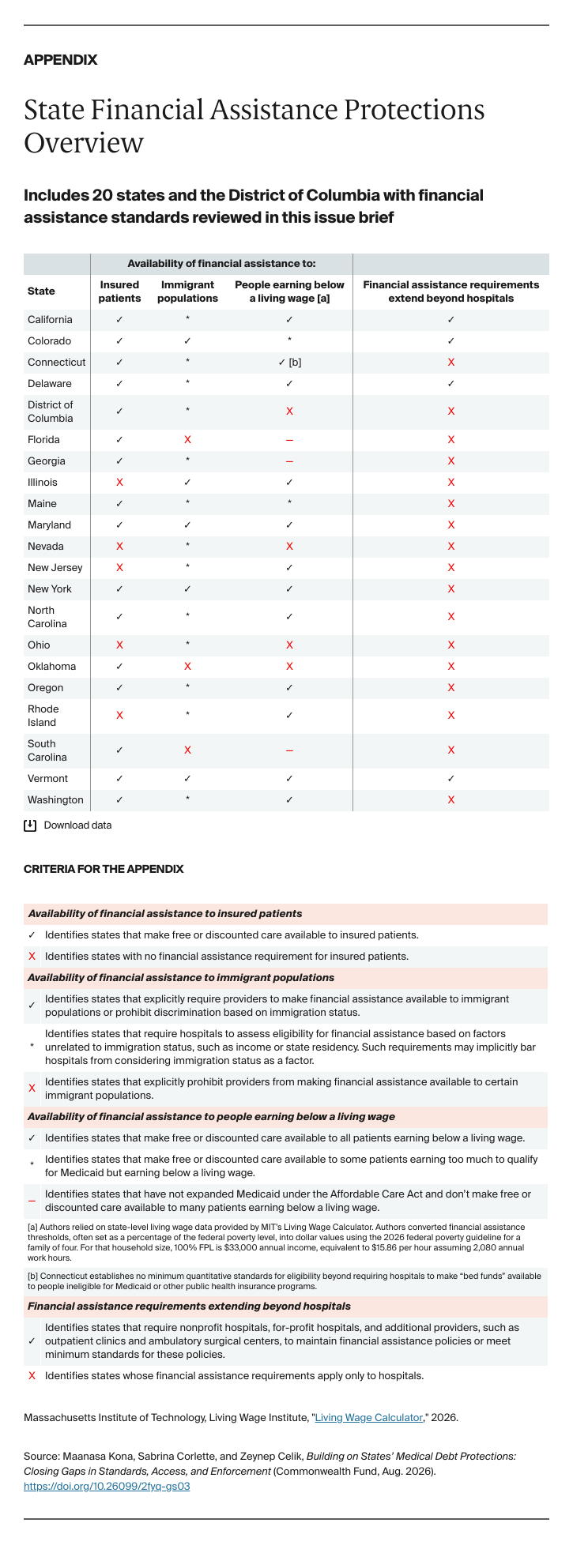
Underinsured patients. Many patients with health coverage are underinsured, meaning they still struggle to pay medical bills because of high deductibles, copayments, or coinsurance. Of the 21 states with financial assistance standards, five limit those protections solely to uninsured patients. That means many underinsured patients don’t have access to this financial help.
Immigrants. Immigrants without legal status are ineligible for public insurance programs and marketplace coverage, which can leave them particularly vulnerable to medical debt. Of the 21 states with financial assistance standards, only five prohibit hospitals from discriminating against immigrants when making financial assistance determinations. Three states exclude undocumented immigrants from accessing this help.
In the remaining 13 states that do not explicitly protect immigrant patients, access depends on how individual hospitals interpret their obligations and what documentation they require from applicants. Immigrants might be disincentivized from seeking financial assistance if hospitals include questions about immigration status in their applications.
People earning below a living wage. Many families earn just enough to disqualify them from Medicaid but still earn less than a living wage — the minimum income needed to cover basic family expenses without outside assistance. Typically, they live paycheck to paycheck. Even when these families have health insurance, it often comes with significant cost-sharing obligations, which can expose them to medical debt. Of the 21 states with established financial assistance standards, only 12 set income eligibility thresholds that ensure patients earning less than a living wage can access financial assistance.
Other gaps. Patients can also lose access to financial assistance or protections related to billing, collections, or lawsuits depending on the kind of debt they owe and on the creditor.
Provider exclusions. Hospital bills can be large and are a major source of medical debt, but they are not the only source. Still, many state financial assistance requirements and billing-related protections apply only to medical bills owed to hospitals. Relatively few states extend protections to bills from affiliated outpatient facilities or hospital-based clinicians who bill independently, such as anesthesiologists. Further, most state medical debt protections don’t apply to outstanding medical bills owed to other nonhospital providers, such as ambulance services and physician and dental offices.
Delaware and Colorado are examples of states that have broadened the reach of their medical debt protections. Delaware applies its protections to a wider array of providers, such as nursing homes and freestanding surgical centers. Colorado extends protections to bills incurred at outpatient health care facilities and bills from licensed professionals who bill independently from the hospital.
Credit card debt. Most state medical debt protections apply only when a patient owes the debt directly to a hospital. The moment a patient converts this medical debt into consumer debt by using a credit card or an alternative financing product, the patient forfeits most state medical debt protections. Patients may then face high interest rates that can cause debt to snowball. This is a particular concern with medical credit cards, as one in four patients with overdue medical bills uses one.
Recognizing this problem, Illinois, New York, and a few other states now prohibit creditors from reporting any medical credit card debt to credit reporting agencies. While these policies offer some protection, they don’t apply to medical debt owed through general-purpose credit cards. They also leave patients who owe debt via medical credit cards largely unprotected against high interest rates or aggressive collection actions.
See the appendix for more detail on these substantive gaps.
Procedural Hurdles Make Medical Debt Protections Inaccessible for Many
Even when statutory medical debt protections are on the books, patients may face procedural hurdles that, in practice, block them from accessing financial assistance, billing-related protections, or lawsuit-related protections.
Burdensome applications and limited ability to dispute denials. In some states where financial assistance is available, many eligible patients never receive it, and some don’t even know such help exists. Those who know about assistance and apply for it often face burdensome application requirements, language barriers, document requests, repeated follow-up demands, or denials they don’t understand.
States have several options for making these processes easier for patients to navigate, including screening people for presumptive eligibility before billing or collections begin. For example, Oregon requires hospitals to accept proof of a patient’s enrollment in other state-operated income-based programs as evidence of eligibility for financial assistance, relieving the patient from what can be an onerous application process.
In addition, patients are not always given the right to appeal adverse financial assistance decisions. Only nine of the 21 states that require hospitals to make financial assistance available also create a pathway for patients to appeal denials.
Difficulty preventing a bill from being sent to collections. The federal government and most states (35) don’t regulate when and how a hospital can send a bill to collections. Some states have created safeguards that slow down a hospital’s ability to assign a bill to collections by setting conditions hospitals must meet first. For example, New Mexico and some other states require hospitals to first screen patients for financial assistance and public insurance eligibility. Other states, such as North Carolina, prohibit hospitals from sending a bill to collections while an insurance or financial assistance decision is pending. Safeguards such as these can help ensure that patients receive all rights and benefits for which they are eligible.
Legal processes favor well-resourced creditors over patients. Most states don’t require hospitals or debt collectors to screen patients for financial assistance eligibility before initiating legal action. Court processes favor creditors with access to legal resources over patients, who frequently fail to appear in court, often because they cannot afford an attorney or take time off from work. The result is often a default judgment, with the court finding for the creditor and the patient facing potentially catastrophic outcomes such as wage garnishment, a lien on their home, or even foreclosure.
In states that have banned actions such as wage garnishment, the burden might be on the patient to demonstrate they are entitled to protections. Many patients, however, are unaware of this, or they are unable to take action because of a default judgment.
States could instead require the creditor to demonstrate that a patient is ineligible for protections. One Tennessee county has piloted a program that allows patients to initiate a virtual dispute resolution process directly with hospital staff, rather than requiring them to defend themselves in court.
Enforcement and Oversight Gaps Can Make Protections Ineffective in Practice
State protections are only as strong as the systems used to monitor compliance and remedy violations. Current state systems for enforcement and oversight of medical debt protections remain underdeveloped.
Gaps in data collection and public reporting. Many states collect little or no information that would allow regulators or the public to assess whether hospitals are complying with financial assistance standards or restrictions on collections practices. Nineteen states collect no data from hospitals relevant to financial assistance or billing- and lawsuit-related actions. Fourteen states collect only basic financial data, such as total charity care provided or bad debt incurred by a hospital. The lack of data in most states makes it difficult to know whether hospitals are complying with state medical debt protections or whether reforms are having their intended effect.
Maryland stands out as a state that has made notable advances in data collection and public reporting related to medical debt protections. The state publicly reports hospital-level data on financial assistance and collections actions, including some demographic information. However, such public reporting systems are rare.
Ineffective penalties for violations. Even when a hospital or debt collector violates a state medical debt protection, they may face only limited consequences. Some states tie compliance with financial assistance rules to licensure or funding, and a subset authorizes monetary penalties. However, it is unclear whether the penalty amounts states have set are significant enough to encourage hospitals, particularly those that are part of large health systems, to comply with the law.
Conversely, if a penalty is too severe, such as revocation of licensure, regulators may be unlikely to use it. Understanding states’ experience with penalty structures will be critical to finding the right incentives for compliance.
One underused enforcement option is a private right of action, which allows patients to directly sue hospitals or debt collectors for violations. Federal requirements for hospital financial assistance don’t give patients a private right of action, and only a handful of states, including Delaware and New Mexico, have done so. Given finite public enforcement resources, offering a private right of action to patients — who are usually the first to notice a potential violation — can improve compliance.
Unregulated use of artificial intelligence and predictive analytics in billing and collections processes. Hospitals and their contractors are increasingly incorporating automated tools in billing, eligibility screening, collections, and broader hospital revenue cycle management. These systems can influence which patients are flagged for charity care screening, how aggressively individual accounts are pursued, when disputes are escalated for review, and which patients are routed to medical financing products. Neither state medical debt laws nor laws regulating hospitals or debt collectors currently require disclosure, validation, or oversight of these tools. Even when a state regulates billing and collections processes, lack of oversight over the automated systems that underpin these processes can create a regulatory blind spot.
Discussion
Recent federal policy changes are making Medicaid and marketplace coverage less accessible, less comprehensive, and less affordable. Given this reality, medical debt protections serve as an important financial safety net.
Well-designed medical debt laws can help patients weather coverage gaps and avoid negative financial consequences. In recent years, state policymakers have made meaningful progress in passing such laws. States can strengthen them by broadening eligibility for financial assistance and extending medical debt protections to more categories of medical debt. Pairing these expansions with lighter procedural burdens and stronger enforcement will help ensure that protections on paper translate into protections in practice.