
Advanced Search

Advanced Search

Current Filters

Filter your query

Publication Types

Other

to

Toplines
  • To preserve their independence and gain a seat at the table in a marketplace where health plans and health systems are rapidly consolidating, small rural hospitals are forging networks that match the scale of larger entities

  • Rural hospitals that joined networks in Minnesota, North Dakota, and Ohio are expanding health care access and changing how payers recognize and reward rural providers for delivering high-quality care

Authors

In North Dakota, references to the Rough Riders — a famed cavalry in the 1898 Spanish-American War — abound. The name graces hotels, grocery stores, and golf tournaments and has become a shorthand symbol of rugged individualism, bravery, and the willingness to act. A mix of cowboys, ranchers, Native Americans, and athletes from Ivy League schools, the Rough Riders burnished their reputation by volunteering to take on a heavily defended enemy and winning. Their improbable victory marked a turning point in the war and captured the public’s imagination to such an extent that it catapulted one of the regiment’s leaders — Theodore Roosevelt, a North Dakota rancher — into the White House.

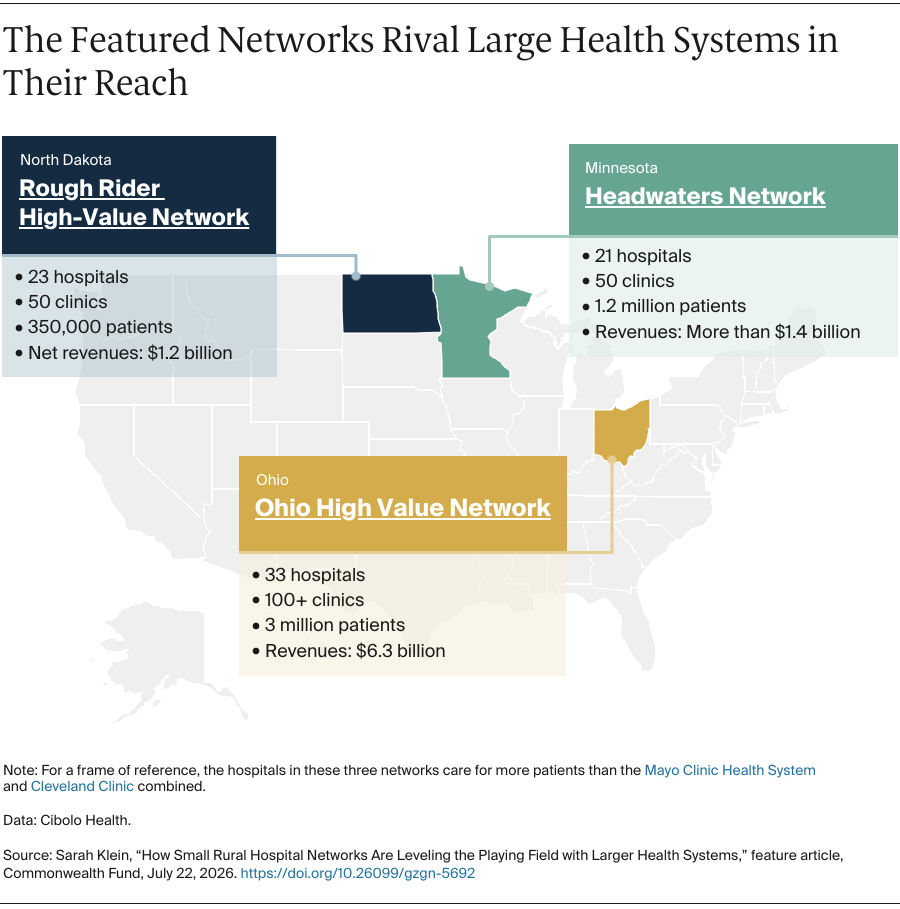
A century later, the Rough Rider High-Value Network is echoing its namesake’s heroics by demonstrating to rural communities and hospital leaders that they may be underestimating their strengths. The network was formed in late 2023 when the CEOs of 23 critical access hospitals — many in sparsely populated frontier towns — came together to brainstorm ways of maintaining local control as hospitals around them were acquired by regional health systems. To preserve their independence in a marketplace dominated by rapidly consolidating health plans and health systems, they figured they needed to match these entities’ scale. Otherwise, they feared they’d have to cede more ground — and a greater share of health care resources — to them.

The problem was not simply that independent rural hospitals were paying more for supplies than large health systems while earning significantly less from commercial insurers, per national data. These hospitals also lacked experience in the value-based payment arrangements that were allowing their competitors to control health care budgets in much the same way a health plan would. If they didn’t develop the capacity to take on financial risk and assume greater responsibility for managing the cost and quality of care, they figured they’d be taking orders from large health systems that did.

North Dakota’s lawmakers, keen to help the 23 hospitals make the transition to value-based payment, gave them $3.5 million to launch the network. The hospitals used the money to invest in tools for benchmarking their clinical and financial performance. Then they turned to negotiating better deals with health plans and vendors. News that a coalition of some of the smallest, most remote hospitals in the United States were not just getting meetings with national health plan executives but also securing more favorable deals and saving as much as 20 percent on the cost of supplies spread quickly. The leaders of more than 200 rural hospitals in 10 other states soon followed suit by creating their own networks. Many care for such a significant share of their state’s population that they match the largest of health systems, giving some small rural hospitals a level of visibility with policymakers and health plans they never had before.
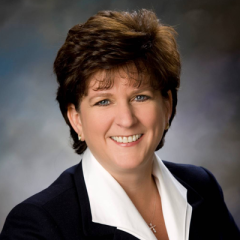
Winona Health president and CEO Rachelle Schultz, EdD

“For the first time, we have a seat at the table and we’re not on the menu,” says Alfred Sams, the former president and CEO of two critical access hospitals in North Dakota. Sams, who now serves as president of the Rough Rider High-Value Network, says they command attention because the network’s hospitals and health clinics care for 70 percent of North Dakota’s rural patients and close to half of all patients statewide.

This issue of Transforming Care looks at how hospitals that joined networks in Minnesota, North Dakota, and Ohio plan to expand rural health care access and change how payers recognize and reward rural providers for delivering high-quality care. “We want to come forward and say, ‘For this work and for these kinds of outcomes, this is how the payment needs to be structured,’” says Rachelle Schultz, EdD, president and CEO of Winona Health in Winona, Minn. We also explore how the networks mitigate concerns that their consolidation will drive up health care costs.

Klein_rural_hospitals_transforming_care_july_2026_map

A Network of Networks

The networks in Minnesota, North Dakota, and Ohio are supported by Cibolo Health, a management company formed only a few months after the Rough Rider High-Value Network to respond to queries the network was fielding each month from hospitals in other states. Cibolo’s founder and CEO, Nathan H. White, JD, and its chief operating officer, Brittany Sachdeva, DNP, are former Sanford Health executives who grew up in small South Dakota towns that were high school rivals. Both had seen how the presence — or lack — of a rural hospital can make or break the local economy and skew health outcomes, especially in ranching and farming communities where people never really have a day off. “One of the things that makes our company unique is that we’re all rural kids,” Sachdeva says.

Cibolo Health chief operating officer Brittany Sachdeva, DNP

White and Sachdeva are aware value-based payment models, particularly ones that reward providers cutting costs, favor urban hospitals that are paid more to begin with and have ways of reducing expenses that most rural communities do not. For instance, while an urban hospital could easily replace skilled nursing care with home health services, a rural hospital in a remote area would face challenges in doing so because there are fewer agencies and their staff would have to travel longer distances to see the same number of patients.

Still, both believe rural hospitals can outperform urban ones in these arrangements because they’re largely staffed by primary care providers and run by hospital leaders with deep ties to their communities. These ties create both the means to influence patient behavior and the motivation to control costs. What’s held rural hospitals back, the two executives say, is lack of access to the costly data, analytic tools, and expertise that enable large systems to mitigate the risk of losses in value-based contracts and determine where to move resources to have the greatest impact.

Managing Concerns About Consolidation

Because White is a lawyer, he’s also aware that federal and state antitrust laws limit the extent to which independent hospitals can legally collaborate. The U.S. Department of Justice and Federal Trade Commission (FTC) had carved out an exception for independent providers to share pricing information and jointly negotiate if they met certain conditions, which were spelled out in joint guidelines. However, both agencies have since withdrawn the guidelines, saying they were overly broad. While the agencies consider a replacement, the networks are adhering to the spirit of the former guidance by requiring staff from each hospital to serve on committees that share strategies for enhancing business operations, improving quality, and better coordinating the care patients require.

Cibolo Health founder and CEO, Nathan H. White, JD

Making cost-cutting an explicit goal may protect the networks from legal challenges. One of the most significant ways to achieve cost savings is by steering patients who need specialized care to hospitals, health systems, and large academic medical centers that offer higher-quality care at lower cost. “Smaller hospitals are saying, ‘We’re going to have our patients end up where they’re going to get the best result. It doesn’t matter what the name of your health system is,’” White says.

Creating new referral pathways for high-cost procedures in orthopedics and cardiac care and less complex needs is harder than it sounds, says Brock Slabach, MPH, chief operating officer of the National Rural Health Association. Physicians, particularly those working in rural emergency departments, are looking for immediate, frictionless transfers. “These networks are going to have to develop that easy button. That may only be feasible in networks where the hospitals have aligned incentives around outcomes,” he says.

Still, if the networks succeed in making the value of care more visible to patients and clinicians, they may accomplish something that has eluded large employers and insurers alike.

An Organized Approach to Managing the Turbulence Ahead

The Minnesota, North Dakota, and Ohio networks were formed in 2023, 2024, and 2025 respectively — before H.R. 1, last year’s massive tax and spending bill, was passed. The law created more financial uncertainty for rural hospitals. It is expected to reduce Medicaid enrollment and reimbursements for rural hospitals, as states institute work requirements and other cost-containment strategies.

Many of the hospital executives that joined networks say the collaboratives are enabling them to chart a path forward during a tumultuous time. “Quite frankly, it’s 180 degrees from where we were a year ago,” says Myron Lewis, MBA, MSW, president and CEO of Blanchard Valley Health System in Findlay, Ohio, who has led the Ohio High Value Network since it was formed in 2025. His 150-bed hospital in Northwest Ohio is surrounded on four sides by cornfields and sandwiched between large health systems in Cleveland, Columbus, and Toledo — all within driving distance.

Blanchard Valley Health System president and CEO Myron Lewis, MBA, MSW 

His hospital is known as a “tweener” because it sits between large health systems, which typically fetch higher reimbursements from commercial payers, and critical access hospitals, which receive cost-based reimbursement from fee-for-service Medicare and some Medicaid plans to protect against losses. If the network’s cost and quality data show Blanchard Valley and other tweener hospitals offer comparable or better care than large health systems at lower cost, they could benefit from an influx of referrals from other network hospitals. Lewis says joining the network — which now includes 33 rural hospitals — has also helped level the playing field between small rural hospitals and large academic medical centers in important ways, including influencing the distribution of Ohio’s $202 million share of the $50 billion Rural Health Transformation Program (RHTP) fund.

Without a network, “there would have been 33 independent rural hospitals submitting proposals and competing with one another,” Lewis says. He’s confident Ohio’s larger health systems — some of which have already classified themselves as rural hospitals because they serve rural patients — would have out-lobbied them. “We wouldn’t have a voice,” he says. Instead, in its application for RHTP dollars, Ohio signaled it planned to devote half of the money to supporting collaboratives of rural providers in their efforts to improve quality and lower costs.

Rural Health Transformation Program Dollars May Boost a Range of Rural Networks

Roughly 28 states have mentioned funding clinically integrated networks or related partnership models in their applications for RHTP funds. The recipients could range from networks of federally qualified health centers or hospitals to less formal partnerships that unite behavioral health providers, public health authorities, and/or community-based organizations. How states will allocate the money (e.g., for investments in workforce, technology, or disease management) won’t be clear until they begin reporting this summer. Some states like Illinois, Texas, and Washington are turning to rural networks to prioritize investments or distribute funds, but not all states are leveraging their depth of expertise, says Linda Weiss, the executive director of the National Cooperative of Health Networks Association, which represents more than 32 networks spread across the U.S. “They’ve been doing this work for decades. Why they weren’t a required part of the process doesn’t make sense to me,” she says.

Tailoring the Metrics of Success to Rural Markets

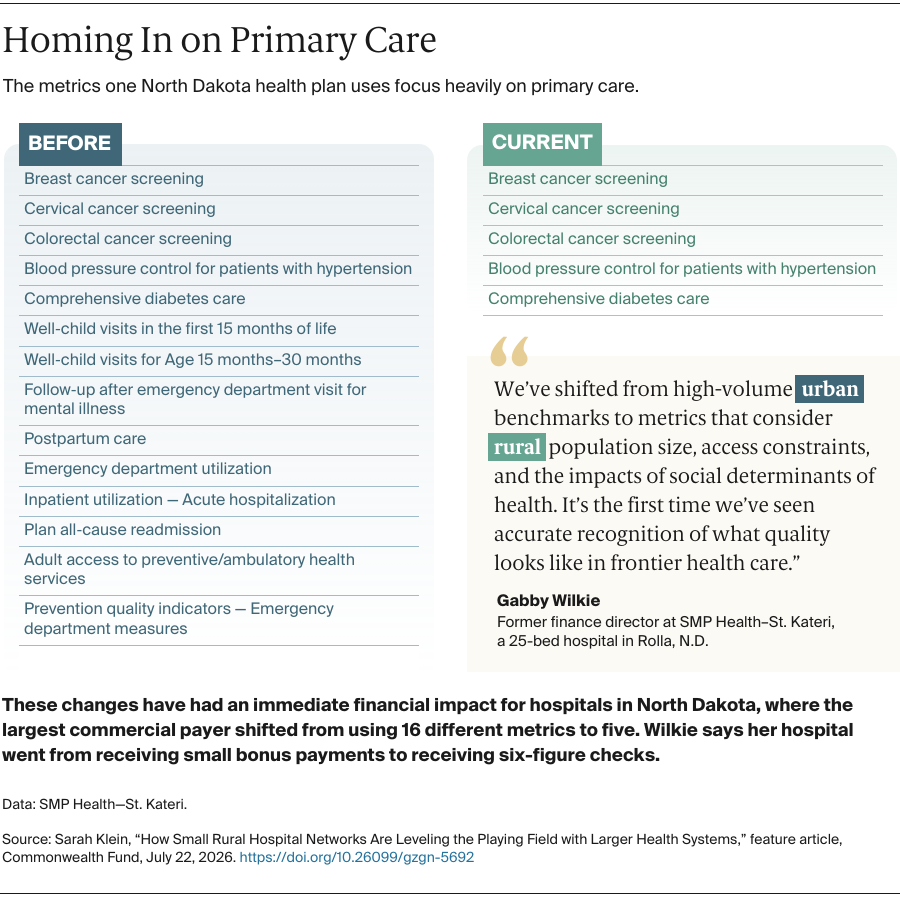
The networks have also had success modifying the ways health plans measure quality and set performance targets hospitals must achieve to receive bonus payments, so the metrics reflect key differences between rural and urban markets. Emergency department (ED) utilization is a prime example. Health plans often use this metric to incentivize health systems and providers to steer patients with less acute needs to less costly primary care offices or urgent care settings. But in small towns that have a single primary care provider and too few residents to sustain an urgent care clinic, the ED becomes the only option for care on nights and weekends.

Rural hospitals say they were also being penalized for not providing follow-up care to patients who’d been hospitalized in urban hospitals even when the urban hospitals didn’t notify them. “It was kind of setting us up for failure,” says Gabby Wilkie, DBA, the former finance director at SMP Health–St. Kateri, a 25-bed hospital in Rolla, N.D., population 1,200.

So far, the networks have persuaded a few commercial health plans, including Medicare Advantage plans, to use more primary care-focused measures. They’ve also persuaded health plans to reward rural hospitals for making incremental improvements rather than meeting a benchmark that may only be achievable when a hospital or health system is serving large numbers of patients who are younger and healthier to begin with.

Lacey Bergh, market president for Blue Cross Blue Shield of North Dakota, says rural hospital networks can be helpful in supporting the health plan’s shared goals of improving health outcomes and lowering costs while prioritizing access and keeping care close to home. But recognizing the strengths and needs of individual hospitals is still important.

Klein_rural_hospitals_transforming_care_july_2026_homing_in

Gaining Access to New Data and Insights

Many rural hospital leaders say they are equally excited about gaining access to data and analytic tools that will allow them to see — for the first time — all of the care local residents receive, even when that care is delivered by other hospitals or providers in other states. These records, which became available through the 21st Century Cures Act, are not only essential for forecasting the total cost of care, but also for identifying care gaps and determining where to direct resources to meet patients’ needs.

To create a comprehensive view of health care utilization and quantify unmet medical and social needs, population health platforms must aggregate and normalize data drawn from electronic health records, payer claims, laboratory systems, and credit card reporting agencies, among other sources. Licenses can cost $1 million or more per year per hospital, putting these systems out of reach of small hospitals and clinics. Spread across more than 200 hospitals in Cibolo-supported networks, access becomes affordable, Sachdeva says.

None of us has troves of analysts sitting in our back hallways crunching numbers for us. It’s hard enough to get the data from your payers.

Rachelle Schultz, EdD President and CEO of Winona Health in Winona, Minn.

The platform being developed for use by network hospitals will create a longitudinal record of each patient and the means by which clinicians, care managers, and financial teams can monitor quality and identify opportunities to intervene earlier to improve outcomes and reduce costs. By revealing which patients are being attributed to each hospital in value-based contracts and tracking progress toward cost and quality goals in real time, the platform will eliminate critical blind spots.

It’s already being used to identify opportunities to expand specialty care services locally. Psychiatry and behavioral health counseling are in high demand, as are rheumatology, neurology, endocrinology, and dermatology. Some network hospitals are sharing specialists to increase access to these services; others rely on a telehealth platform from a vendor they’ve jointly contracted with. The platform’s providers are credentialled at the rural hospitals, so the hospitals retain a share of the billings.

By expanding access to specialty care locally, wait times for referrals to specialists have dropped from six months or more to just 10 to 14 days, Sachdeva says. Just as important, patients are not incurring the cost of traveling long distances for care, including lost wages, lodging, and childcare.

Leveraging AI to Increase Margins and Workforce Capacity

The networks also provide a means of delivering artificial intelligence (AI) tools to rural hospitals. One AI agent embedded in the population health platform ingests payer contracts, forecasts expected reimbursement, and flags variances — enabling hospitals to identify underpayments. “We’ve noticed a lot of these rural health systems are losing out on millions of dollars in reimbursable revenue just because of the complexity of these contracts. It’s almost impossible to track it manually,” the CEO of the company says.

Cibolo Health has also partnered with a California-based startup that leverages AI to identify patients with unmet health needs based on the hospitals’ electronic medical record data. In addition to prioritizing patients for follow up, the tool can tell care coordination staff what time of the day a patient is most likely to answer the phone, what number to call, and which nickname to use. Some rural hospitals rely on the company’s centralized care team to make outbound calls to patients and encourage them to seek care; others have their own staff act on recommendations of patients to prioritize.

Wilkie says SMP Health–St. Kateri opted for a hybrid approach. She was impressed by how effectively the AI startup sizes up opportunities to make care more accessible. “There are a lot of kids in foster care in our community and some families with multiple kids, plus mom and dad. They’ll arrange for all of them to be seen at the same time, so the parents only have to take one day off of work,” Wilkie says. (In June, Wilkie joined the company as its director of business development.)

As a result of the company’s intervention, well-child visits at SMP Health–St. Kateri quadrupled, from 64 visits over 12 months to 142 in the first six months of the program. Cancer screenings and rates of hemoglobin A1c control among patients with diabetes also increased by more than 10 percentage points over six months. The additional care generated more than $100,000 in new revenue without adding labor costs for care coordination, Wilkie says.

A Network of Shared Services

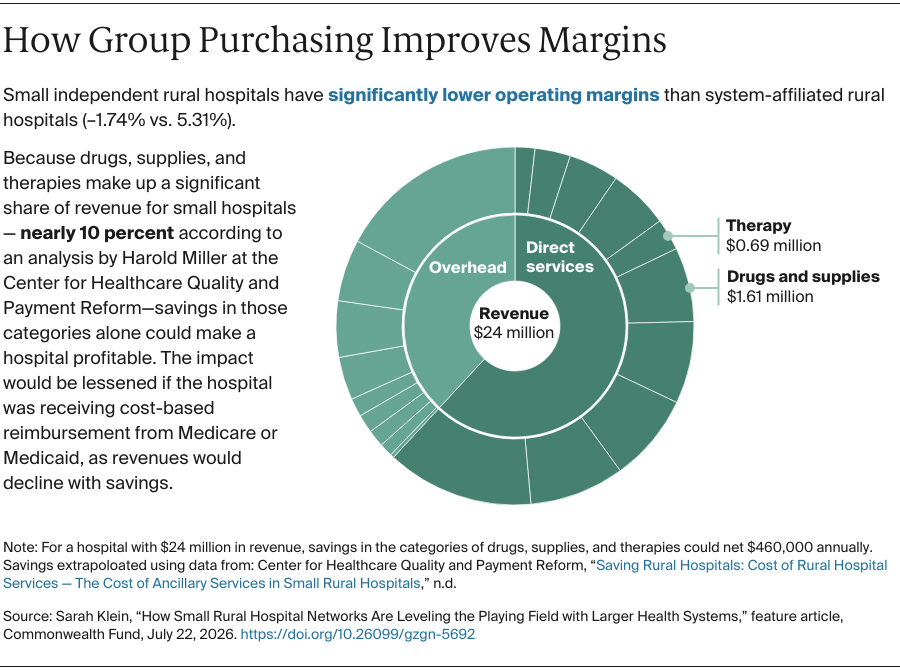
Cibolo Health staff have sought out other ways of achieving savings for hospitals without forcing new products and services on them. “We tell hospitals if you can get a better price elsewhere, take it,” Sachdeva says. Bulk purchasing has allowed hospitals to secure discounts of up to 20 percent on a wide range of goods and services, including employee health insurance, property insurance, laboratory services, pharmaceuticals, and surgical supplies. Cibolo Health has also invested in a staffing company that uses anonymized salary data to help hospitals monitor market conditions and assess whether the salaries they are offering are too high or too low.

Klein_rural_hospitals_transforming_care_july_2026_group_purchasing

Challenges and Opportunities Ahead

Across the United States, a diverse range of partnership models have enabled rural providers to design and implement solutions to shared challenges, including recruiting specialists, investing in telehealth infrastructure, creating affordable housing for staff, and lowering the price of drugs and employee benefits. Many of these collaboratives have been around for decades and show that it’s possible to impact outcomes without joint contracting.

Whether value-based payment is the best path forward for rural hospitals remains to be seen. Some network hospitals are venturing into these models for the first time and face a steep learning curve. There’s a long way to go before they’ll be ready to take responsibility for managing the total cost of care in two-sided risk contracts.

Geography also remains a formidable challenge in reducing expenses. Critical access hospitals require experienced staff who can transition between settings and levels of care — for example a nurse skilled at delivering emergency, acute, and rehab care. Recruiting that kind of talent to remote areas where the temperature drops to 40 degrees below zero often requires paying more, not less. Rural patients who need highly specialized care may also be reluctant to travel long distances for care at hospitals the networks deem to offer the highest value.

Harold Miller, president and CEO of the Center for Healthcare Quality and Payment Reform, argues it would be better to pay rural hospitals fee-for-service payments that cover their higher operating costs. “The real goal should be to pay them adequately for delivering high-quality services, not forcing them to turn into health plans by taking on risk,” he says.

However the payment formulas are ultimately worked out, there’s no question the networks are resetting relationships between and among rural hospitals, health plans, and large health systems. In some states, the networks have persuaded large health systems that there’s value in partnering, whether by simply sharing data or working collaboratively to improve quality and controls costs for patients shared by rural and urban providers. In some cases, larger health systems have agreed to provide specialty care in local hospitals through partnership agreements. The networks also see opportunities to partner with health plans by assuming responsibility for care management and by developing care models and incentive programs that draw busy, otherwise disengaged farmers and ranchers into care.

“We’re not anti-system or anti-payer. We’re pro-rural,” says Ben Bucher, FNP, Cibolo’s executive vice president of network operations and former board chair of the Rough Rider High-Value Network.

Publication Details

Date

Contact

Sarah Klein, Consulting Writer and Editor

sklein@cmwf.org

Citation

Sarah Klein, “How Small Rural Hospital Networks Are Leveling the Playing Field with Larger Health Systems,” feature article, Commonwealth Fund, July 22, 2026. https://doi.org/10.26099/gzgn-5692