It’s hard to imagine a more devastating diagnosis than blindness, but that is a danger for the 37 million Americans who have diabetes and are at risk for developing diabetic retinopathy (DR), a complication of diabetes and the leading cause of blindness in working-age adults. The condition is entirely preventable when caught early.
Leaders at community health centers (CHCs) across the country are addressing this public health challenge by leveraging new artificial intelligence (AI) algorithms that can screen and detect DR in less than 15 minutes, without a specialty eye center or a trained ophthalmologist.
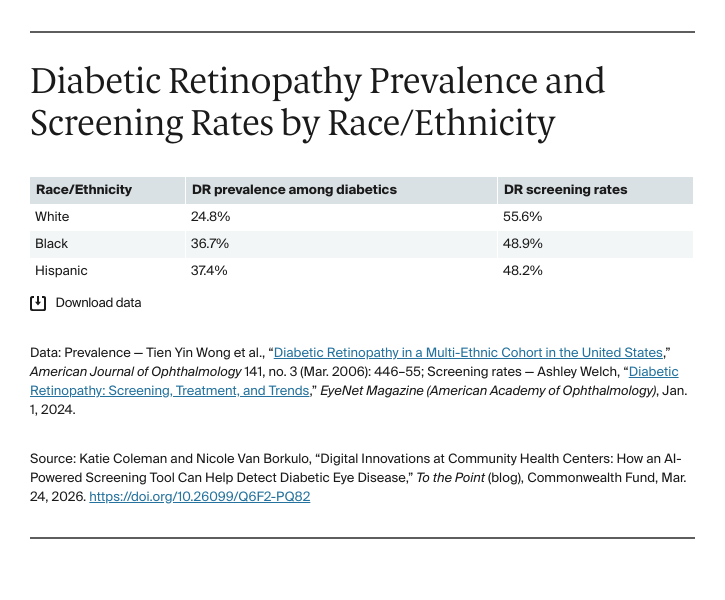
This is especially important for at-risk communities served by CHCs, which include many Black and Hispanic patients. Despite clinical guidelines recommending annual DR screening for people with diabetes, fewer than half of people get screened. Black and Hispanic people face higher prevalence of diabetes and lower screening rates than white people do.
Communities served by CHCs often lack ready access to specialists like ophthalmologists. “We should be using every single tool we have to meet the needs of our populations,” said Sonia Tucker, vice president of population health at San Diego–based San Ysidro Health, on the decision to test out AI-powered DR screening in her CHC. “Why not use the best of the best so that we can have equity?”
How Does the New DR Screening Technology Work?
Historically, people needed to get their eyes dilated at an ophthalmologist’s office to receive DR screening. Recent advances have enabled machines to take pictures of the retina without dilation, which patients could do in settings like drug stores or a primary care provider’s office. However, the images still required analysis by an ophthalmologist to identify DR and other diseases. New AI-powered software eliminates the need for human review. Using machine learning, AI algorithms can analyze retinal images and identify signs of DR in near real time, without the need for an eye specialist. Alison Connelly-Flores, chief medical information officer at Urban Health Plan in New York City, said, “This is the beauty of the AI piece. We didn’t have anybody to read the exams. We needed an ophthalmologist, and they’re just challenging to find, especially for a CHC.”
Patient Impact
This quick, automated feedback may help more patients receive the recommended screening by eliminating the barrier of needing to travel to a specialist who may not accept uninsured or Medicaid patients. Connelly-Flores emphasized the power of making screening easy and accessible. “As soon as a patient comes into one of our facilities, [if he or she] hasn’t had a dilated eye exam, our [DR machine] operators get an alert, and they locate the patient, and offer the exam,” she said. This can often take place while the patient is waiting for a medical appointment. Urban Health Plan also offers drop-in screenings for patients. “We had over 100 patients show up when we did [a drop-in campaign for DR screening] on a Saturday,” Connelly-Flores said.
Patients get one of three results back from the screening: negative for DR, positive for DR, or inconclusive. Patients with negative results do not need immediate additional care and can return to the practice for screening in a year. Patients who receive a positive or inconclusive result need additional screening and potentially treatment from an eye expert. The AI systems have been shown to be accurate in flagging positive DR cases in clinical trials. In practice, CHCs find that about 60 percent of patients receive negative results, 20 percent of patients receive positive DR results, and 15 percent to 20 percent of patients receive inconclusive results. By conducting the testing in primary care practices, it keeps the 60 percent to 65 percent of patients who test negative from needing to travel to eye specialists, and it clarifies the urgency for subsequent treatment for the 35 percent to 40 percent who test positive for DR or who have inconclusive findings. “It helps us prioritize who definitely has to be seen” by an ophthalmologist, said Connelly-Flores. “We explain the importance of keeping the appointment to prevent blindness, and what the test means. That’s communicated right away.” Sonia Tucker agrees, noting that when patients have information about DR, they “follow-up with their care in a timelier manner than someone who doesn’t have any [information].”
Despite worries that patients would be nervous to try an AI technology, “most patients were very excited to use it,” said Fatima Muñoz de Flores, associate vice president of health support services at San Ysidro Health. In Chicago, Lauren Sullivan, the chief information officer at Howard Brown Health, is hoping that same excitement and curiosity may help empower people to “make some diet and lifestyle changes or become adherent with medications or take [diabetes] more seriously.”
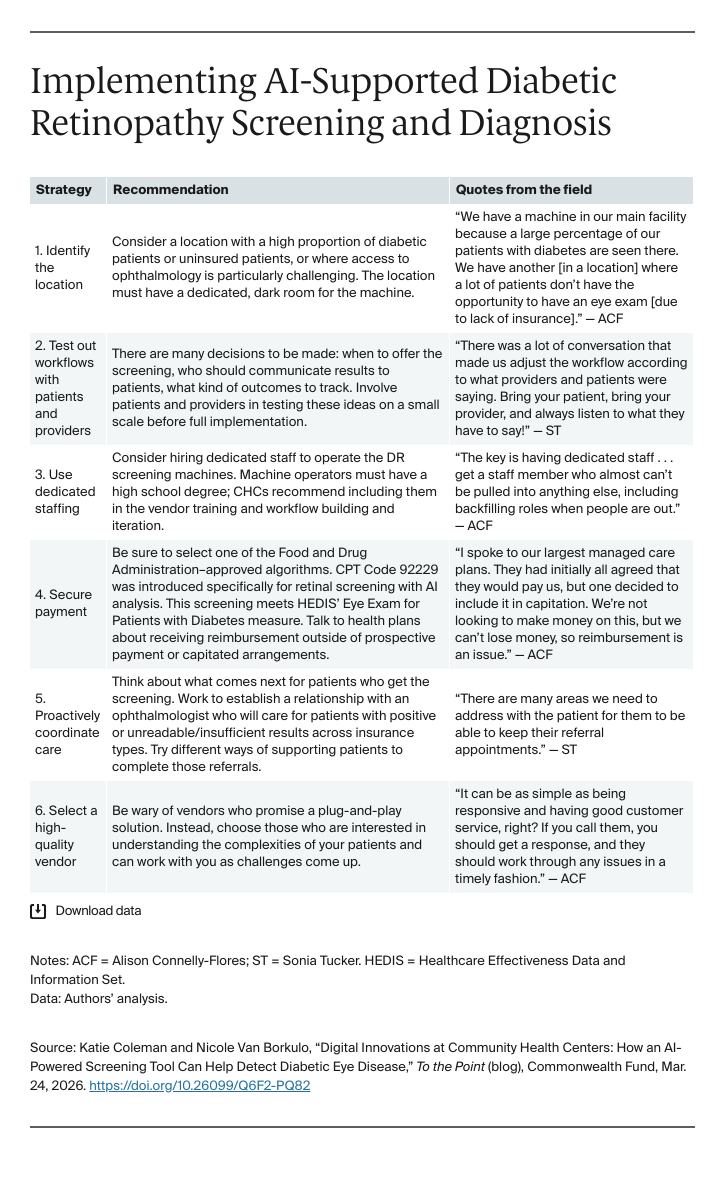
Implementing Changes
Despite patients’ interest in and the benefit of using AI-supported DR screening, implementation is not easy. CHCs say that it is important to plan and test different approaches. “The companies will tell you that you need one day to do training and then you can start using the machine. It’s not like that. You can start using it, but you cannot be proficient. It takes time to build expertise,” cautioned Dr. Edgar Diaz, director of research and health promotion at San Ysidro Health.