


Advanced Search

Advanced Search

Current Filters

Filter your query

Publication Types

Other

to

Blog

/

Digital Innovations at Community Health Centers: AI Ambient Scribing in Rural Health Care

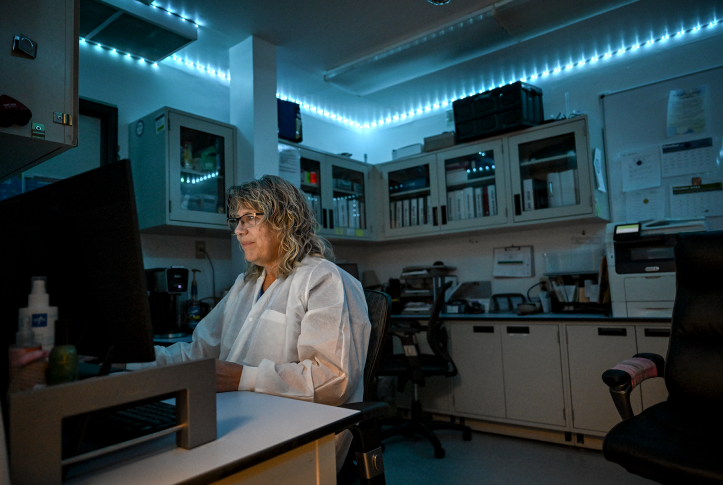
Tech in front of computer in white lab coat.

Lab technician Julie Tagtmeyer works at her computer at Lincoln Health Community Hospital in rural Hugo, Colo. There are more than 60 AI scribing tools being implemented in health care today. Photo: AAron Ontiveroz/Denver Post via Getty Images

Lab technician Julie Tagtmeyer works at her computer at Lincoln Health Community Hospital in rural Hugo, Colo. There are more than 60 AI scribing tools being implemented in health care today. Photo: AAron Ontiveroz/Denver Post via Getty Images

Authors
Authors
Toplines
  • AI scribing reduces charting time, giving clinicians added capacity to address social needs, like food and housing insecurity, while still handling medical care

  • AI scribing technology can make care more equitable and accessible by generating patient education materials in preferred languages and producing care plans at accessible reading levels

This is the second in a three-part series exploring the impact of digital technology innovations in community health centers (CHCs). Artificial intelligence (AI) is rapidly reshaping the health care landscape, yet it is not being evenly adopted. An “AI digital divide” is emerging between well-resourced health systems and safety-net providers like CHCs that offer critical access to primary care, behavioral health, and dental services in underserved and rural communities across the country. CHCs serve one in seven people nationwide and up to one in three rural residents. They provide critical care for 54 million Americans, regardless of their ability to pay, yet often have the “least AI capacity to meet the most ambitious AI and equity expectations.” This series highlights insights and lessons learned from interviews with a diverse group of early-adopter CHCs that are using AI to meaningfully improve patient health and provider well-being in practice. This case study explores AI ambient scribing, one of the most widely adopted AI tools in CHCs, and implications for rural and frontier (i.e., less than six people per square mile) CHCs, specifically.

Building long-term relationships with patients is a key reason doctors go into primary care. Clinicians want to know their patients, follow their stories, and build trust over time, yet the structure of modern health care makes this challenging. Since electronic health records (EHRs) emerged more than two decades ago, the time clinicians spend documenting visits with patients has skyrocketed even as visit lengths remain fixed at 15 or 20 minutes. Many clinicians say they now spend more time documenting than connecting with patients, which is a significant contributor to clinician burnout. Artificial intelligence (AI) ambient scribing is changing this by lightening the administrative load and giving clinicians their time and their craft back.

AI scribing is compelling for clinicians in rural and frontier CHCs who deliver a broad scope of services to patients facing significant barriers to care, including transportation challenges, food and housing insecurity, and limited access to specialists. Reducing charting time gives clinicians added capacity to address social needs while still handling immediate medical concerns, tracking preventive and chronic care needs, reviewing test results, and managing follow-ups. “It’s one of the first technologies that providers are clamoring for . . . everybody’s like ‘This will actually help!’,” says Dr. Aaron Grigg, chief medical informatics officer at Grande Ronde Hospital and Clinics in La Grande, Oregon.

How It Works

There are more than 60 AI scribing tools being implemented in health care today. They vary widely — some are embedded in specific EHRs, others are EHR-agnostic, and still others operate through individuals’ phones — but the technology works the same way. First, automatic speech recognition records and transcribes a medical visit. Then, natural language processing identifies clinically meaningful content — symptoms, medications, history. Finally, large language models generate a structured medical note for the EHR. This frees clinicians from documenting during the visit and does the initial work of translating, synthesizing, and summarizing the main points for the clinical note. AI scribes make errors. Clinicians must review and approve every note, assuring it is complete and accurate, and are accountable for the note regardless of how it is produced.

Monitoring for Accuracy

Clinicians must review every note for accuracy and omissions as the tools make mistakes, producing confident but incorrect information known as AI hallucination. Examples include:

  1. Adding medical interpretations or judgments:

It sometimes makes assumptions, and it interprets things. I don’t want it to add that the patient’s blood pressure is “controlled” at 140/80. For some patients that might be true, but for another it might not be.
— Dr. Sarah Sowerwine

  1. Reversing the intention or meaning of a statement:

A problem with AI translation or interpretation is that it will randomly and very disturbingly change a positive to a negative or a negative to a positive.
— Dr. Kirsten Meisinger

  1.  Misattributing speakers:

When I first started using the tool, it would have a really hard time distinguishing between female voices in the room, switching what was attributed to the patient and to me, the clinician.
— Dr. Sarah Sowerwine

The Documentation Experience

With AI scribing, clinicians aren’t building notes from scratch but reviewing and editing drafts, which requires less mental effort than documenting a visit from memory. The lighter cognitive load is good for clinicians and may reduce after-hours documentation and lead to charts getting closed more quickly. While early research shows that overall time savings are often modest and vary across settings and specialties, for some clinicians, the change has been substantial: “It is two or three minutes, instead of 15, to close a chart,” notes Dr. Liz Powers, health services officer at Winding Waters Clinic in eastern Oregon. The operational impact can be good for the bottom line. “The open chart rate at the end of the week has gone down by 80 percent,” shares Marc Lorenz, information technology director at One Health in Montana and Wyoming.

But implementing AI scribing is not plug-and-play. Clinicians must learn to narrate specific details aloud to make sure they are captured correctly, and they may need to modify sections of the note where the AI scribe documents too much or too little. Dr. Sarah Sowerwine, vice president, medical director, and family physician at One Health, with clinics located in Montana and Wyoming, says: “It became more helpful as I learned how to use it, and it learned how I practice.”

More Comprehensive Care

For practicing clinicians, the benefits of AI scribing extend beyond documentation. Dr. Powers says adopting AI scribing has restored her well-being and reconnected her to the reasons she became a doctor: “While I’m offering the same or better care, the cognitive burden it removes makes it so that I finish the day feeling like I’ve been able to help humans without feeling weighed down and crushed by the associated work.”

Dr. Sowerwine agrees, noting that reducing documentation burden enables her to provide better quality care: “It is allowing me to do more in the same amount of time in a way that is better for my patients. I’m improving my quality metrics . . . . My patients walk out of the room with everything they needed completed that day. I know I’m doing better.”

Some payers are noticing this increase in comprehensive care, and the potential increases in billing, to see if and how health care spending grows.

Getting Patient Consent

In many states, clinicians must get patient consent before recording a visit. Even in states that do not legally require it, using clear language to describe how AI scribing works and how data are protected helps patients feel more comfortable. This is essential for building and maintaining trust in the patient–clinician relationship.

Discussing with patients:

When asked for consent to record the visit, most patients say ‘Sure! If it means we can interact more, if it means you have more time for me.’ And that’s the customer experience part.
— Lander Cooney

You have to engage patients in this tool and this transition. I really do walk in the room and say ‘I have my scribe on today to write our notes for us. It writes my note for me. It writes your instructions for you. Is that OK?’ It is very important that the patient is a part of the conversation.
— Dr. Liz Powers

Patient Experience

AI scribing also changes patients’ care experiences. Some have concerns about data privacy and how recordings are used, and may raise questions when asked to provide informed consent.

Those who do consent may notice benefits like increased clinician eye contact and presence. Dr. Grigg describes how visits changed when he began to rely on the AI scribe: “I’ll roll my chair over next to the patient, sit next to the table, and we’re just having a conversation. I have eye contact. I have the ability to better connect with my patients.”

Many AI scribing tools are beginning to offer additional supports for patient‑centered care. One is language translation, where the system can accurately interpret multilingual conversations. “The AI scribe tool was able to definitively separate spoken English, Mexican Spanish, and Spanish from Spain and document the entire visit with a level of accuracy that blew away the clinician,” shared Mr. Lorenz.

Other functions include automatically generating education materials in a patient’s preferred language and writing care plans at an accessible reading level. “It takes what I talk about in the diagnosis and differential, and it explains everything at a sixth grade reading level in the after‑visit summary,” notes Dr. Powers. These kinds of features may help clinicians deliver clearer, more equitable, and more accessible care to patients.

In rural and frontier CHCs, where staffing challenges are persistent, AI scribing may be a powerful recruitment and retention tool, too. “[Not having AI scribing] will become another thing that makes it hard to recruit and retain providers in our rural communities where patients are complex and we have fewer resources. Having AI scribing to support clinicians will very rapidly will become a differentiator,” notes Lander Cooney, executive vice president and chief operating officer of One Health.

The authors gratefully acknowledge our rural and frontier CHC respondents for sharing their time and expertise: Liz Powers, M.D., and Nic Powers, M.B.A., from Winding Waters Clinic in Enterprise, Oregon; Lander Cooney, M.S., Marc Lorenz, and Sarah Sowerwine, M.D., from One Health in Montana and Wyoming; and Aaron Grigg, M.D., from Grande Ronde Hospital and Clinics in La Grande, Oregon. Additional gratitude for the valuable insights on AI scribing from Kirsten Meisinger, M.D., M.H.C.D.S., from Cambridge Health Alliance in Cambridge, Massachusetts; and Matt White from Contra Costa Health Services in Martinez, California.

Publication Details

Date

Contact

Katie Coleman, Owner and Principal, Research to Practice, LLC

Citation

Katie Coleman and Nicole Van Borkulo, “Digital Innovations at Community Health Centers: AI Ambient Scribing in Rural Health Care,” To the Point (blog), Commonwealth Fund, May 13, 2026. https://doi.org/10.26099/68b7-vm96