




Advanced Search

Advanced Search

Current Filters

Filter your query

Publication Types

Other

to

Blog

/

Could Notifications Help Medicare Advantage Beneficiaries Utilize Their Unused Benefits?

Seniors on exercise equipment

Photo: Giselleflissak via Getty Images

Photo: Giselleflissak via Getty Images

Authors
  • Avni Gupta
    Avni Gupta

    Researcher, Expanding Coverage and Access, The Commonwealth Fund

  • Gretchen Jacobson
    Gretchen Jacobson

    Vice President, Medicare, Expanding Coverage and Access, The Commonwealth Fund

  • Faith Leonard
    Faith Leonard

    Senior Program Associate, Medicare, Expanding Coverage and Access, The Commonwealth Fund

Authors
  • Avni Gupta
    Avni Gupta

    Researcher, Expanding Coverage and Access, The Commonwealth Fund

  • Gretchen Jacobson
    Gretchen Jacobson

    Vice President, Medicare, Expanding Coverage and Access, The Commonwealth Fund

  • Faith Leonard
    Faith Leonard

    Senior Program Associate, Medicare, Expanding Coverage and Access, The Commonwealth Fund

Toplines
  • Many Medicare Advantage enrollees don’t use the extra benefits available through their plans, often because they’re unaware of what’s covered or unsure about how to use them

  • Eight in 10 Medicare Advantage enrollees said they’d like to receive notifications about unused benefits; the majority prefer to receive notifications by email

Medicare Advantage (MA) plans offer supplemental benefits that are not included in traditional Medicare. These commonly include dental, vision, and hearing coverage, but can also involve services like meal delivery or transportation. In 2025, the Centers for Medicare and Medicaid Services (CMS) paid plans $39 billion to provide these extra benefits. Plans extensively market their supplemental benefits; one of four MA enrollees report choosing their plans over traditional Medicare because of them.

But many enrollees don’t use the extra benefits. In 2024, three of 10 MA beneficiaries reported not using any supplemental benefits in the past year. Less than half used dental, vision, gym memberships, or over-the-counter drug allowance benefits, and less than 10 percent used benefits like hearing, grocery allowance, or meal delivery. If the benefits are not used, the insurers are permitted to keep any unspent funds. This has raised questions about whether enrollees are aware of their benefits, if benefits are aligned with enrollees’ needs, if the benefits are leading to better health outcomes, and whether payments to plans for funding these benefits are being used most efficiently.

To learn more, the Commonwealth Fund and SSRS surveyed MA enrollees. The survey explored beneficiaries’ use of supplemental benefits, their reasons for not using them, and their views and preferences regarding notifications about unused benefits.

Two of Five MA Beneficiaries Don’t Plan to Use Some of Their Benefits

Two of five Medicare Advantage enrollees said they don’t plan to use some of their plan benefits. When asked why, 58 percent said it was because they don’t need them. More than one of five either said that they don’t know all the benefits (24%) or don’t know how to use them (21%). More enrollees with lower incomes (i.e., below $50,000), compared to those with higher incomes, said they don’t plan to use benefits because they don’t know how to use them (31% vs. 7%). Those with higher incomes were more likely to report not needing the benefits (70%) compared to enrollees with lower incomes (50%).
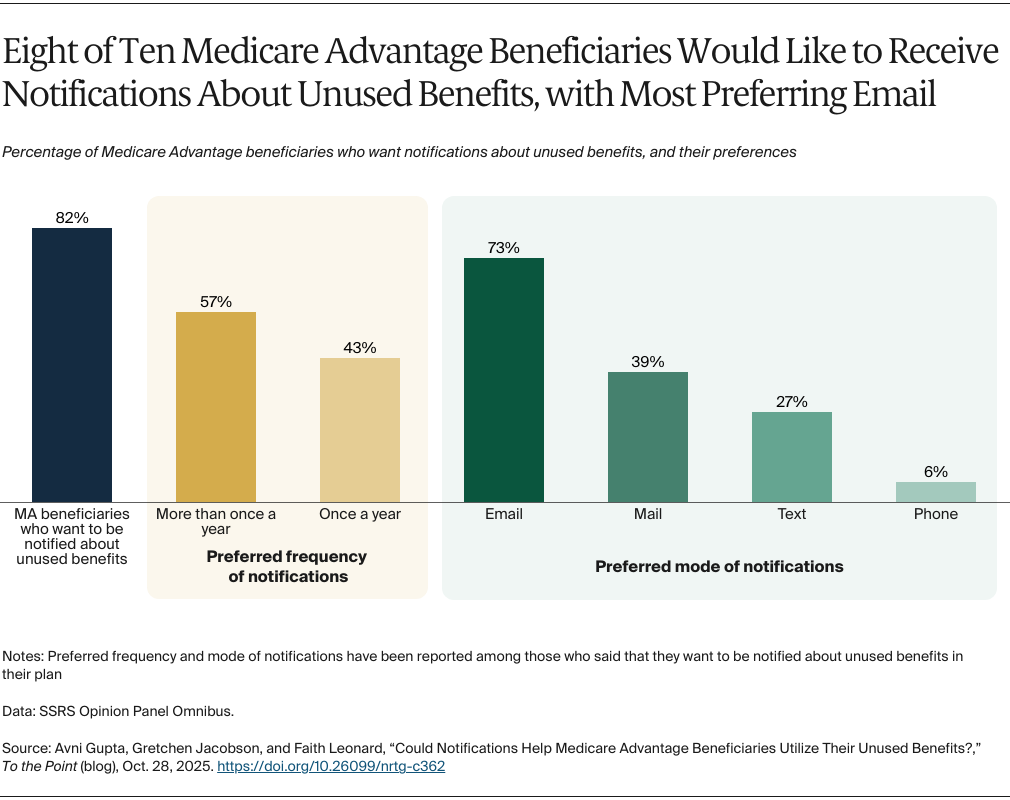
MA Enrollees Would Like to Know About Their Unused Plan Benefits, with Most Preferring Email Notification

Chart: Eight of Ten Medicare Advantage Beneficiaries Would Like to Receive Notifications About Unused Benefits, with Most Preferring Email

Eight of 10 MA enrollees said that they would like to receive notifications about their unused benefits, with most preferring email notification (73%), followed by mail (39%), text (27%), and phone (6%). Nonwhite enrollees indicated a stronger preference for getting notices by text or phone (data not shown). Of those who wanted to receive these notices, a similar share indicated a preference for receiving them once a year (43%) versus more than once annually (57%).

In September, the Centers for Medicare and Medicaid Services delayed a rule that would require MA plans to issue notices to enrollees to inform them about their unused supplemental benefits. The requirement has been delayed until further notice.

Discussion

Our findings confirm that Medicare Advantage beneficiaries overwhelmingly want to receive personalized notices about unused benefits in their plans. Yet, these notices may not spur many to use their benefits. Most people with unused benefits said they didn’t need the benefits; that viewpoint may not change after receiving a notice. However, this information raises questions about the current benefits offered and whether different benefits would provide greater value to beneficiaries and be a better use of federal funds. Beneficiaries also reported barriers to using benefits that may not be addressed by sending a notice, such as not knowing how to use the benefits, finding it inconvenient to use them, not being able to find in-network providers or vendors, and difficulty affording them. Some of these issues could be addressed by the specifications included in the 2024 final rule. These required that notices have relevant details for each unused benefit, including its scope, cost sharing, instructions on accessing, network information, and a customer service number.

CMS could consider requiring plans to use multiple communication channels for sending the notices, particularly using text and phone calls in regions with a higher proportion of nonwhite beneficiaries. The 2024 final rule only required plans to mail the printed notices.

Lastly, the findings raise a broader question about whether the benefits offered by plans are aligned with beneficiaries’ needs or are largely a marketing gimmick. The plans receive significant federal funding for these benefits, and it is important to ensure that the payments translate to better health outcomes for beneficiaries.

Publication Details

Date

Contact

Avni Gupta, Researcher, Expanding Coverage and Access, The Commonwealth Fund

agupta@cmwf.org

Citation

Avni Gupta, Gretchen Jacobson, and Faith Leonard, “Could Notifications Help Medicare Advantage Beneficiaries Utilize Their Unused Benefits?,” To the Point (blog), Oct. 30, 2025. https://doi.org/10.26099/nrtg-c362