


Advanced Search

Advanced Search

Current Filters

Filter your query

Publication Types

Other

to

Blog

/

Congress and the Trump Administration’s Efforts to Cut Health Insurance Coverage Will Undermine the Health of the U.S. Workforce

View of capitol building during rain

A view of the U.S. Capitol following rain showers on October 8, 2025, in Washington, D.C. Medicaid and Affordable Care Act marketplace plans are critical sources of health coverage for many workers. Congress and the Trump administration have enacted sweeping changes that will significantly disrupt access to these. Photo: Brendan Smialowski/AFP via Getty Images

A view of the U.S. Capitol following rain showers on October 8, 2025, in Washington, D.C. Medicaid and Affordable Care Act marketplace plans are critical sources of health coverage for many workers. Congress and the Trump administration have enacted sweeping changes that will significantly disrupt access to these. Photo: Brendan Smialowski/AFP via Getty Images

Authors
  • Avni Gupta
    Avni Gupta

    Researcher, Expanding Coverage and Access, The Commonwealth Fund

  • Sara Collins
    Sara R. Collins

    Senior Scholar, Expanding Coverage and Access and Tracking Health System Performance, The Commonwealth Fund

Authors
  • Avni Gupta
    Avni Gupta

    Researcher, Expanding Coverage and Access, The Commonwealth Fund

  • Sara Collins
    Sara R. Collins

    Senior Scholar, Expanding Coverage and Access and Tracking Health System Performance, The Commonwealth Fund

Toplines
  • Congress and the Trump administration have enacted sweeping policy changes that will disrupt access to health coverage for working people who depend on Medicaid and the Affordable Care Act’s marketplaces

  • Federal policy changes will bump legally present immigrants off the marketplaces and Medicaid, add red tape for other people who are eligible to enroll, and sharply increase workers’ insurance premiums

In May 2025, nearly 163 million people in the United States were employed either full or part time. Employer coverage forms the backbone of the health insurance system, but not all working people get coverage through their jobs — not all firms offer coverage and, even when they do, not all workers are eligible. The Affordable Care Act’s (ACA) coverage expansions help many of these working adults obtain coverage. Currently, more than 23 million Americans get their coverage from the marketplaces and about the same through the ACA’s Medicaid expansion.

But the budget reconciliation law (H.R. 1), along with the potential expiration of the enhanced premium tax credits and the Trump administration’s final rule on the marketplaces, will bring major changes to Medicaid and marketplace coverage. Estimates from the Congressional Budget Office and the Urban Institute show that the combined effects of these changes will increase the number of uninsured people by about 15 million in 2034. This could drive the overall number of uninsured above 40 million, close to pre-ACA levels. Using data from the Commonwealth Fund 2024 Biennial Health Insurance Survey, we examine how these major federal policy changes will affect the lives of working Americans.

According to the survey, 80 percent of full- or part-time workers were employed in firms where they were both offered and eligible for coverage through their companies. But there was wide variation, by firm size and income. Only 40 percent of workers in small firms (i.e., fewer than 50 workers) with incomes under 138 percent of the federal poverty level (i.e., $20,782 for an individual and $43,056 for a family of four in 2024) were both offered and eligible for their workplace coverage. In contrast, 71 percent of workers in the same income group in larger firms (i.e., 50 or more workers) were offered and eligible for coverage. There were similar divides among workers with higher incomes: among those with incomes at 138 percent of the federal poverty level or higher, 61 percent in small firms were offered and eligible for coverage compared to 93 percent of those in large firms. Part-time workers were both less likely than full-time workers to be employed by firms that offered insurance and to be eligible for coverage in firms that did offer health benefits (data not shown).
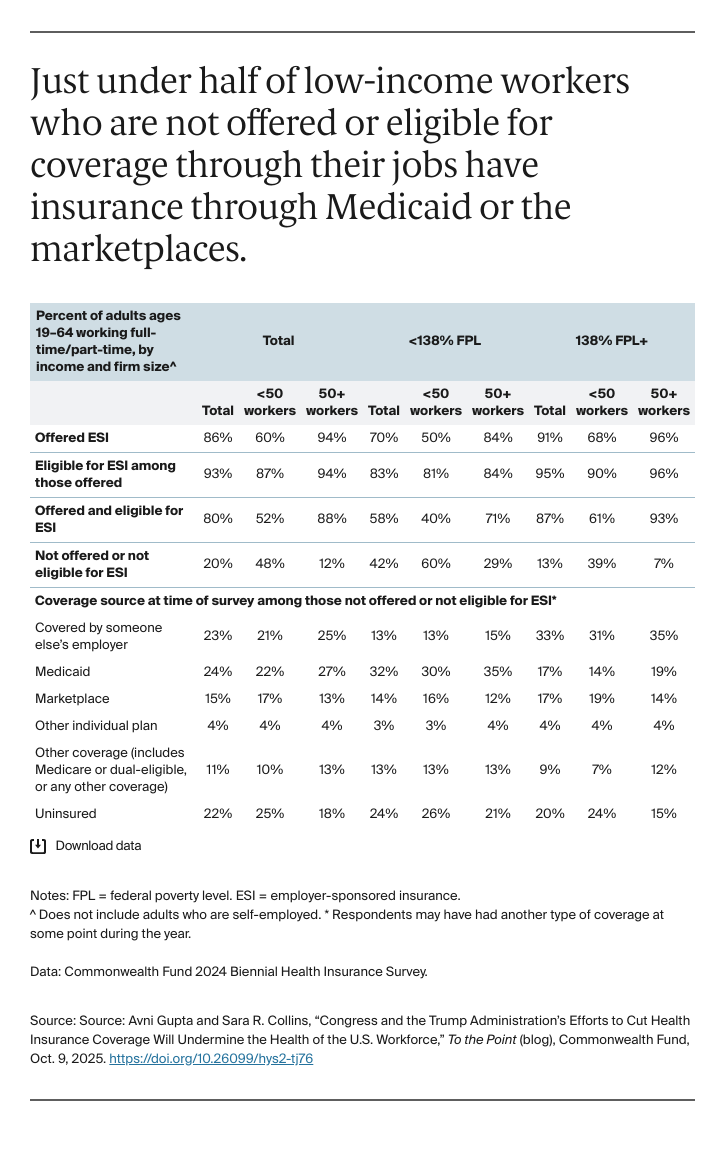
Where do workers who are not offered or are not eligible for coverage through their jobs get health insurance?

Just under half of low-income workers who are not offered or eligible for coverage through their jobs have insurance through Medicaid or the marketplaces.

Medicaid and marketplace plans are critical sources of coverage for workers who are not offered or eligible for coverage through their jobs. Among those with incomes under 138 percent of the federal poverty level, nearly a third (32%) were enrolled in Medicaid and 17 percent had marketplace or individual market coverage. Thirteen percent had insurance through a family member’s employer.

Employer coverage through a family member is more common for higher-income workers — 33 percent of workers without job-based coverage were insured that way. Among the higher-income workers without employer coverage, more than 20 percent purchased plans through the marketplaces or the individual market.

About 22 percent of workers who lacked access to employer coverage were uninsured. These workers were disproportionately male, younger, born outside the U.S., or living in states that haven’t expanded Medicaid (data not shown).

Where do self-employed workers get coverage?

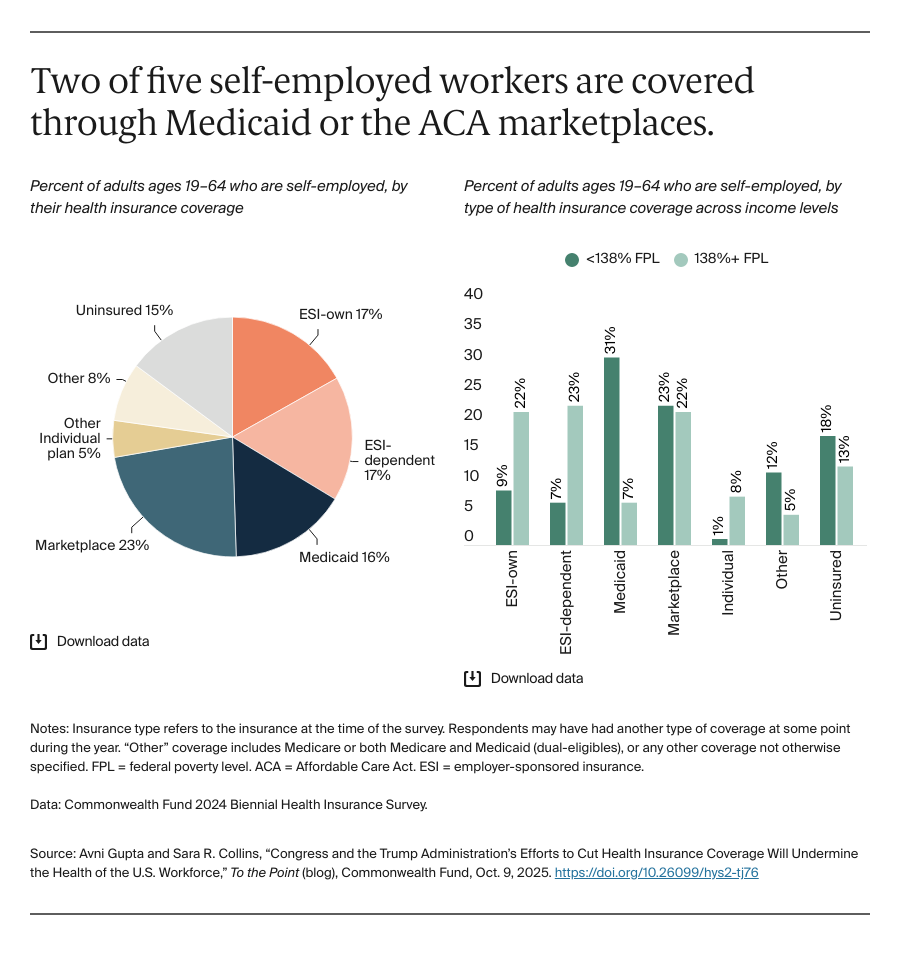
Two of five self-employed workers are covered through Medicaid or the ACA marketplaces.

An estimated 16 million to 27 million people are self-employed in the U.S. Our survey found that nearly a quarter of self-employed people rely on the marketplaces for their health insurance. More than three of 10 (31%) low-income self-employed people were covered by Medicaid. Coverage through an employer, either their own or a family member’s, was much more common among those with higher incomes.

Policy implications

Congress and the Trump administration have enacted sweeping changes that will significantly disrupt access to health insurance coverage for working people who currently depend on Medicaid and the marketplaces. These policy changes will bump legally present immigrants out of the ACA marketplaces and Medicaid, add reams of red tape for people to wade through to enroll in coverage they are eligible for by law, and sharply increase workers’ premiums. The United States is certain to see increasing numbers of working people without insurance. Ultimately, these efforts will undermine the health of the U.S. workforce.

Publication Details

Date

Contact

Avni Gupta, Researcher, Expanding Coverage and Access, The Commonwealth Fund

agupta@cmwf.org

Citation

Avni Gupta and Sara R. Collins, “Congress and the Trump Administration’s Efforts to Cut Health Insurance Coverage Will Undermine the Health of the U.S. Workforce,” To the Point (blog), Commonwealth Fund, Oct. 9, 2025. https://doi.org/10.26099/hys2-tj76