

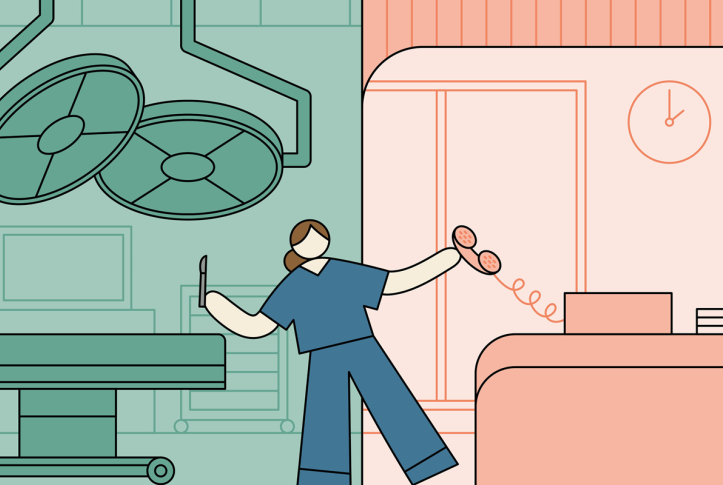
Dr. Elisabeth Potter was in the middle of operating on a patient with breast cancer when a nurse delivered an urgent message: UnitedHealthcare was on the line. She stepped outside the OR and took the call. It was the insurer asking why the patient, who was on the operating table, needed to stay overnight.
“It felt like they had invaded a very sacred space where the priorities should be really clear, patient first always, and they were bringing these administrative questions into the moment.”
On The Dose podcast, Dr. Joel Bervell talks with Dr. Potter, a surgeon in Austin, Texas, about what years of fighting insurance companies, building her own surgery center, and walking the halls of Congress have taught her about how our health system actually works, and how we can change it.
“Doctors should be able to spend more time being doctors,” Potter says. “And patients should be able to spend less time fighting the system just to get well.”
Transcript
JOEL BERVELL: My guest on this episode of The Dose is Dr. Elisabeth Potter, a plastic surgeon whose practice and advocacy work is focused on breast reconstruction after breast cancer. Dr. Potter has performed more than 1,000 deep inferior epigastric perforatory, or DIEP, microsurgeries, a technique developed to use a woman’s own tissue to avoid implants. Last year, Dr. Potter went viral after posting a video describing a call she received from UnitedHealthcare in the middle of a breast reconstruction surgery. The video was viewed millions of times and made national news, but that moment is really just one part of a much larger story.
Dr. Potter has spent years confronting the ways insurance rules, billing codes, and health care pricing can all shape what care patients are actually able to receive. She’s the founder of the Community Breast Reconstruction Alliance, an advocacy organization she launched to lobby lawmakers for the preservation of insurance codes that help women pay for these procedures. The clinical work and learning her way around Washington are both part of Dr. Potter’s current work, and she’s working to take the taboo out of talking about what it costs to be well, get well, and stay well. So today, let’s take a deeper look at what it takes for a physician trying to change the system from the inside.
I’m so happy to welcome you to The Dose for this conversation, Dr. Potter.
ELISABETH POTTER: Wow. Taking the taboo out of this. I love it. Yeah, thank you for that.
JOEL BERVELL: You began your work as a physician performing surgeries for women living with breast cancer and built your own surgery center in Austin, Texas. Before we get into the policy, I would love to hear how you found your way into breast reconstruction, and why did you ultimately decide to practice independently?
ELISABETH POTTER: So breast reconstruction for me, when I was in medical school, I had taken five years to work before I went back to medical school, and so I was really trying to focus on what made me click. I knew that I wanted to work with my hands, and I was in a surgery on the surgical oncology rotation. I saw a mastectomy. And at the end of that case, the plastic surgeons arrived, and my team was done for the day.
And my attending said, “Elisabeth, you’re welcome to go now.” And the plastic surgeons asked if I wanted to stay. And I saw a version of the surgery that I do now, and everything clicked. I knew in that moment, this is what I want to do, and it doesn’t just feel like a job. It feels like I’m bringing myself into the work, and that’s so meaningful. So that’s how I found it.
JOEL BERVELL: Yeah. Having a part of yourself in the work is so important. I love that.
ELISABETH POTTER: Yeah.
JOEL BERVELL: A large part of your practice is a procedure, too, called deep inferior epigastric perforatory, or DIEP flap reconstruction. For someone who’s never heard of it, what is it, and why might a patient choose that over an implant?
ELISABETH POTTER: Well, so it’s when I basically take your own tissue from your abdomen, what would normally be discarded, say, if you were having a tummy tuck. For a lot of women, it’s extra tissue.
And I dissect out or find the blood vessels that keep that alive. I find the blood vessel in the chest. So it’s like a garden hose to a spigot. So after the mastectomy, the breast is gone on the chest, the chest is flat, we’re going to reconstruct it with something.
And a deep flap is when I use your own skin and fat, instead of an implant. So it’s like a living implant. I transfer that to the chest and sew those vessels together under a microscope so that you have a reconstruction that’s kind of like your body giving back to you after such a traumatic experience of maybe feeling betrayed by your body. So it’s really beautiful in sort of this meta sense.
But then also implants, they’re not perfect. They’re not lifetime devices. There can be issues with them. And it’s not that . . . When I was training, implants were really the main option that women had, unless you were in an academic center, really in front of someone who was kind of on the forefront of moving breast reconstruction.
And I wanted to bring that into communities. I wanted women in rural Texas, in the Deep South to have real options, not just the dream of an option like that. They could get to Atlanta or they could get to Austin or get to Boston and maybe have that special surgery, but that it could be in their city, in their town, in their hospital. So I became expert at that thing, at deep flaps in order not just to do them, but to offer both options.
So I do like half-and-half. I do a lot of implants because women come to me with their own needs and desires. I want them to feel like they are looking at someone who could offer them those things.
JOEL BERVELL: Absolutely. Well, I want to get into advocacy, but before I do that, I have to spend a few minutes introducing people to the moment that introduced a lot of people to you overall. So last year you received a call from UnitedHealthcare questioning an overnight hospital stay that had already been approved. Maybe you can take me back to that moment of what happened.
ELISABETH POTTER: Yeah. I was in the operating room doing the third of four cases that day. I do a lot of these cases. And a nurse came in the room, and I could tell that there was some kind of kerfuffle behind me, and someone spoke up and said, “Dr. Potter, there’s a message for you. There’s a call from UnitedHealthcare that they say is urgent.” And I was like, “This is really weird. This has never happened to me before.”
I looked at my partner, who’s a surgeon. We were finishing that case, and the patient was safe, and I immediately thought, “Oh, they’re going to try to not pay for this surgery” because I’ve been fighting that battle for years. So I said, “I think I should take this call to make sure that I’ve advocated for this patient so she doesn’t get a bill.” And he said, “Of course.”
And I stepped about 10 feet away, 10, 12 feet outside of the OR doors, returned the call and had a three-minute conversation. And that conversation was asking me for the diagnosis of the patient who was on the table with breast cancer, their member who was on the table and had breast cancer, and they wanted me to justify why she needed to stay overnight in the middle of the case. And I explained to them, I’m the surgeon, I’m operating. And when I said, “We had approval for this. Don’t you have all that information?” And the person said, “No, that’s another department.”
And it was just this complete absurdity, a disconnect between the business of medicine and the practice of medicine. And although I had stepped out of the operating room, it certainly felt like they had invaded a very sacred space where priorities should be really clear, patient first always, and they were bringing these administrative questions into the moment. I said, “I really got to get back to my patient.” I finished the case, I did another case, kept operating, and at the end of the day, still, I was just so disturbed and kind of sad.
And I also felt like I wanted people to know, so I just made the video. And I wasn’t really checking TikTok. I saw on Instagram maybe a day later that it was kind of gotten some attention.
JOEL BERVELL: Yeah. Why do you think this particular story struck such a nerve with people?
ELISABETH POTTER: Well, a couple of things. I think that there’s been an undercurrent of what’s going on in American health care. We have real problems, and I think people wanted to talk about it.
So January 2025, this was a month after, or a little over a month after the CEO of UnitedHealthcare had been murdered in New York. There had been sort of this public discussion around that, and that had been kind of surprising because it really revealed a lot of cynicism in America about insurance. So this was on the heels of that.
But I think the real thing that resonated was that Americans started to see doctors and patients on the same side. They could see that I was trying my best and that a lot of doctors were, and that we were both fighting the system and feeling frustrated and marginalized and harmed.
JOEL BERVELL: Yeah. And you mentioned that this wasn’t new to you at all. You’ve been doing this work already. And at one point there was something even obscure as a billing code that threatened whether patients across the country could access the surgeries we were talking about before DIEP flap reconstruction. I’m hoping you can explain kind of what happened to make that a controversy because I think it connects to your overall mission really well.
ELISABETH POTTER: Sure. Well, I received this little email way back. It was actually something called the Coding Corner from the Plastic Surgery Society, and it was just a notification that the coding for breast reconstruction had changed. And they had basically decided that all types of reconstruction that are natural using your own tissue should be considered and valued the same.
And okay, that maybe sounds reasonable unless you know the details. And the details are that there are surgeries that are harmful to patients truly, that remove their entire muscles, like both erectus muscles, and their surgeries save them. And those surgeries should be valued differently, rewarded differently, encouraged.
It’s sad to say, but like you have to have some motivators in there to help everyone choose the right course. If you’re rewarding all of those things equally, then the danger is that there’s a regression to the bottom.
And so I take care of a lot of women who have a really hard time accessing great care, and I see that they get the bare minimum. So I saw that the bare minimum was going to be the standard. So yeah, I enlisted the help of patients and went on social media and had little Instagram Lives and hired lobbyists.
I mean, I called my society and I said, “This can’t happen.” And they said, “It’s done. You can’t undo it.” And I was like, “Yes, I can. Watch this.” And it took a year and a half, a year and a half, and I drained a lot of my savings to do that and went to D.C. And I knew that if I could just explain the issue in the simple way that I experienced it and that my patients experienced it, if you take a woman’s muscle or you can keep a woman’s muscle, the rest of her life is different.
We should be doing surgeries that are hard on the surgeon, easy on the patient, and not the other way around. And once I got that message, people were like, “Of course, of course.” And I got all the way to the head of CMS [the Centers for Medicare and Medicaid Services] and explained things to them and did all the data and had a public hearing, and then they reversed their course. They rolled that back, and it really did save this option for so many women.
JOEL BERVELL: Absolutely. And your work really started to morph when you, as you mentioned, realized the challenges to your practice were kind of routine. For example, your patients were being denied care or redirected in their care because your prices were too low and didn’t align with how insurance companies and hospitals preferred to bill and get paid. How was that playing out for your patients and in your billing office?
ELISABETH POTTER: Okay. So yeah, I wanted to be independent, and I knew that in order to be independent, I didn’t want to be an employed physician by a big system. And when I did the numbers, I needed to build my own surgery center to be able to do that.
So I invested and did it, and I proved that I could do surgeries for 40 percent of the cost that they were being done in the hospital. And I assumed that that would be well-received by insurance companies, et cetera, and it wasn’t.
And that in itself was so shocking, but also is information. And if I can be excellent, one of the best microsurgeons in the country with some of the best outcomes and lower cost, and that’s not welcomed with open arms when I’ve delivered it on a platter, I’ve built the center, I’m doing it, that information is so important for all of us to consider. Because if we can’t, as an American medical system, adopt those types of things, then we really are just serving a broken system.
JOEL BERVELL: Why would an insurance company even prefer that a patient receive more expensive care somewhere else?
ELISABETH POTTER: So that’s a great question. And I don’t know that they prefer that it’s more expensive, but I think you have to recognize the degree of power. They prefer the system that’s in place that is sustaining them, and a threat to that system is troubling.
So we do have monopolies, and we have four big insurers and some others. We have a few hospital systems. So you can imagine that like the hospital system where I am did not want me to take this business. I’m very busy. I do 500 surgeries a year. They did not want me to take this business out of their hospital system into an outpatient center. Although I had gone to them and asked them to do a joint venture with me and said, “Let’s do this together,” they said no. And I can give you one kind of troubling and specific thing that happened.
JOEL BERVELL: Yeah.
ELISABETH POTTER: So when you build your own center, you have to have a few things. You have your operating rooms, I have two. You have to find nurses and doctors to work there with you, and so you need to have anesthesia coverage.
Well, anesthesia has become very consolidated, and there are only a few groups, for instance, in Austin that are owned by private equity or other big groups, and they contract with the hospital system. So there’s really two major hospital systems in Austin. So there’s two groups and two hospital systems, and they’re kind of wed to one another.
So I went to one of the groups and said, “I’m opening this center. You guys work at other outpatient surgery centers, in addition to the hospital. Would you be willing to work with me? I think it’d be a great experience.” And they were like, “Of course, we love working with you, Dr. Potter. We’ve worked with you for years.” So I did that.
And then a year later as I was building the center, right before I’m opening, I got a phone call from the head of that anesthesia group, and they said, “You know what? We’re not going to be able to cover.” And that’s a huge deal, huge. And I’m like, “Whoa, what do you mean?” And they said, “Well, we’re not going to be able to cover, and some things have come up.” And so I’m scrambling and I’m getting people, patching it together, and I made it work.
But 11, 10 months later, the doctor was at dinner with me, and she had been in that anesthesia group, and she left, and she said, “I need you to know something. Right before we were supposed to start covering you, we were all excited to do that. And we got a phone call. We had a meeting with the hospital system, and the hospital system said to us, ‘It’s either her or us.’”
JOEL BERVELL: Wow.
ELISABETH POTTER: “‘You’ll lose our big contract, the majority of your business, if you cover her.’” It’s dark, but real.
JOEL BERVELL: We make this assumption that everyone in health care has an incentive to lower costs or do what’s best for the patient. I think that’s how we came into it as physicians. That’s the part we see, especially being so patient-facing. But that story you just told shows us that’s not always the truth in all of medicine.
ELISABETH POTTER: It’s definitely not. We’re all becoming less healthy, providers and patients, in a lot of ways, and it’s becoming more difficult to get care, and we can’t afford care. But the system that we have in place — and we need to look at this really scientifically and really dispassionately — we are getting what we’ve designed it to do, which is to make a lot of money.
JOEL BERVELL: Many of these experiences that you’ve shared eventually pushed you away from becoming just a surgeon into becoming an advocate, too. What were you hoping to accomplish when you founded the Community Breast Reconstruction Alliance?
ELISABETH POTTER: So I did that when I was doing the coding work, and that was really a way to say I’m not just a voice in the darkness. So when I went to D.C. and people said, “The AMA [the American Medical Association] isn’t supporting you,” and I would say, “But I founded my own nonprofit, and I have this letter with 5,000 signatures,” it was a way of saying I can be part of a society, too. I can develop an organization, too.
JOEL BERVELL: Yeah. And the Community Breast Reconstruction Alliance, too, helped with a significant win with CMS, the Centers for Medicare and Medicaid [Services], that ended up reversing course on coding changes, too. I’m hoping you can tell us a little bit about that effort and the outcome.
ELISABETH POTTER: Yeah. Right. So I would make phone calls to surgeons around the country and say, “Let’s talk about this. How is this going to affect your practice?” And more and more people were like, “Wow, we don’t have to just give up. We can join together and do this.”
And it really did lead to going direct to the patient and saying, “I need you, the patient, to understand the impact and taking that message to Congress and CMS.” And that really landed. And honestly, the most powerful voice in American health care right now is the voice of the patient, no doubt.
JOEL BERVELL: Absolutely. I mean, we’ve been talking a lot about a part of medicine that we’re not trained about, which is about money, but for patients, costs can determine whether they fill a prescription, schedule procedure, or seek care at all.
I was hoping to talk about some policies, too. For example, one of them is the Patients Deserve Price Tags Act, which was introduced last summer, passed out of committee in the Senate this summer, and is now waiting for a vote from the Senate before being taken up by the House. Are you able to kind of share what is in this bill, and what its chances of succeeding in this political environment are?
ELISABETH POTTER: This is a really exciting bill, and this has been years in the making, and so many things have come to this point where I think that this has a very good chance of passing in this administration, in this environment, in the country, and having a real-world impact on the way that patients experience receiving and choosing medical care and paying for it.
And it’s really just very straightforward stuff. Like when I go to the grocery store, I look at the price tag. When I go out to a restaurant, I’m the kind of person who looks at the cost, and most Americans are. Like I’m thinking about how much money I have, how hungry I am. I’m really happy with the salad, with the chicken. I don’t need a steak. I’m weighing my choices. And in medicine, the patient hasn’t been able to see the price upfront.
Now, when we had a system that was like, okay, whatever you choose will be paid for by the benevolent insurance company, no matter what, you’re going to be okay. But we have an adversarial relationship in a lot of ways. We do. They’re looking for ways to save money.
So the Patients Deserve Price Tags Act really says patients need to know the prices upfront, and employers need to know the price of health care, and we need to have itemized lists. So you need to know the price upfront and then you need to see what’s billed. And we need to be able to compare those things and say, “You said it was this, and you billed me this, and that’s not fair.”
Can you believe that we don’t have that now? Like we’re having to ask for that really basic thing that’s just budgeting. We need to be able to budget our health care. So that’s the heart and soul of it. It’s just showing prices and having transparency. And it’s not general prices, it’s actual prices. It’s not ranges, it’s specifics. Yeah. This is a legislation that is opening up the force of the American market and the American medical consumer to say, no, no, we demand to know the cost and we’re not going to participate in a system that’s this obscure.
In America, we currently need to know the prices because medicine exists in the marketplace. And so unless we’re in a system where it’s just free health care for all, we need to drill down into this point.
JOEL BERVELL: Absolutely. What are some of the resistances to wanting this to open up an entirely different way of thinking about health care and seeing prices that people are pushing back against?
ELISABETH POTTER: That’s an interesting question. And honestly, it’s industry. There’s no patient group that doesn’t want this to happen, but there’s a lot of vested interest in maintaining the veil over the numbers. There’s just a lot of overcharging. There’s practices in the accounting of medicine that would not be accepted in other areas of American business.
And while medicine and insurance can seem very complex and codes and insurance policies and prior auths and bring it down into our living rooms, our dining tables where we can talk about, “They said it was $100 and they charged me $250,” or “This person’s paying $1,000 and I’m paying $5,000, that’s not fair. That’s not American.” That’s where I would say maybe we need to reset the equilibrium where we recognize it’s not just about making money, that hasn’t served us well, but pour some money back into the system to support that baseline level of care, and then maybe have other . . . I’m not saying Medicare for All is the only option, but have other options as well.
JOEL BERVELL: Yeah. What I love is you’re not just advocating for this as a policy idea, you actually run a medical practice.
ELISABETH POTTER: Right.
JOEL BERVELL: So I’m curious if price transparency or even the Medicare for All were to become laws tomorrow, what would you see change inside your office?
ELISABETH POTTER: I mean, I think any change is going to have some discomfort, but I’m taking the long view.
So, I was just thinking about this yesterday with like different technologies in the practice, like how will that affect my practice? I think that Medicare for All is going to take time, or a nationalized health care is going to take a lot of time, but the idea that I spend half of my time administering my practice, paying for the overhead just to do the administrative tasks that the current system is demanding of me, the fact that I could practice medicine in a way that was supported by the American people, I see that as a better option.
But I think in the end, if we can support physicians, providers in a lot of different ways to better take care of people and not better navigate a complex system, then that’s good for all of us. And what I mean is like I don’t know exactly what the mechanism is. So should there be tax credits for providers, right?
JOEL BERVELL: Mm-hmm.
ELISABETH POTTER: Should the EMR be free and nationalized? For independent providers, like how do we better support folks who are not employed? There are things that the government can do to make it much easier to put the patient first that aren’t just nationalized health care. There’s steps that we can take in the middle towards balance.
And honestly, I think for the next couple of years, I see that as the big push. I see the big push of getting doctors out of the employed model, where they’re beholden to Big Medicine and beholden to insurance companies and back into their own center, where they feel their power to help patients again and then can decide from there what’s the next best course.
JOEL BERVELL: Absolutely. I think that’s an incredible place to leave it, that last point you were making about what the health care system could look like if doctors could spend more time being doctors and patients could spend less time having to fight the system just to get well.
So, Dr. Potter, thank you so much for joining me on The Dose. And I have to say, after hearing everything that you’ve done, from taking care of patients in the operating room, to taking on insurance companies, to walking the halls of Congress and actually helping change policy, you really are a real-life superhero.
And what I keep coming back to from this conversation is something you’ve made feel so simple. Doctors should be able to spend more time being doctors. And patients should be able to spend less time fighting the system just to get well. And I think your work is such a powerful example of what can happen when physicians don’t just recognize where the system is failing their patients, but decide to do something about it.
So thank you for the work you’re doing. Thank you for continuing to speak up. And thank you for being here with us today. Dr. Potter, thank you again.
ELISABETH POTTER: Thank you. And I’m so encouraged that you’re the future of medicine.
JOEL BERVELL: This episode of The Dose was produced by Jody Becker, Richard Shapiro, and Naomi Leibowitz. Special thanks to Barry Scholl for editorial support, Jen Wilson and Rose Wong for art and design, and Paul Frame for web support. Our theme music is “Arizona Moon” by Blue Dot Sessions. If you want to check us out online, visit thedose.show. There, you’ll be able to learn more about today’s episode and explore other resources. That’s it for The Dose. I’m Dr. Joel Bervell, and thank you for listening.


