

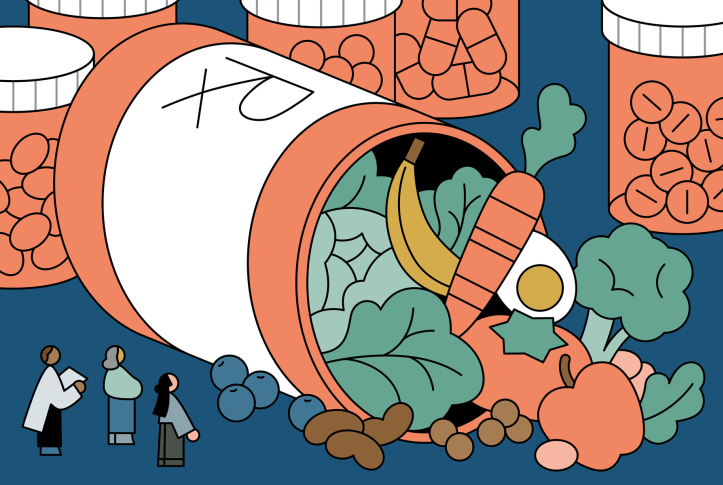
Eighty-five percent of all U.S. health care spending goes toward managing chronic diseases connected to poor diet and nutrition. Yet most doctors receive little to no meaningful training in nutrition. As a result, food and nutrition remain absent from doctor–patient conversations, with medications the default option for most ailments.
On The Dose podcast, Dr. Joel Bervell talks with Dr. Dariush Mozaffarian, director of the Food Is Medicine Institute at Tufts University, about why that gap exists, what it will take to close it, and what’s presently working.
Increasingly, doctors are beginning to prescribe produce or meals medically tailored to a patient’s condition, with the cost covered by the patient’s health plan. And a growing number of states are currently testing or planning to test food-as-medicine programs through Medicaid. Meanwhile, a third of U.S. medical schools have committed to meaningful nutrition education for doctors, something that would have been unthinkable a decade ago.
“Food is the single biggest challenge and opportunity, not just in health care, but also in our economy and the environment,” says Dr. Mozaffarian. “And it’s all fixable.”
Transcript
JOEL BERVELL: My guest on this episode of The Dose is Dr. Dariush Mozaffarian. He’s the director of the Food Is Medicine Institute at Tufts University, where he’s also a professor and practicing cardiologist at Tufts Medical Center. Dr. Mozaffarian is a leading voice in the growing food is medicine movement. His work focuses on building the evidence for a food system that doesn’t just prevent disease but helps improve health and making sure that system is nutritious, equitable, and sustainable. He’s authored more than 650 scientific publications, many based on his research. And this month he’s adding something new to that list: his book, Food Is Medicine.
Dr. Mozaffarian, I’m so glad to have you here to talk about the science behind Food Is Medicine, what it can mean for the future of health, and of course, your new book. Thank you for joining me on The Dose.
DARIUSH MOZAFFARIAN: It’s great to be here, and you’re known as a medical myth buster and what better place to start busting myths than in nutrition.
JOEL BERVELL: Absolutely. So let’s start with the big picture for a minute. Right now, 85 percent of all health care spending in the U.S. goes towards managing chronic diseases that are connected in one way or another to diet and nutrition. So I’m in my second year of residency right now. And while my medical training, we learned about nutrition, but we didn’t focus on how to actually use food as clinical intervention. Even now working in the hospital, food often feels separate from the medications, procedures, and other treatments we reach for every day. But then you look at the history and the ideas are truly ancient, the benefits of fermented foods, medicinal beers, yin and yang, even the Hippocratic caveat, “Let food be thy medicine.” And yet you are still making the case today, even publishing a book this month because food is medicine is not fully integrated into health care as we know it in the U.S. So simple question, why is that?
DARIUSH MOZAFFARIAN: Well, your experience was my experience. I did four years of college, four years of medical school, three years of internal medicine, four years of cardiology. So put all that together, what is that, 15 years? And in that 15 years, I hardly learned anything about nutrition. And yet to me, Joel, it was obvious that that was one of the biggest issues facing my patients. And so, that was the first big realization that the top cause of poor health is not being addressed in health care. So then the second realization I had was when I decided to read all the science myself, this was around 2000, went deep into all the papers I could find on nutrition and cardiovascular disease as a cardiologist. And I found that even then at the height of the low-fat diet, that a low-fat diet wasn’t supported by the evidence, and yet that was the guidance of the land.
And so that was my second big realization that even the facts we know aren’t being translated to people. And so that’s been the focus of my career. And then one of the core theses of the book is that our food is the single biggest challenge and opportunity, not just in health care, but facing humanity. This is the biggest issue for our health, for our economy, for the environment, and it’s all fixable. And change is coming and the public is realizing this, policymakers are realizing this. And so, topics of food as medicine are now being discussed in hallways of power across the country.
JOEL BERVELL: Absolutely. And as you’re kind of mentioning, we have decades of evidence that better nutrition can help prevent, manage, and in some cases even slow the progression of chronic disease. And there’s research suggesting that billions of dollars each year could be saved if eligible Americans had access to medically tailored meals. But as you’re mentioning also, that’s not the world that we’re living in. Even this year, an anticipated announcement by federal health officials defining ultra processed foods has been delayed for several months now. When you look at what’s actually standing in the way of more widespread adoption of this idea of food as medicine, what’s the biggest disconnect? Is it a mindset problem? Is it the way our health care system is structured and financed? Or are there other barriers that we’re overlooking?
DARIUSH MOZAFFARIAN: This is something that I though about a lot in my career and I also lay out in the book is how we got here explains where we are today. And the reasons for this lack of attention are actually pretty straightforward if you just look back about a hundred years, and it has to do with how we started approaching modern nutrition science. As you mentioned, healers have known for millennia that certain foods are important for certain conditions, but it wasn’t based on what we would consider modern science, understanding the molecules involved or the pathways involved. And so, really modern nutrition science started around 1930 with the discovery of vitamins. Vitamins are a very new discovery. And until that discovery, people thought these devastating diseases — pellagra, night blindness, scurvy, rickets, beriberi — these are all vitamin deficiency diseases from common vitamin deficiencies. People didn’t know what caused them. And in many cases they though they were infectious diseases actually.
And so when it was discovered that simple compounds in food could cure these devastating diseases that tens of millions, hundreds of millions of people suffered from, it really changed the way we looked at food and made us think about food as a delivery vehicle for nutrients. And so, that concept of food as a delivery vehicle for nutrients was really the start of modern dietary guidance. And then that got further complicated by the population boom in the last century and the world population quadrupled: up to 6 billion by 2000. And we just didn’t have enough food to feed the planet. And so, we have to understand that history because the focus on vitamins and calories was enormously successful, but then it was mistakenly translated to chronic disease. And so people said, “Okay, we figured out vitamin deficiencies, we figured out calories. In 30 years, we solved these massive problems. How can we use technology and science and government policy to solve chronic disease?” And that led to the low-fat diet, very simplistic kind of nutrient-focused.
And since that focus on the low-fat diet now about 45 years ago, I think what we’ve learned is that nutrition is much more complicated and much more interesting. So what’s exciting now is, as the science has finally matured and we’re starting to really understand ultra processed foods and the gut microbiome and polyphenols and antioxidants and all the incredible effects of food on our health, I think we’re starting to turn the next chapter.
JOEL BERVELL: Yeah. I think it’s a perfect segue to my next question, because for many physicians, so much of our clinical work comes down to finding the right therapy for our patients. Often that means pharmaceuticals. When we write a prescription, it’s usually for a medicine, but there are some states now where doctors can write prescriptions for produce, for medically tailored meals to treat or prevent illness. And in some cases those interventions can actually be covered as part of a patient’s health care. What does it actually mean to prescribe food? How do these types of programs work? Who qualifies? And what do we know so far about whether they’re working, especially for as what you’re saying in this chronic disease space?
DARIUSH MOZAFFARIAN: Yeah. Well, this is now happening for millions of Americans. There’s actually prescriptions of healthy food. So this is about treatment, right? It’s about taking a patient with a significant life-altering disease — heart failure, uncontrolled diabetes, cancer, AIDS, cardiovascular disease, even depression, end stage renal disease —` and within months, within months altering their course with healthy food as a prescription. And so, there’s a range of programs now across the country happening in Medicaid, in Medicare Advantage programs, in commercial programs at the VA hospital, at the Indian Health Service. All of these places are actually piloting and testing this. And so how does it work? So when we see a patient whose fundamental issue is really that they can’t eat a healthy diet, we don’t just give them a blood-pressure-lowering pill, a cholesterol-lowering pill, a diabetes pill, an obesity-reduction pill, an anti-inflammatory pill and send them on their way. We address the root cause, that they’re not able to eat healthy.
JOEL BERVELL: And when it comes to patients, are they skeptical about this? Are they receptive?
DARIUSH MOZAFFARIAN: Well, of course not everybody adheres to anything we do, whether it’s a drug prescription or healthy food. But what’s really amazing to me is that both patients and doctors, as soon as you explain what food is medicine is, immediately, immediately people are like, “Duh, of course. Why haven’t we been doing this before?” And so, we’ve done studies here in Boston, in California, in Georgia, and in every case, patients are like, “This is amazing.” And so this is something that’s, again, it’s ancient wisdom that we’re rediscovering.
JOEL BERVELL: What about scaling? I mean, you’re doing this so well with your patients, you’ve taught your fellows. What would it take for this to become a national program or for more states to adopt it?
DARIUSH MOZAFFARIAN: Well, this is the fundamental thing that we’re focusing on at the Food Is Medicine Institute is scaling, right? In health care, this is about showing for the right patients, for the right conditions, what works, and then mapping that to the complicated coverage system we have. And the two biggest insurers in the country are Medicare and Medicaid. And so now there’s probably 25 states that are testing food as medicine and Medicaid, and most of them are seeing significant benefits. And so that will lead to them being able to propose permanent benefits to use food in Medicaid, which is the health insurance program for the poor. Medicare Advantage is the value-based care, private Medicare for seniors. Almost 60 percent of seniors are in Medicare Advantage programs. These are all doing food as medicine as well. Sometimes it’s more marketing than real because they’re trying to get members, but still they’re implementing food as medicine.
Recently, a bill to add and test medically tailored meals in Medicare came out of the House Ways and Means Committee by a vote of 39 to 0, overwhelming unanimous support to try to implement this in Medicare. And then you have the commercial plans, the private plans, the employer-based plans, and they’re all experimenting and trying food as medicine.
JOEL BERVELL: I also want to include SNAP, WIC, EBT in this conversation because I know equity is a huge part of your work as it is mine. Can you give us a snapshot of the programs or provisions that support a food as medicine approach for those who receive federal food assistance and have those survived recent budget reconciliations?
DARIUSH MOZAFFARIAN: So among those programs, WIC, that’s actually the original food as medicine program. You identify women who have food insecurity or low income, they’re pregnant or they have young kids, and through health care, you pay for them to have healthy food. And WIC has shown for decades to improve outcomes for the mom, improve outcomes for the baby, even improve outcomes for the young child — better learning in school, better body weight — and set them up for long-term success. School meals is pretty good. It’s much better since the Healthy Hunger-Free Kids Act in 2010 that Michelle Obama championed improved school meals. And I’m hopeful this administration will actually announce new school meal guidelines that will make them even healthier. But the biggest program by far is SNAP. And as you know, and as you’ve said, SNAP has always been controversial, with more conservative politicians wanting to cut it, saying it’s kind of welfare, it’s handouts, why are we doing this?
So the way I look at SNAP, if we can show that it’s going to healthy food and it’s lowering costs in health care, Medicare, Medicaid, others, we can show it’s an investment, everybody will come together. Most people will come together and say, oh, this makes sense. And 30 states now, as you know, around the country are testing this, for example, by restricting soda or candy as one first step. I don’t think that’s enough as the only solution, but I think it’s one step just to test and see if it works.
JOEL BERVELL: I mean, question about that. Does your book dive into this? Do you talk about this very much in terms of federal subsidies that need to be going towards healthy foods more in order to have more people be able to actually afford this, as opposed to just saying you can’t eat this, go find the healthy stuff when it’s not affordable?
DARIUSH MOZAFFARIAN: Yeah, absolutely. As I said, we have to use basic economic principles to think about how to shift the food system. This isn’t like tobacco where it’s a fight to the death and we’re just trying to eliminate tobacco. We need the food sector, we need farmers, we need food manufacturers, we need restaurants, we need supermarkets. We’re not trying to put them out of business. We’re trying to shift the products they sell and we’re also trying to shift consumer demand. Farmers have to plan years ahead of time. Farmers have to have a steady signal of demand before they’re going to shift their products, otherwise they’ll go out of business. So we spend about $2 trillion a year in our food system. More than half of that is on restaurant foods and deli foods and pre-prepared foods. So it’s actually mostly going to human labor. It’s not actually food costs.
Health care is 6 trillion. So imagine if 100 billion or 200 billion or 300 billion of that 6 trillion were spent on food as medicine programs buying healthy food, that’s a massive signal to the industry about where we want to go. Now imagine SNAP and WIC and school meals and other programs, another 150 billion. We would shift the whole demand curve. We would help shift the cost and healthy food would become the less expensive, more common food. And then we also need to do things to make the really, really bad foods in our food supply more expensive. But when you have 94 percent of American adults have a diet-related condition, 94 percent, the system is broken. And what I’m excited about is that we could actually shift the food system within a decade. And so by the time you’re done with your fellowship training and in practice, we could have a healthier food system.
JOEL BERVELL: Where does HHS [the U.S. Department of Health and Human Services] stand on these programs today?
DARIUSH MOZAFFARIAN: Yeah, so we started working actually with Congress and the Biden administration on these issues pretty intensively. And President Biden hosted in 2022 a White House conference in hunger, nutrition, and health, and then it brought together leaders across advocacy, clinical societies, industry, health care to think about food as medicine and think about hunger and nutrition and health. And change started happening after that. And what’s, to me, interesting is when the Trump administration came in and also Senate and House went Republican, there was no slowdown of this momentum. And in fact, there was acceleration of the momentums. And HHS has a lot of smart people working there who are thinking really carefully about food as medicine and how to make sure we’re doing it right and advance it carefully. And so, I really believe that this is going to keep accelerating even whatever the next administration is.
JOEL BERVELL: We can’t have a conversation about treating diet-related chronic disease today without also talking about GLP-1s. These drugs have transformed the treatment of diabetes and obesity, and their use has grown remarkably quickly. Some people might look at that success and ask, where does food as medicine fit in a world where we have increasingly effective medications for obesity and metabolic diseases? So I want to ask you, do you see GLP-1s and food as medicine as competing approaches or potentially complementary ones, and has the rise of these drugs changed the ways you think about the role food should play in treating chronic disease?
DARIUSH MOZAFFARIAN: Terrific question and definitely complementary. We need to be prescribing GLP-1s for the right patients, but we’re not using them wisely. And so, a few years ago before GLP-1s were prescribed, we spent $600 billion in this country a year on all prescription drugs combined, 600 billion. Just last year on GLP-1 drugs alone, we spent 150 billion. So they’re not even cost-effective because you lose weight initially and then plateau and need to take the drug for the rest of your life at thousands of dollars a year. There is cost savings for having less disease, but the net cost of the drug outweighs any cost savings. They probably have to be about $50 a month to be cost savings. And then third, and I think most importantly, is patients don’t stay on the drug. At best right now, about 50 percent of people are still on the drug at two years and then people regain the weight.
And they not only regain the weight, they may be worse off because they’ve lost both lean muscle mass and fat. So we have a circumstance right now where for many patients, if they go on and off the drug, you’re not buying long-term health, you’re renting weight loss and you’re renting weight loss at a pretty penny. And if you look at the FDA [the Food and Drug Administration] approval, it actually says GLP-1s are approved as an adjunct to nutrition and lifestyle for obesity. That’s the right approach. And so for me, I think we should be only prescribing GLP-1s if we’re providing and offering the patient a wraparound program of lifestyle and nutrition counseling and for the right patients, food as medicine prescriptions to help them in their journey when they start the drug and especially if they go off the drug.
And so, right now we’re proposed several large, controlled trials to test this approach showing that if you give people healthy food and they go off GLP-1s, they maintain their weight better. And then the last thing I want to say about GLP-1s, and we could talk the whole time about them, is that one of the more interesting things about GLP-1s is they not only reduce the amount of calories a person consumes, but for some people they actually change their preferences. And in almost every case, they change their preferences away from junk food and toward healthy food. And so there’s stories of people who used to have Ho-Hos and Twinkies and soda and candy every day, and now when they taste those foods, those foods taste artificial, taste plasticky, taste sickly sweet, and they can no longer eat them. And they’re actually craving lettuce and cherries and salmon and yogurt and healthy foods.
And so, there’s been this narrative that the food industry has hooked us on fat and sugar and salt and junk food because we’re hardwired and humans are hardwired to like these foods. I think what GLP-1s are showing us is that we’re actually hardwired to crave healthy foods. And if we can fix this with or without the medication, we’re actually all going to actually crave the natural healthy food that we’ve evolved to eat.
JOEL BERVELL: Absolutely. I want to ask about the business case as well emerging around food as medicine. You talked about this a little bit already, but we’re seeing a lot of private investments in companies trying to deliver medically tailored meals, services, and food interventions at scale. What’s the value proposition for investors? We’ve talked about the government a little bit, but is the bet ultimately that insurers and health systems will realize it’s cheaper to pay for healthy food upfront than to pay for the consequences of diet-related disease later? We’ve talked about that $50 mark for it to actually be effective. And do you see a world where the financial incentives and the health incentives actually align where food as medicine scales because there’s a return on investment and that patients are genuinely getting healthier?
DARIUSH MOZAFFARIAN: So first, just a quick health care economics. We think about cost savings interventions as those that actually bring direct financial ROI, like you’re saying, they actually save money. And then we think about cost-effective interventions as interventions that buy health for a reasonable amount of money, but we still pay for health, but we buy health for a reasonable amount of money. And then we think about interventions that aren’t cost-effective as things that we’re spending a lot of money for a small amount of health. Most of health care, almost all of health care is the latter two categories right now. There’s almost nothing in health care we do right now that’s cost-saving. Vaccines are one example of something that’s cost-saving because it’s a very low cost and it saves disease across the population down the road. But generic blood pressure screening and control, cholesterol screening and control, cancer screening and control, none of that’s cost savings. All of that’s cost-effective. And obviously if those things were cost savings, we wouldn’t be spending $6 trillion in health care because we’d be saving money.
So the first point I want to make is right now, food as medicine is facing a double standard because people are expecting it to always save money. And that’s not fair because again, most things in health care don’t save money. So my hope is that people will judge food as medicine like they judge everything in health care. It might be cost savings in some circumstances, and in most circumstances it’ll probably just be cost-effective. It’ll cost about the same as everything else we do in health care. But that being said, there are some exciting programs that do seem to be cost savings. And the best example of that is medically tailored meals for people who are quite sick. Medically tailored meals are about 10 meals per week, so about half the meals you would need in a week.
So you could think of it like lunch and dinner Monday through Friday, usually for three to six months, and they’re medically tailored to the patient’s set of conditions. They might have chronic kidney disease, diabetes, heart failure, and some other condition making it hard for them to chew, for example. So they get meals that are tailored to their suite of conditions. They’re not cheap. Medically tailored meals might cost about $400 a month, about the same as a GLP-1. But if you give them to the right patients who have very high risk of being hospitalized or going to the emergency room, you actually keep them out of the hospital or the emergency room. And so, we did an analysis in Massachusetts of this program in Medicaid, and we studied nearly 2,000 people who’d gotten these meals over three years for an average of about six months, and we compared them to people who were eligible but didn’t get the meals and we matched them very carefully.
And we found that while on the program, the meals paid for themselves through lower risk of hospitalizations and emergency room visits. So they cost nothing to the health care system. And then in recent work that we haven’t yet published, we found that that benefit lasts even a few months after they stop the meals. They still stay out of the emergency room in the hospital because they’re nourished. And so net, there’s cost savings. And so I think that’s really the most exciting direction for food as medicine is these cost savings.
JOEL BERVELL: Yeah. I think that’s such a great example as well. Well, I want to end this conversation with a statement that you made towards the end of your book. You said, “A future is coming into view in which doctors are trained to understand nutrition and to use it deliberately as a tool for healing.” Tell me more about that because I do hope you’re right. And I wish I’d seen more of a focus on food as medicine when I was a medical student, now a resident. I know your perspective is broad.
DARIUSH MOZAFFARIAN: Yeah. So for decades, there’s been official reports and statements from a range of organizations saying that doctors need to have meaningful training in nutrition to be able to diagnose and manage and treat their patients. And this doesn’t mean doctors need to become registered dieticians, but they need to know enough to know to screen and address these issues in their patients, and we’re not getting that training. And it’s also an issue that both the Biden administration and the Trump administration and Congress have started to put pressure on all the organizations that train doctors. And so it starts with medical school and then it goes to residency and fellowship, and then it goes to the CME or continuing medical education programs for practicing doctors. Across all of those things, there’s now real momentum toward training doctors. And this is where I have to give credit to Secretary Kennedy and HHS.
They’ve really amped up the pressure. And so based on what’s happened in the last few years, you have a third of medical schools just this last year have committed now a third of medical schools to either 40 hours of meaningful nutrition education for doctors and/or making sure they have the competencies to screen and discuss nutrition with their patients. Then you have the residency and fellowship programs, and I actually sit on a task force with the accrediting agency, and many of them have recently proposed new updated standards for nutrition education. And then you have states actually passing laws like Texas and other states passing laws saying doctors have to be trained in nutrition. And then lastly, you have the testing organizations. So the national board that does the USMLE, which all medical students have to take this three-part exam, have committed that 15 percent to 20 percent of the exam will be on nutrition questions moving forward.
So once that’s implemented, medical nutrition education is going to have to change. And so this is all early, and if all this keeps going, five years from now, doctors are going to be trained completely differently than they’re trained now. And we could really, again, have a renaissance of understanding why food is medicine is important, why we should let medicine be thy food and food be thy medicine.
JOEL BERVELL: Absolutely. Well, Dr. Mozaffarian, I want to say thank you so much for joining me on The Dose and for helping us think differently about the role food can play in our health system. Congratulations again on the new book, Food Is Medicine. I’m really excited for people to read it, for myself to read it fully, and to see where the movement goes next. Thank you so much for being here and sharing your wisdom.
DARIUSH MOZAFFARIAN: Yeah, thanks for having me. It’s been great to talk to you.
JOEL BERVELL: This episode of The Dose was produced by Jody Becker, Richard Shapiro, and Naomi Leibowitz. Special thanks to Barry Scholl for editorial support, Jen Wilson and Rose Wong for art and design, and Paul Frame for web support. Our theme music is “Arizona Moon” by Blue Dot Sessions. If you want to check us out online, visit thedose.show. There, you’ll be able to learn more about today’s episode and explore other resources. That’s it for The Dose. I’m Dr. Joel Bervell, and thank you for listening.


