

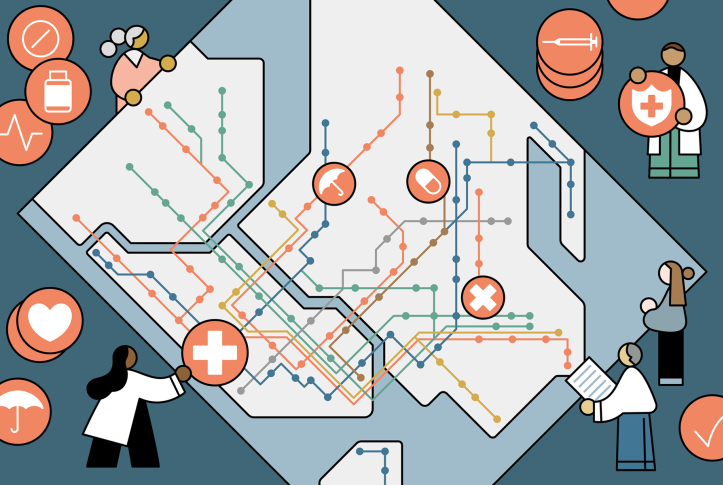
The prospect of 900,000 New York City residents losing Medicaid coverage under H.R. 1, the tax and spending law passed by Republicans last year, amounts to “bureaucratic violence,” says Dr. Alister Martin. In response, he’s devised a plan that starts on the streets of Queens and builds out from there, with strategically placed community health workers and people assisting with insurance enrollment.
On this episode of The Dose podcast, Dr. Joel Bervell talks with Dr. Martin, an emergency physician, former White House Fellow, and now health commissioner for 8.5 million New Yorkers. They discuss what a city can do when the federal safety net is pulled out from under its residents.
“Having people be at the center of our response is critically important, because that’s what’s going to make a difference. You can only move at the speed of trust in public health.”
Transcript
JOEL BERVELL: My guest on this episode of The Dose is Dr. Alister Martin, Commissioner of the New York City Department of Health and Mental Hygiene. Dr. Martin is an emergency physician, an assistant professor at Harvard Medical School, and his career is defined by his work at the intersection of clinical care and public health. As a White House Fellow, Dr. Martin was a senior advisor to Vice President Kamala Harris. And as a CEO of A Healthier Democracy, he directed efforts helping patients register to vote and assisted eligible families access cash assistance benefits. Today, Dr. Martin is back home in his native NYC. He’s living in Queens, and as a top health official in a city of about 8.5 million people, he’s a very busy man.
So, thank you so much, Dr. Martin, for taking a minute to have this conversation with me on The Dose.
ALISTER MARTIN: Dr. Joel Bervell, very good to pick up the conversation with you and very much looking forward to hearing where we go here. So, handing it back to you.
JOEL BERVELL: Absolutely. And it’s crazy because we were just talking about how it’s been years since we saw each other, but the last time was when you were in that role as a White House Fellow. So, it’s become full circle here.
ALISTER MARTIN: That’s right, that’s right.
JOEL BERVELL: So, you took over one of the largest health departments in the country at a moment when major federal changes to health coverage were already on the horizon due to H.R. 1, which is the Trump administration’s One Big Beautiful Bill Act. When hundreds of thousands of New Yorkers are at risk of losing coverage, what can a city actually do and where does your responsibility begin and where do you just not have the resources to replace what the federal government has taken away?
ALISTER MARTIN: Yeah, first of all, thank you for having me on, Joel. And to put it bluntly, what this bill is going to do for health coverage in this city is nothing short of bureaucratic violence. It is a way of curtailing health coverage for the most vulnerable New Yorkers. Our estimates internally here suggest that hundreds of thousands of New Yorkers could potentially lose their health coverage — up to 900,000 New York City residents. Because of these work requirements, because of these extra provisions, for instance, shortening the period of time that someone can retroactively be enrolled in Medicaid, because of the way that this is chipping at the underlying foundation of health coverage, I’m deeply, deeply, deeply concerned.
So, now what do we do about it? New York City Health Department is not going to stand idly by and watch this happen. We’re pushing our department to respond in ways that we have never done so in the past. And a couple of the highlights that I’ll give, and we’ll go deeper into each of these over the course of our conversation, are number one, we’re leveraging our board of health, which is a regulatory apparatus that we have at the health department. We’ve never leveraged this regulatory apparatus in the past to protect health coverage, and we did so in May.
Number two, we launched a brand-new team called the Health and Affordability Resource Team. These are dozens and dozens and dozens of community health workers, insurance enrollers who are hitting the streets as recently as about four weeks ago, doing the screenings, doing the enrollments, doing the education that’s needed to make sure people know what’s coming and know how to respond.
Number three, we are training our entire staff at the health department to take a no-wrong-door policy. What that means is, we have 7,000 staff here at the health department. Many of them, thousands of those staff are interfacing with New Yorkers on a daily basis, whether they’re the nurse in the Nurse-Family Partnership program in someone’s living room, whether they’re the public health doctor in one of our 11 clinics, whether they’re helping someone do their earned income tax credit, their taxes at one of our action centers. Bottom line is, every place that we have a New Yorker that we are interfacing with directly, we are using those as opportunities to screen people and to make sure that their Medicaid stays intact.
JOEL BERVELL: Yeah, that’s so powerful. And as you mentioned, you have 7K staff. They’re really focused on reaching people who are vulnerable to losing health care access and by deploying counselors in neighborhoods and communities. I know you’re working also with faith-based organizations, small nonprofits, other trusted partners. Can you give us a snapshot of how that works on the ground? How are counselors connecting with the people who most need their help, who may have limited mobility, limited English language skills, or just concerns about eligibility overall?
ALISTER MARTIN: Yeah, I mean, Joel, you nailed it, man. We have to go out of our way to reach them. There’s no-one-size-fits-all approach to messaging in public health. We need to identify who the best messengers are to deliver the message, and we need to help equip those messengers with accurate information and with the information that’s going to help move the needle.
I’ll give you an example. Just a few weeks ago, we connected with over 35,000 physicians, nurses, nurse practitioners, PAs, to get them the information they need to arm them to have these conversations with their patients. Just yesterday, I was with a room full of community-based organizations where we launched our webinar series over the course of the next three months, which is where we’re going to be teaching them how to use our pamphlets, our handouts, our posters to get the message out to their patients.
I’ll give you one more example. When we think about community health worker staff, you asked how’s it going to work? How actually is that going to be effectuated on the ground? So, we actually are going to be deploying our community health workers in the communities that have the highest likelihood of having health coverage drops, and these folks will be deployed to places like faith-based institutions or FQHCs, federally qualified health centers, or other community health centers to make sure we’re meeting people where they’re at.
JOEL BERVELL: As of January 1st next year, there will also be new federal work requirements, also part of H.R. 1, that are going to be enforced. I’m hoping if we can talk briefly about how that eligibility work requirement will impact people and how the city’s helping there.
ALISTER MARTIN: Yeah. Every single place where these work requirements have been instituted has had the same result: people lost coverage. This is what happened in Arkansas, this is what happened in Georgia, and if we are not careful, it is what is going to happen here in New York City. So, let me talk a little bit more about what these work requirements are. So, these are “community” requirements which mandate that an individual must do 80 hours a month of qualifying activities. Now these are things like working, volunteering, going to school as part of a university program. And so the bottom line is the federal government is essentially dictating to people what qualifies with regard to being worthy enough to be covered with Medicaid.
And so from our standpoint, this is the best metaphor that I can share here. It’s a little bit like the federal government has demanded that 4 million New York City Medicaid residents, you remember those puzzles, those jigsaw puzzles we used to do when we were growing up, right?
JOEL BERVELL: Yep.
ALISTER MARTIN: It’s asked these 4 million New York City residents to put this jigsaw puzzle together without knowing what the greater picture is that they’re trying to put together. And oh, by the way, every month they’re adding new jigsaw puzzle pieces. And so it’s our job to bring that full picture into view and to assist folks as they do this work. We can’t do this for them. I wish we could, but at the end of the day, we need to be standing shoulder to shoulder with New Yorkers to help them navigate this period.
JOEL BERVELL: Absolutely. And especially for individuals that have chronic illnesses, I mean, that may not even be a reality for individuals, so I appreciate you sharing that.
ALISTER MARTIN: That’s exactly right. I’m so glad you mentioned that, because there is in this first year a way in which individuals who have conditions which make them medically frail and unable to work or where their condition impacts their ability to work, there is a one-year period where they’ll be able to do a self-attestation. That essentially means they can write a letter themselves saying that they don’t think that they’re in a position to work.
Now that’s only for one year. The question becomes what happens after that? We have individuals who are dealing with end-stage cancer, people who have chronic liver disease, chronic heart disease, profound mental illness. Why are we asking these individuals to jump through these extra hoops just to get their medication, to get their surgery that they need, to get the treatment that they require? Why are we making them do all of these extra administrative steps?
And so from our standpoint, the New York City Health Department, our job we feel is to help mitigate the harms that H.R. 1 is going to cause.
JOEL BERVELL: Since coming into your post, you’ve also talked about how the department is leveraging AI, artificial intelligence, to identify health care access or alternatives for those who have lost coverage. I’m curious about how that’s going. There are about 350,000 people who live in NYC right now without a home, whether that’s at a shelter on the street or even in crowded apartments. Each one of those people represents a whole health history, and collectively that means a lot of data points. So, what exactly are you hoping to use AI to do or doing? And what safeguards are you also putting there in place to make sure that the people you’re trying to reach aren’t instead being missed by the technology?
ALISTER MARTIN: Well, it’s incredibly important to always start with the people. From our standpoint, having people be at the center, at the core of our response is critically important, because that’s actually what is going to make a difference. We have this saying here at the New York City Health Department, you can only move at the speed of trust in public health. And so at the end of the day, we need to have trusted relationships with our community health workers and the patients, our navigators and the patients that we see, with our enrollers, and the New York City residents that we are helping. The bottom line is it starts with people.
Now, given that, someone’s got to fill out the application. Someone’s got to sit there with hands on keyboards and they’ve got to type away and get that thing submitted. And this is where we think artificial intelligence can be helpful. It’s in the cutting of the bureaucratic extra steps that need to be taken.
I’ll give you an example. If I fill out a Medicaid application on behalf of a New Yorker and help them do that, but then that same New Yorker is also eligible for SNAP, shouldn’t the information that was used, like name, date of birth, address, email address, all these things just be ported over? Why do I have to sit and fill out two different applications? This New Yorker does not have time. Each one of these can take up to 45 minutes. They do not have time to sit and do two 45-minute application sessions with us.
And so it’s in this way that we’re using artificial intelligence as an enhancer when it comes to administrative issues that are related to H.R. 1.
JOEL BERVELL: Absolutely. I want to transition a little bit and talk about New York’s public health vending machines.
ALISTER MARTIN: Excellent.
JOEL BERVELL: They’re currently stocked with a lot of different products, we’ll talk about many of them, but I wanted to start with an interesting one that many people may not think maybe in a vending machine, naloxone or Narcan, the drug that can help reverse an opioid overdose if administered immediately. I know that getting the dose out of the machine is free, it’s anonymous, it can be accessed by anyone who puts in their zip code. It’s been about three years since these are put in some of the New York neighborhoods. Do you see data showing that these vending machines are helping?
ALISTER MARTIN: Well, the data is very clear that year over year we are now seeing consistent declines in overdose death rates here in New York City, and that’s a huge, huge, huge sign that what we are doing is working. We just recently opened up or launched our first set of vending machines in Staten Island about a month and a half ago. And you’re right, we have things like naloxone in those vending machines, safe syringe use kits in those vending machines, and other types of important harm-reduction tools and products in those vending machines. And so the bottom line is, any way that we can get these tools, these products, these resources in the hands of New Yorkers is an important intervention, and these vending machines really enable us to do that in a highly scalable way.
JOEL BERVELL: You mentioned some of the other things that are in there. There’s also, I know, fentanyl test strips, safer sex kits as well, including condoms, lube, sharps containers as you mentioned, sterile syringes. Do you know which items are most accessed, and are the machines restocked using data on what items are accessed the most or with any community feedback about what is used the most?
ALISTER MARTIN: Yeah, we’re constantly in conversation with our community-based organizations and partners in the communities where these vending machines are deployed, because that gives us a sense of what needs to be in the vending machine. And so we’re always responsive and sensitive to what the community’s telling us about what we need to provide. And by the way, it’s not just the vending machines, it’s also our other services, our syringe service providers, our street teams, our response teams that are staffed by our navigators in the mental hygiene division. All of this is dictated by what the community is telling us and where our interventions should be positioned.
JOEL BERVELL: Well, I want to transition again because we’re in back-to-school season, and I wanted to talk to you about something that’s been a hot topic, as I’m sure you know, vaccinations. So, you’re a veteran organizer in campaigning when it comes to getting folks to vaccinate and vaccinate their children. We know it’s medically advised and it’s a personal and public health issue, but vaccinations have become increasingly politicized, especially in this post-COVID era in the time of this administration. So, I wanted to take this opportunity to check in on how those conversations have been going for you personally and for your health department employees on the front lines with people in New York.
ALISTER MARTIN: Well, I think what people in New York right now are sensing and feeling is frustration and a degree of confusion. I think what they are hearing from this federal government, from what they’re hearing from our leaders in D.C. is essentially making it more challenging, more difficult for them to understand what’s right and what’s wrong. Just about a month ago, the President announced an executive order, signed an executive order that hinted at changing recommendations around which vaccines are recommended on the pediatric schedule. He also recommended in that executive order that these pediatric vaccines, for instance, be individualized. I’ll give you an example, the MMR [measles-mumps-rubella] vaccine, which is currently a combined vaccine. The recommendation from the President was to split those vaccines up, so each one of them should be given on its own. That might sound reasonable on first listen, but the reality is, what he’s suggesting is not possible at this moment. These vaccine manufacturers have said that it would take nearly a decade to move forward and do what the President is asking, which is to individualize these doses. Not to mention the position that he holds with regard to the executive order on reducing the number of recommended pediatric vaccines is not backed by evidence, science, new data, new studies.
So, here’s the thing, at the end of the day, New Yorkers need a trusted source, a trusted voice to be able to help guide their efforts when it comes to vaccinating themselves and their children. And the challenge is that the federal government is making it much more hard for them to believe in their position, their perspective. And so that’s where we come in at New York City Health Department to help clarify and make sure folks know right from wrong.
JOEL BERVELL: I’m sure it’s very frustrating when you’re having to not only combat misinformation just on the ground, but also coming from the federal government as well, especially when it comes to things like this. For kids to attend a New York City public school, they have to show proof of vaccination, and that’s nearly eliminated noncompliance among school-aged children, but there’s another interesting fact that’s less visible and does have health impacts. Many NYC parents delay or just don’t get their infants or toddlers vaccinated. I’m hoping you can talk about that gap, first why it matters, and then why there might be resistance that persists among parents with very young children.
ALISTER MARTIN: That’s a really, really good point. So yeah, let’s start with the data. So, our data demonstrates that roughly 95 percent of school-aged children have their recommended vaccines by the time, they’re required vaccines, by the time they matriculate into school. So, that’s some of the highest rates in the country, by the way. You also look at a vaccine like the measles vaccine, 97 percent of kids have their recommended vaccine by the time they enter into the kindergarten. And so the bottom line is, New Yorkers get this. New York families understand the importance of vaccines, they understand they’re safe, they’re effective.
Now, we are seeing decreases in vaccinations in the earlier cohorts, and I think that this is what we’re talking about right here. We just talked about it a couple of minutes ago, that it’s the confusion that is being injected into the system. It’s the doubt that is being raised in people’s minds because of what they’re hearing from previously trusted sources like the CDC [federal Centers for Disease Control and Prevention], like the White House. And so combating this misinformation is where we come in at the New York City Health Department.
JOEL BERVELL: As we get to the end of this conversation, I definitely want to talk about mental health. So, Mayor Mamdani’s platform included a pledge to create more accessible mental health resources for New Yorkers. Can you tell us where that stands right now and if there are community mental health navigators in place?
ALISTER MARTIN: Absolutely. Mayor Mamdani took the bold new step of launching the first ever Office of Community Safety. And this is, I think, a really, really important example that other cities could and should follow. It’s this idea that we cannot arrest our way out of the mental health crises that are so often at the core of some of the most challenging community violence situations that our city has seen. The posture is philosophically different. We need to be treating individuals. We need to come to individuals with a different set of tools, a different set of resources, a different set of asks for them. And that’s where the Office of Community Safety has really begun to lay the foundation of a new way to do this.
I’ll give you another example. With our co-response teams, this is a team that is essentially made up of individuals who are social workers who are working with police officers. And so if a police officer is needed because the situation is unsafe, if there is a threat of violence, okay, well, we have our police officers there, but there are also social workers there. And by the way, the police officers are trained in de-escalatory interventions and are trained to help navigate individuals who are in crisis to get to a safer place.
And so these are just some of the examples that I think really underpin what could be the future of how we respond to mental health crises that are happening in our city.
JOEL BERVELL: So, the Mayor has also released a budget plan for fiscal year 2027, which includes more than $11 million for a new effort to help those living with severe mental illnesses. What can you tell me about the street health outreach and wellness program?
ALISTER MARTIN: Well, I’ll tell you that one of the most important aspects of the work that we do with street outreach is our response engagement team. I was just out with them a few months ago right before we had a code blue, this was in the winter months, absolutely horrid stretch of cold, cold weather. And the response and engagement team, which is made up of navigators, they literally do rounds around blocks that are highly trafficked by folks who are unhoused, and they approach individuals who are sleeping on the streets.
And I watched one of our navigators who’s on our response and engagement team interview an unhoused individual, and then right there on the street, on 42nd Street, offered them, “We can help get you to a food pantry. We can help get you to a shelter.” And in fact, the individual said, “Absolutely, I’d love that.” We were able to make the call right then, and within 10 minutes, a New York City transport vehicle showed up and this individual was transported with all of his belongings, his suitcases, to the nearest shelter. And this individual, were it not for that engagement with this response engagement team navigator, he might’ve slept outside during this brutal cold stretch. And it’s not clear what would’ve happened, but it’s possible that he could have experienced either cold exposure injury or maybe even hypothermia.
And so the bottom line is that’s what the work looks like, and that’s happening every single day of the week.
JOEL BERVELL: I want to end this conversation by zooming out a little bit. You are still relatively new to this role. When you look ahead to the next few years, what’s the one thing that you hope will be meaningfully different about the health of New Yorkers because you were health commissioner?
ALISTER MARTIN: We are going to demonstrate how a health department addresses affordability in a meaningful and concrete way, whether it’s what we’ve been talking about today, which is helping individuals who are on Medicaid maintain their health coverage, or whether it’s helping individuals access the billions of dollars that go unspent every single year in cash assistance programs, or it’s helping individuals who are facing eviction navigate that difficult period of their lives and stay housed, or it’s helping to erase medical debt or prevent it from starting in the first place. These kinds of interventions are what underpin what health departments can and I believe should be doing to address affordability in the 21st century.
JOEL BERVELL: Well, Dr. Martin, we’ve covered a lot, from changes in health coverage and access, AI, mental health in New York City. And I think what really comes through is just how much of our health is shaped by decisions and systems far beyond the doctor’s office. You’re someone who’s seen it all from the policy angle to really just the front lines as an emergency medicine physician as well. So truly, thank you so much for joining me for shedding light on this issue and for all the work that you’re doing.
ALISTER MARTIN: Thank you so much, Joel. I really appreciate you, and good luck in residency.
JOEL BERVELL: Thank you. Appreciate it.
This episode of The Dose was produced by Jody Becker, Richard Shapiro, and Naomi Leibowitz. Special thanks to Barry Scholl for editorial support, Jen Wilson and Rose Wong for art and design, and Paul Frame for web support. Our theme music is “Arizona Moon” by Blue Dot Sessions. If you want to check us out online, visit thedose.show. There you’ll be able to learn more about today’s episode and explore other resources. That’s it for The Dose. I’m Dr. Joel Bervell, and thank you for listening.


