Policies at the U.S. State and Country Level
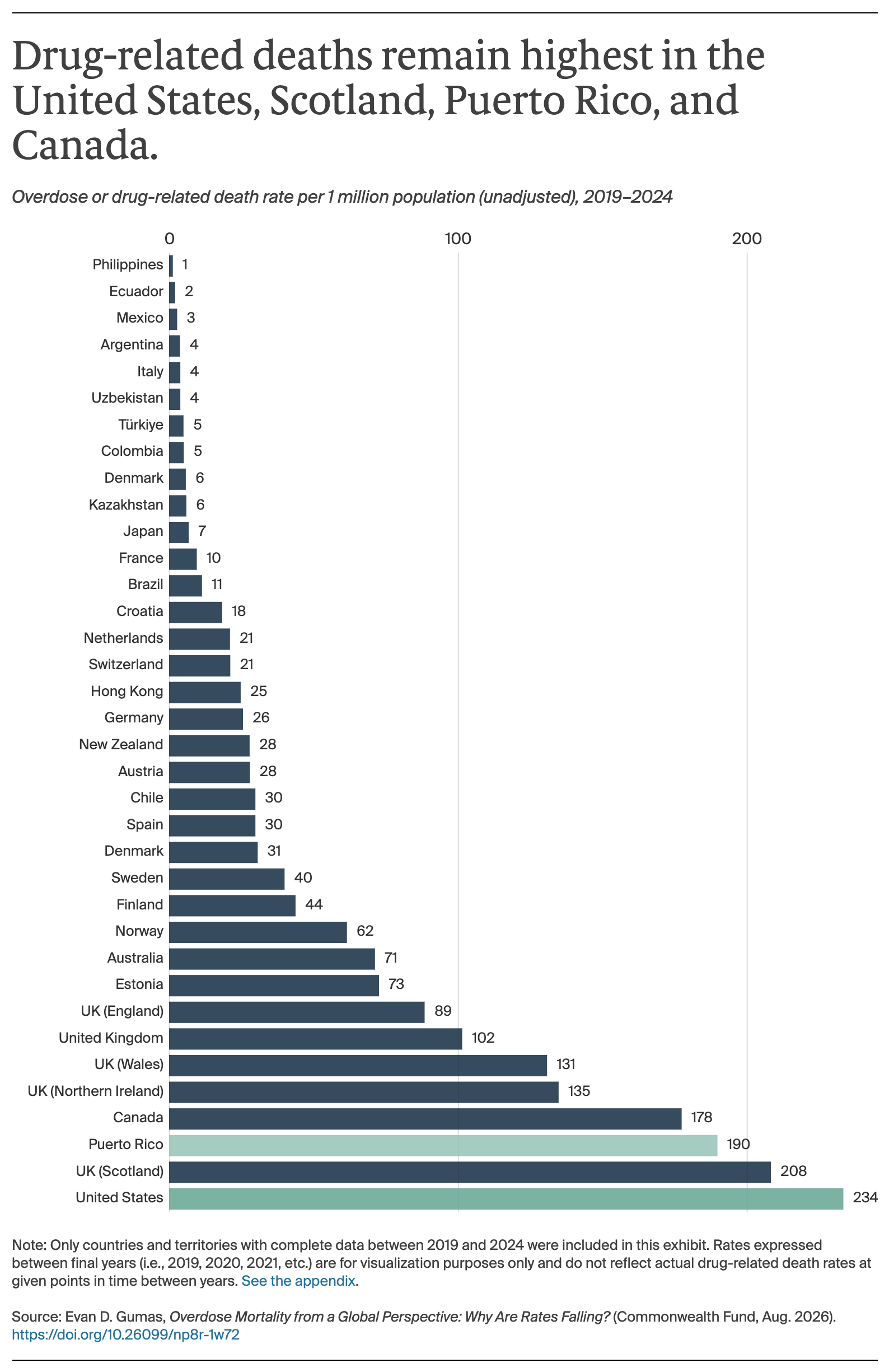
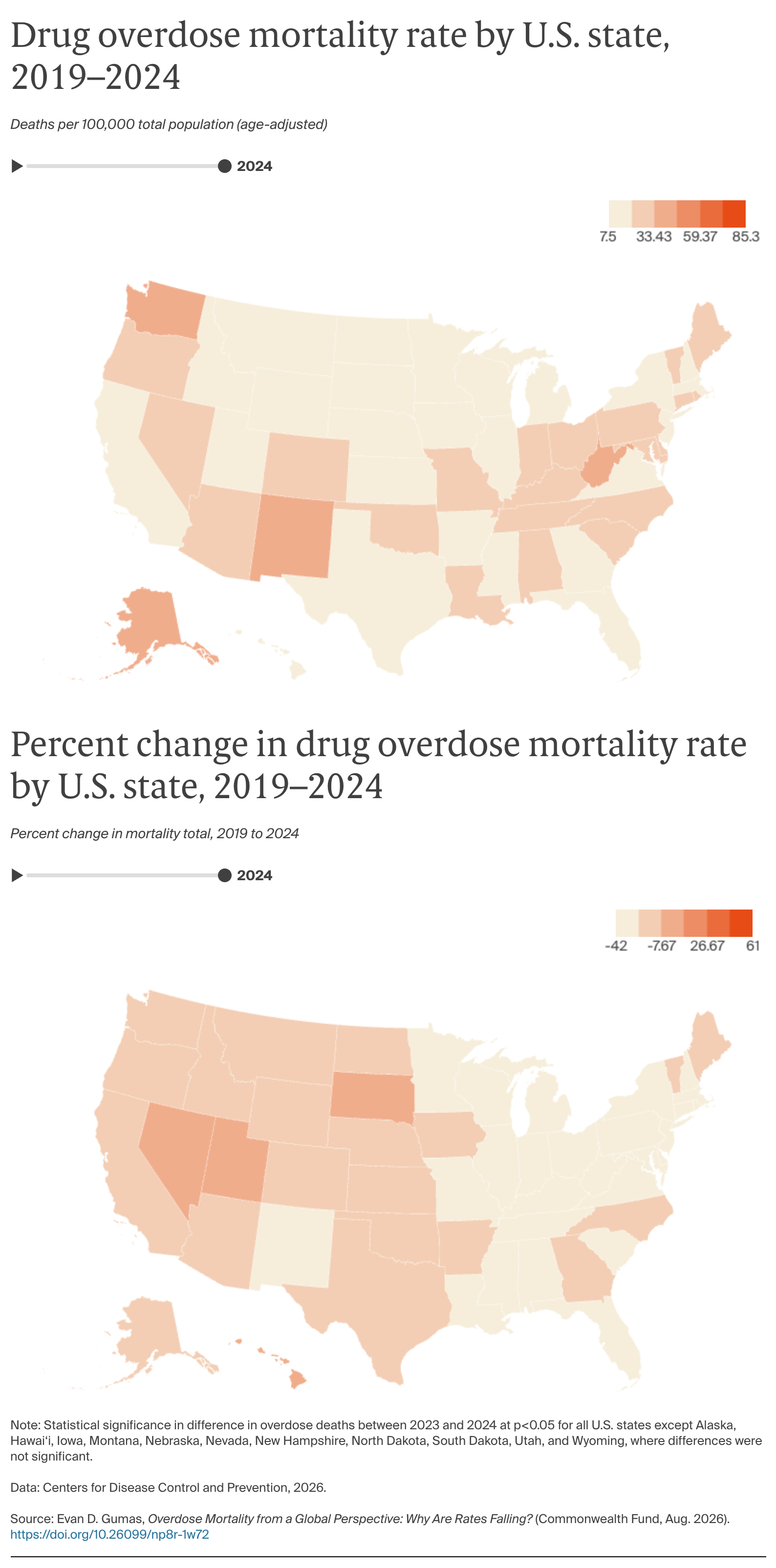
There is no single explanation for the 2023 to 2024 decline in overdose deaths across the U.S. states and countries in this analysis. Likely contributors include declining fentanyl potency, safer use behaviors — including increased drug checking (meaning services that analyze substance contents to inform people who use drugs what they are or may be consuming), less solo use, and a move from injection to smoking — as well as naloxone reaching saturation in many jurisdictions, and an aging population of people who use drugs. This trend may not hold: Available provisional 2025 data already show upticks in several states and Scotland.
One through line is clear, though: Years of sustained, layered policymaking accompanied the declines, particularly across five key themes.
1. Naloxone Saturation
Naloxone saturation refers to the idealized scenario where there is enough of the opioid overdose reversal drug available and accessible in an area such that it can be administered whenever an overdose occurs. Importantly, the U.S. Substance Abuse and Mental Health Services Administration (SAMHSA) required grantees to develop “naloxone saturation” plans as part of the 2022 State Opioid Response funding opportunity.
Maryland pairs centralized naloxone purchasing with decentralized, community-based naloxone distribution, more than doubling distributions between 2021 to 2025 to over 460,000 doses, with growth largely concentrated in low-barrier settings like vending machines, emergency medical services (EMS) leave-behind programs, and opioid-associated disease prevention and outreach programs (OADPOPs). Missouri’s centralized purchasing and distribution model leverages naloxone vendor competition to drive down naloxone costs statewide, and now has one of the highest rates of naloxone distribution in the country, reaching saturation in 2021. Virginia launched its REVIVE! program in 2013 which, in part, trains people to administer and distribute naloxone; following the states’ 2023 saturation plan, naloxone is largely free to high-risk populations across the whole state.
Access has also been key for several other states that saw significant drops, including Ohio (which offers no-cost naloxone as of August 2022, and has naloxone vending machines in prisons and at highway rest stops) and New York (which has the nation’s first online portal where all state residents can request free naloxone; 390,000 kits have been distributed since 2022).
Saturation remains volatile in some states. Colorado’s Naloxone Bulk Purchase Fund reaches all 64 counties at no cost, but funding is not permanent, so long-term saturation sustainability is unclear. Florida’s naloxone kit distribution nearly doubled from 2018 to 2024 (to 767,931 doses) though reported overdose reversals have stayed relatively flat, suggesting saturation may be outpacing use.
Scotland has long been held as a global standard for naloxone distribution: Over 12,000 law enforcement officers carry naloxone, and it is widely distributed for free through drug services, pharmacies, ambulances, prisons, peer networks, and a national click-and-deliver service. While law enforcement carrying naloxone is not unique to Scotland, it is more common in the North American and U.K. contexts, but it is expanding to other countries as well. In Canada, naloxone access has expanded since 2016, with kits now distributed at no cost through pharmacies, community organizations, and harm reduction programs, reaching hundreds of thousands of kits annually by 2024. Spain is in the midst of distributing free intranasal naloxone through its harm reduction centers, expanding access beyond people who use drugs to family members, peers, and professionals.
2. Broader Harm Reduction Responses
Drug testing strips — like fentanyl or xylazine test strips — are a widespread harm reduction strategy that allow for quick and direct checking of drug samples for the presence of unwanted substances like fentanyl. While research on the direct link between drug testing strips and reduced overdose mortality is varied, evidence strongly suggests that use of drug testing strips enables better risk reduction behaviors and engagement with other harm reduction strategies.
In some states, drug testing strips may still be criminalized under drug paraphernalia laws, or certain test strips for some drugs (like xylazine or medetomidine) may still be criminalized while others are legalized. Ohio legalized fentanyl test strips in 2023 and has since preemptively decriminalized access to testing strips for emerging substances like xylazine, medetomidine, nitazenes, and others via executive order in October 2025. Delaware recently passed legislation to decriminalize the full range of harm reduction supplies to cover emerging substances as they appear, instead of after they have appeared. Delaware has previously invested heavily in access to test strips through a network that includes physical therapy offices, chiropractic practices, construction sites, and restaurants.
Texas leveraged a multimedia public awareness campaign as a key driver in its “One Pill Kills” harm reduction response to educate the public on the dangers of fentanyl in the drug supply. Maryland’s Rapid Analysis of Drugs (RAD) program collects drug samples through OADPOP participants and submits them to the National Institute of Standards and Technology for analysis; the program has processed thousands of samples across numerous sites and jurisdictions, helping inform where resources are directed within the state.
Save Lives Oregon provides lifesaving supplies, including naloxone, at no cost to organizations that distribute them to people at risk of overdose. It has distributed more than 770,000 doses of naloxone since 2021, with more than 27,000 overdose reversals reported. Participating organizations submit quarterly reports. The distribution of naloxone is not conditioned on substance use treatment. Colorado passed legislation in 2024 allowing schools to provide naloxone and fentanyl test strips for students, as well as clarifying legal issues around naloxone administration and possession. Scotland meanwhile has begun rolling out a drug checking service in four cities with a national laboratory for processing, though this service is limited to users over age 18 under U.K. Home Office conditions.
3. Expanded Coverage and Access to Treatment
In the United States, Medicaid expansion is the single most influential lever for coverage and access to medication for opioid use disorders (MOUD). In West Virginia (which has approximately 30% of its population enrolled in Medicaid) and Virginia (approximately 20% enrolled), expansion has allowed for significant improvement in access to MOUD. Ohio has prioritized removing barriers on the provider side through mobile clinics and updated prescribing rules, while Maryland has launched targeted buprenorphine outreach and a new grant program to train paramedics to administer buprenorphine on site immediately following a nonfatal overdose. The same Maryland legislation that established the EMS buprenorphine grant program also established a working group, which recently submitted recommendations to improve MOUD treatment access, notably highlighting the need to reduce geographic gaps through telehealth or by using federal Rural Health Transformation Program grant dollars, and encouraging low-barrier access to MOUD treatment, among many others. Similarly, Oregon has leveraged its certified community behavioral health clinics to provide integrated, accessible care, and coordinates care through a single entity under its Medicaid program.
The number of methadone clinics in Colorado has increased from 25 to 54 over five years; improved patient retention following several state regulatory changes has seen a flattening of overdoses in clinic settings. In New York, methadone access grew from 29 to 43 counties over five years, and methadone programs increased from 98 to 137, supplemented by mobile medication units and a new integrated outpatient model in 70 statewide programs.
Globally, Spain’s national health system guarantees assessment and treatment within 15 days of request for access and has also begun shifting to long-acting injectable buprenorphine. Sweden’s decade of MOUD expansion has contributed to a roughly 25 percent reduction in deaths since 2017.
4. Integration with the Prison System
Drug overdoses are one of the leading causes of death among people who have recently been released from prison. In the U.S. — which has one of the highest incarceration rates and largest prison populations in the world — drug use disorders are 12 times higher among those at prison intake versus the general population, and opioids make up more than half of postrelease overdose deaths. The two weeks to one month after release from a correctional facility represent a period of significantly elevated risk of overdose, something noted in nearly every jurisdiction in this analysis as a crucial element to address.
West Virginia — which has one of the highest incarceration rates per 100,000 people in the world — ensures each person is actively connected to community care upon release. Maryland’s 2024 Medicaid 1115 waiver extended coverage to incarcerated people 90 days before release, with the waiver set to pilot in two facilities in 2026 before statewide expansion. In Ohio, naloxone release kits are provided to everyone upon reentry, and in 2024, initiated a pilot program to provide long-acting injectable buprenorphine on release. Delaware is working to formalize a Recovery Friendly Workplace initiative which will extend naloxone access and recovery support into human resources policies of participating employers. New York provides services in all 58 jails and 41 prisons, reaching nearly 20,000 people with a noted sevenfold increase in medications for opioid use disorder between 2022 to 2025.
Canada and Scotland both distribute naloxone in prisons and upon release. Canada seeks to coordinate care with Indigenous governance structures to support provincial Indigenous populations upon reentry; linkage with community care is a noted continued challenge for Scotland.
5. Enhanced Data Infrastructure and Coordination
Timely overdose surveillance data allows for more rapid deployment of prevention resources to communities most highly impacted by the overdose crisis. Rhode Island’s Overdose Spike Alert System (OSAS) triggers a public health alert and response once nonfatal overdoses cross a 55-case threshold in a week. Ohio’s RecoveryOhio Early Warning system predicts ZIP codes at a heightened overdose risk 30 days in advance using emergency medical reports, naloxone administration, and law enforcement data. Likewise, Virginia shares available information with neighboring states to anticipate shifts in drug usage patterns before they manifest as local deaths. In Missouri, in response to an increase in overdose deaths among Black men in North St. Louis, resources were funneled to several Black-led organizations in the area, which in large part supported formalized drop-in centers; reported deaths in the area have since plummeted.
Coordination has also been crucial: Oregon and Idaho’s data-sharing agreement tracked a measurable decrease in fentanyl in the drug supply between 2023 and 2024, which would not have been flagged without cross-state surveillance. Massachusetts and West Virginia monitor regional drug supply trends, with Pennsylvania cities like Philadelphia and Pittsburgh serving as key early warning zones. Close coordination with law enforcement in West Virginia helps inform harm reduction responses and treatment planning at the federal and community levels.
At the national level, the National Drug Early Warning System operates a network of sites across the U.S. that work with community epidemiologists and over 1,700 community partner organizations that provide wastewater analysis, darknet monitoring, and real-time 911 data to issue public health alerts for researchers, policymakers, communities, and first responders, well before new drug threats escalate to crisis level. Canada’s response networks operate at the regional, provincial, and territorial levels with national level monitoring of emerging issues and trends as well as analysis of seized substances and wastewater, while Scotland has leveraged its police radar system to track near-real-time alerts in emerging trends.
Conclusion and Recommendations
Evidence at the U.S. state and international level underscores how important strong system supports are to prevent overdose deaths. As noted, provisional 2025 data show an additional 70,000 lives lost to overdose in 2025, with several states seeing upticks in deaths after a year of declines in 2024.
Increases in drug deaths in other countries like Argentina (which had a 32% increase in drug overdose deaths between 2023 and 2024) and Brazil (which had a 21% increase during the same period) point to the importance of strong social services as social programs and harm reduction services have been disrupted across both countries against broader socioeconomic instability. In Brazil, drug-related mortality rates have also risen rapidly as synthetic opioids flood the supply.
In April 2026, SAMHSA announced that agency funding can no longer be used for drug use supplies including drug testing strips. Likewise, cuts to Medicaid — the main source of coverage for adults with opioid use disorder and those receiving treatment services — will significantly and adversely impact access to MOUD and naloxone.
However, setbacks are not limited to the United States: Increasing backlash to harm reduction saw the ending of provincial funding for provincially funded supervised consumption sites in Alberta and Ontario, Canada, as of June 2026, despite overwhelming evidence supporting their efficacy and cost-effectiveness.
To sustain and encourage declines in preventable deaths due to drug overdose in the United States, options include:
- Sustained funding for existing programs: Evidence from U.S. states and overseas underscores the necessity of sustained funding for policies that support prevention and treatment. Cuts to Medicaid funding and federal and state policy changes will create catastrophic gaps in coverage, which could ultimately lead to more overdose deaths.
- Leveraging new financing models: Based on evidence from multiple U.S. states, leveraging models like value-based payment for treating conditions like opioid use disorder could be crucial for improving and incentivizing high-quality care and healthier outcomes, while lowering health care costs.
- Targeting policies for specific communities: The overdose crisis has hit different communities to varying degrees of intensity (see the appendix for overdose deaths and decreases by race and ethnicity). Continuing to leverage community care models, like community-based Native and Tribal organizations for Indigenous populations, will be vital to ensuring equitable overdose declines.
- International coordination: Drug-related mortality is an inherently global issue. Data and response coordination, uniform mortality definitions, and shared early-warning systems are essential to cross-border system preparedness and ability to respond meaningfully in real time.
Mortality declines in the U.S. and internationally are a step in the right direction, but continued efforts to reduce preventable deaths due to drug use are far from over. The most successful policies will prioritize supporting, sustaining, improving, and integrating models that have demonstrated they can help save lives.