Relative Value Scale Update Committee
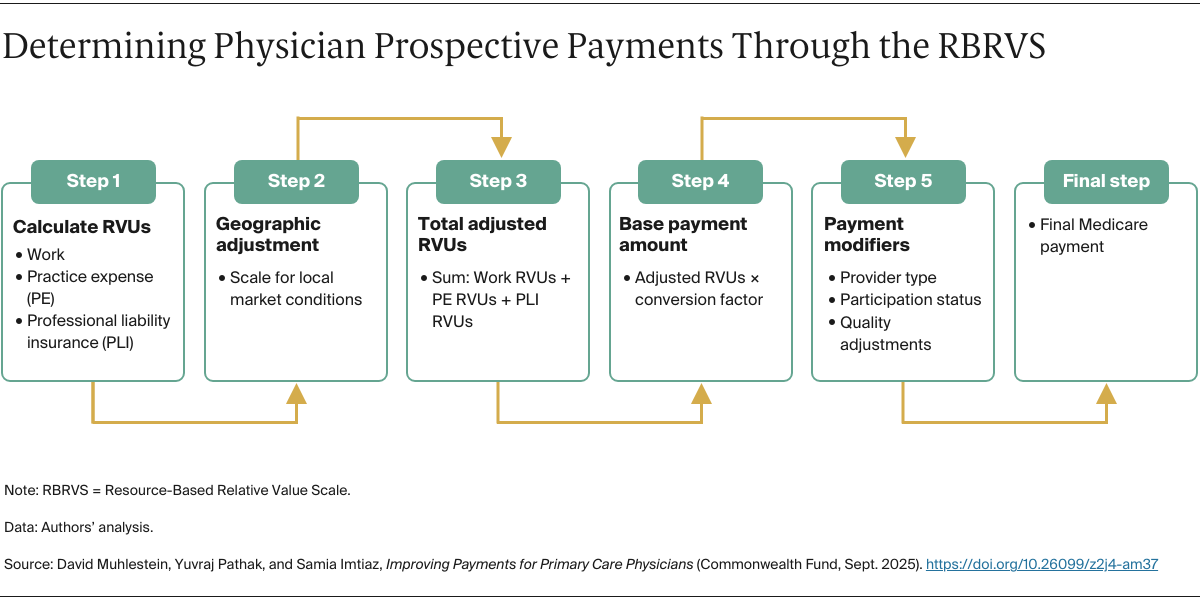
While CMS is responsible for annual updates to the RBRVS, it relies on external recommendations on the relative value of physicians’ work from the Relative Value Scale Update Committee (RUC), established by the American Medical Association (AMA).13 The RUC consists of 32 volunteer physicians, with 22 permanent seats represented by medical specialty groups and four seats that alternate between specialties. Furthermore, there are seats for the RUC chair, the cochair of the RUC Healthcare Professionals Advisory Committee Review Board, and representatives from the AMA, American Osteopathic Association, the chair of the Practice Expense Review Committee, and CPT Editorial Panel. The committee is intended to provide physicians with a voice in shaping Medicare payment rates based on the resources needed to provide services. The specialty societies that constitute the RUC elicit information from their members about the estimated time and intensity of their work for different procedures through standardized surveys.14 While the RUC serves an unofficial advisory role, CMS has historically adopted about 90 percent of its recommendations.15
Primary care physicians represent only 19 percent of RUC seats, despite accounting for nearly a quarter of the physician workforce and handling 35 percent of all patient visits.16 The RUC has been criticized for specialty bias, which has resulted in procedures and the direct provision of specialized treatment being valued more than treatment plans, diagnosis, coordination, and long-term patient care — undertaken largely by primary care physicians.17 The relative overvaluation of procedural services and the undervaluation of nonprocedural services, as well as the cognitive work involved in creating treatment plans and in diagnosis, coordination, and long-term patient care, has led to the significant payment gap between primary care and specialists.18
In addition to specialist bias, the RUC has been criticized for its lack of transparency and objectivity. The AMA has financial interests in the billing codes: it receives licensing royalties from effectively all payers and providers for the use of Current Procedural Terminology codes used for RVUs, worth hundreds of millions of dollars each year.19 Members of the RUC also sign nondisclosure agreements and vote on the valuation of services via a secret ballot, preventing external scrutiny of the RUC process.20
While medical specialty groups undertake surveys of their members, the sample sizes are small and the data are self-reported. The results are therefore subject to bias and inaccuracies that inflate procedural valuations.21 The survey-based time estimates that shape RUC recommendations are also highly variable and inaccurate.22
Given these shortcomings, reforms are needed to improve accuracy and fairness of physician payment rates and to bridge the gap between procedural services and primary care.
Improving How Primary Care Providers Are Paid
Recommendations for improving how primary care providers are paid fall under three categories: 1) changes that CMS can implement under current law, 2) adjustments to how CMS uses RUC-produced recommendations, and 3) legislative opportunities.
Opportunities for CMS Under Current Law
Reevaluate the RVU work component to better recognize longitudinal care.
The RVU work component is an imperfect measure of the effort involved in delivering care. For example, it does not sufficiently account for the expertise needed to care for patients with complex needs and multiple comorbid conditions who might need ongoing care for extended periods of time (longitudinal care). CMS could increase the RVU work component for longitudinal care to better recognize the necessary time, effort, and skill.
Create an alternative committee to evaluate payments.
CMS could create an alternative to the RUC that represents physicians more fairly and uses reliable data to set payment rates. This new committee, which could be funded through the Center for Medicare and Medicaid Innovation with the goal of improving health outcomes through investment in primary care, would be able to address the committee’s shortcomings. It would obtain more accurate data, for example, by leveraging electronic health records to accurately measure effort; decrease the number of billing codes; and include a more representative number of providers.23
Pilot a global primary care payment model.
CMS could adopt a global or prospective payment model that compensates the primary care providers with a fixed monthly payment per patient instead of per visit or service. Certain costly procedures could still be reimbursed, while most payments become predictable and based on the existing system. This could build on previous demonstration projects, such as Comprehensive Primary Care, Comprehensive Primary Care Plus, and Primary Care First, but offer a larger prospective payment to primary care providers.24
Allocate funding based on categories of care.
CMS could set a target share of total spending on primary care and then allocate payments within that fixed budget. This approach ensures consistent investment and encourages long-term growth in the primary care workforce. An estimated 5 percent of Medicare spending is on primary care, and CMS could increase this to 8 percent and adjust rates for primary care services up or down, depending on utilization.25
Opportunities for CMS and the RUC
Put the current RUC through peer review.
CMS could require the RUC to be transparent and conduct an internal or external peer review of the committee’s methodology. Such a review could bring transparency to the RUC’s methodology, which can potentially lead to improvements in the methodology. This also could serve to increase trust in the RUC’s process. In the absence of transparency, CMS could decide to significantly discount or even disregard the RUC’s recommendations.
For procedures with variable timeframes, CMS could pay based on better performance.
For some procedures, like surgery, work values are based on median or average completion times. Anchoring work values to higher performers could incentivize providers to be more efficient. For example, for an average completion time of 30 minutes with a standard deviation of 10 minutes, CMS could decide to pay based on one standard deviation away, or 20 minutes of effort. This would encourage specialists to provide care efficiently but also give flexibility to increased payments for the work component of primary care services.
Establish an alternative valuation framework for primary care within the existing RUC structure.
Instead of replacing the RUC, an additive approach would involve creating a parallel valuation pathway focused on primary care services. This would ensure adequate consideration of key aspects of primary care, such as coordination, preventive care, and cognitive effort, in payment valuations.26 Budget neutrality could be achieved by allocating a larger share of Medicare spending to primary care.
Ideas to Improve Payment Through Legislation
Create a statutory “cognitive services modifier.”
A billing code modifier specifically for primary care providers could help them bill for cognitive work. A cognitive services modifier would apply an add-on payment to services involving evaluation, diagnosis, counseling, and care coordination for patients with multiple chronic conditions, which would increase reimbursement for cognitive, nonprocedural care. This would help capture the value of time-intensive, decision-oriented work typically performed by primary care and other cognitive services. While there are codes for care management services, this would allow existing billing codes to receive increased payments for medically complex patients.27
Create an alternative for PCPs to the RBRVS.
A separate payment model could be created for primary care that accounts for the unique nature of long-term and preventive care. Legislation for the development of such a payment structure — called the Pay PCPs Act of 2024 — has been proposed but not enacted as of August 2025.28
Include an expected benefit component to the calculation.
An additional expected benefit component in RVUs would involve accounting for the clinical value or health outcome associated with a service at the population level. This would ensure that services with high impact on patient health, such as prevention or chronic care management, are more appropriately valued and reimbursed.
Conclusion
The RUC’s role in determining the reimbursement rates for primary care, which is undervalued relative to other specialties, has come under scrutiny for its underrepresentation of primary care physicians and lack of transparency around its methodology.
CMS realizes the importance of improving primary care payments as evidenced through the proposed efficiency payments in the 2026 Medicare Physician Fee Schedule rule. Their proposal to move away from survey data to more rigorous methods to inform payment updates is a step in the right direction.29