
Advanced Search

Advanced Search

Current Filters

Filter your query

Publication Types

Other

to

Issue Briefs

/

The Impact of Proposed Federal Medicaid Work Requirements on Hospital Revenues and Financial Margins

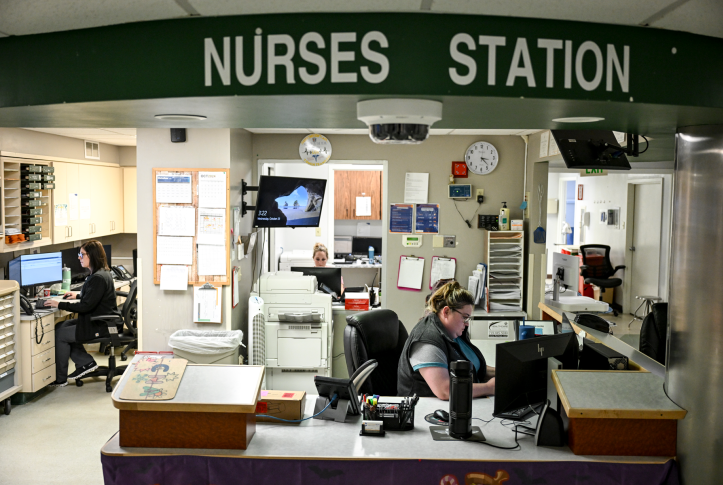
Nurses working at computers in a cluttered hospital nurses station

The nurses station at Lincoln Health Community Hospital in Hugo, Colo, on October 23, 2024. Proposed federal Medicaid work requirements could lower hospital revenues and force hospitals to reduce staff or eliminate services. Photo: AAron Ontiveroz/Denver Post via Getty Images

The nurses station at Lincoln Health Community Hospital in Hugo, Colo, on October 23, 2024. Proposed federal Medicaid work requirements could lower hospital revenues and force hospitals to reduce staff or eliminate services. Photo: AAron Ontiveroz/Denver Post via Getty Images

Toplines
  • Introducing federal Medicaid work requirements for enrollees in the ACA’s Medicaid expansion will lead to coverage losses that will reduce hospital revenues, increase uncompensated care costs, and lower operating margins.

  • These adverse outcomes will affect not only Medicaid patients but the communities served by these hospitals.

Toplines
  • Introducing federal Medicaid work requirements for enrollees in the ACA’s Medicaid expansion will lead to coverage losses that will reduce hospital revenues, increase uncompensated care costs, and lower operating margins.

  • These adverse outcomes will affect not only Medicaid patients but the communities served by these hospitals.

Downloads

Abstract

  • Issue: Analyses of mandatory federal work requirements for Americans covered by the Affordable Care Act’s Medicaid eligibility expansion have focused on potential coverage losses, overlooking the financial impact on health care providers.
  • Goal: To assess the financial impact of the work requirement policy on hospitals in affected states.
  • Methods: We used Urban Institute estimates of coverage losses to project the financial impact on acute-care hospitals.
  • Key Findings and Conclusion: Hospitals in Medicaid expansion states could see operating margins reduced by an average of 11.7 percent to 13.3 percent. Safety-net hospitals could be disproportionately impacted: their operating margins could fall by an average of 25.9 percent to 29.6 percent, and even more in certain states and in rural areas. Both Medicaid enrollees and the broader communities that hospitals serve would likely be affected, as lower revenues and increased uncompensated care costs could force hospitals to reduce staff or eliminate services.

Background

Congress recently passed unprecedented cuts to federal Medicaid spending that will not only impact beneficiaries but the entire safety-net system that serves a wide array of patients and families. To achieve a large portion of these cuts, lawmakers adopted mandatory federal work requirements for people who qualified for Medicaid through the Affordable Care Act’s (ACA) expansion of eligibility. Under this policy, enrollees ages 19 to 64 must engage in at least 80 hours per month of community engagement activities (such as work, volunteering, or enrollment in an educational program) and must verify these activities twice a year to retain coverage. The law exempts caregivers of dependent children under age 14, people with disabilities, people who are pregnant, and several other groups.1

Forty states, along with the District of Columbia, have expanded Medicaid eligibility to nonelderly adults with incomes up to 138 percent of the federal poverty level (FPL) — more than 16 million people in 2024.2 In these states, Medicaid beneficiaries could lose health insurance if they cannot find work, are unable to document the required number of hours they work, or cannot document an exemption. While the vast majority of Medicaid beneficiaries subject to the requirements either work or qualify for an exemption, millions could lose coverage because of difficulties they experience in navigating complex work-reporting and verification systems or the work-requirement exemption process. Others who could lose their Medicaid are people who have been laid off or are temporarily unemployed.

While the work requirement policy could generate federal and state savings by reducing the number of people that receive Medicaid insurance, it could leave many uninsured. This would lead to lower revenues and higher uncompensated care costs for hospitals.

Alongside the potential loss of coverage for Medicaid beneficiaries is the work requirement policy’s impact on hospitals — a subject that has received less attention. Coverage losses will affect hospitals by reducing their revenue and increasing uncompensated care costs. These adverse outcomes will affect not only Medicaid patients but the broader community as well, since lower revenues and increased uncompensated care could force many hospitals to reduce staff and payroll or eliminate important clinical services used by all patients.3

Based on the impact that Arkansas and New Hampshire’s state work requirement programs had prior to their halt in 2019, the Urban Institute has estimated that about 5.5 million to 6.3 million people across all Medicaid expansion states would lose access to coverage if such a policy were fully implemented in 2026.4 Although the Urban Institute report did not attempt to estimate the number of people losing Medicaid coverage who would become uninsured, our estimates show that 5.1 million to 5.8 million people would become uninsured and that 400,000 to 500,000 individuals would either enroll in employer-sponsored health coverage or purchase nongroup health insurance (see “How We Conducted This Study” for details). In comparison, the Congressional Budget Office (CBO) estimated that 5.2 million people would lose Medicaid coverage and 4.8 million would become uninsured by 2034.5 The Urban Institute study assumed that Medicaid agencies would rely on existing state databases to automatically determine whether enrollees are meeting work requirements or are exempt from the policy, using data-matching processes similar to those that Arkansas and New Hampshire used previously. The study’s estimates also assumed that noncompliance rates for people not automatically exempted from the reporting requirement are consistent with the noncompliance rates observed in Arkansas (with a low-range estimate of 72%) and New Hampshire (with a high-range estimate of 82%).

In this brief, we examine the potential financial impact of federal mandatory work requirements on hospitals once the new policy is implemented for Medicaid expansion enrollees in 40 states and the District of Columbia. Our analysis provides high- and low-range estimates of the impact of Medicaid coverage loss on revenues, uncompensated care costs, and financial margins for hospitals in the affected states. For modeling purposes, we assume the policy is fully implemented in all expansion states in 2027. We present impact estimates by state and focus on two specific subgroups of hospitals: safety-net hospitals and rural hospitals (see “How We Conducted This Study” for details).

How Medicaid Coverage Losses Impact Hospital Finances

Reductions in Medicaid coverage will decrease Medicaid payments and increase uncompensated care costs, resulting in lower hospital operating margins. Exhibit 1 shows the projected baseline revenues and expenses by payer source under current laws for 2,958 general acute-care hospitals in the 40 expansion states and the District of Columbia, compared to projections if the proposed work requirement policy were to be fully implemented.
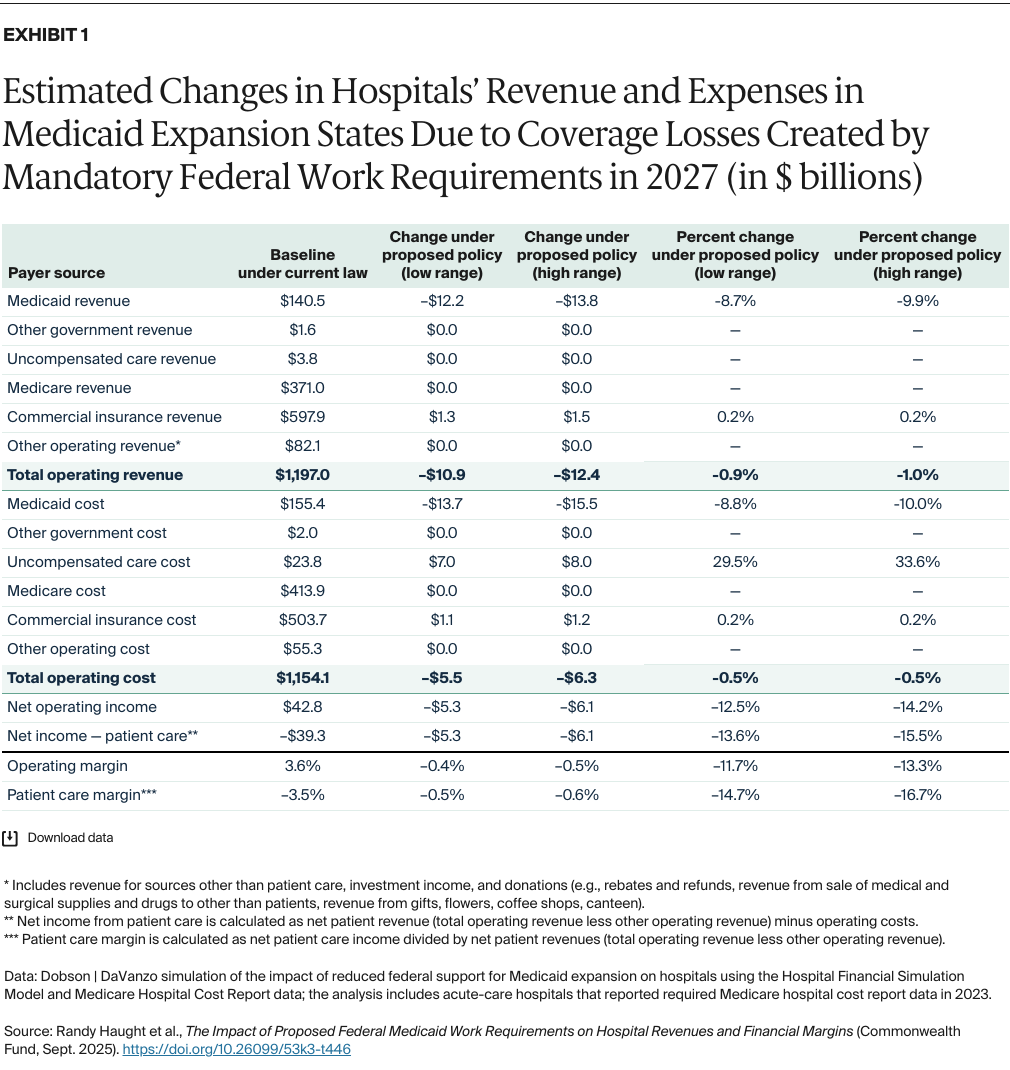
Haught_impact_medicaid_work_requirements_hospitals_Exhibit_01

The Dobson | DaVanzo Hospital Finance Simulation Model (HFSM) incorporates the following dynamics of how changes in coverage across a population would affect hospital utilization, costs, and revenues:

  1. The Urban Institute estimates that about 5.5 million to 6.3 million Americans would lose Medicaid coverage. Based on this projected level of coverage loss, the HFSM estimates that hospitals’ expenses for Medicaid patients would decline by $13.7 billion to $15.5 billion (−8.8% to −10.0%) and corresponding revenues would decline by $12.2 billion to $13.8 billion (−8.7% to −9.9%).
  2. We estimate that of those who lose Medicaid coverage, about 5.1 million to 5.8 million would become uninsured. With this change in coverage status, the HFSM estimates that hospitals’ uncompensated care expenses would increase by $7.0 billion to $8.0 billion (29.5% to 33.6%), as former Medicaid beneficiaries lose their coverage and become uninsured.
  3. We further estimate that of the Americans losing their Medicaid coverage, about 0.4 million to 0.5 million would either enroll in employer-sponsored health insurance or purchase nongroup health plans. For this segment, the HFSM estimates that hospitals’ expenses for commercially insured patients would increase by $1.1 billion to $1.2 billion (0.2%) and corresponding revenues would increase by $1.3 billion to $1.5 billion (0.2%), based on the assumption that payment rates would remain similar to those for current commercially insured patients.

The work requirement policy would reduce hospital expenses by $5.5 billion to $6.3 billion because people use hospital services less when uninsured compared to being covered by public or commercial insurance. As such, hospital revenues are projected to decline by $10.9 billion to $12.4 billion (representing $12.2 billion to $13.8 billion in Medicaid revenue reductions partially offset by a $1.3 billion to $1.5 billion increase in commercial insurance revenues). Thus, hospital net operating income is projected to decline, resulting in hospital operating margins falling by 11.7 percent to 13.3 percent.

To help offset increased uncompensated care costs in hospitals, Medicare could increase disproportionate share hospital payments and uncompensated care payments to hospitals. Local governments also could increase tax appropriations to hospitals for uncompensated care. However, we did not assume that these amounts change in this analysis.

How Medicaid Coverage Losses Impact Safety-Net Hospitals

The financial impact of the proposed work requirement policy on hospitals will vary dramatically across different groups of hospitals, depending on their patient–payer mix and the level of Medicaid expansion enrollment in their respective states. Safety-net hospitals would likely be disproportionately impacted because they treat a higher share of Medicaid and low-income patients.

On average, the 567 safety-net hospitals identified in this study located in Medicaid expansion states are estimated to receive about $90 million per hospital in Medicaid revenues (24% of net patient care revenues) and provide $10.3 million per hospital in uncompensated care (2.6% of total operating expenses) in 2027 (see Appendix B for a list of these hospitals). In contrast, other acute-care hospitals are estimated to receive about $37 million per hospital in Medicaid revenues (10% of net patient care revenues) and provide $7.5 million per hospital in uncompensated care (1.9% of total operating expenses).

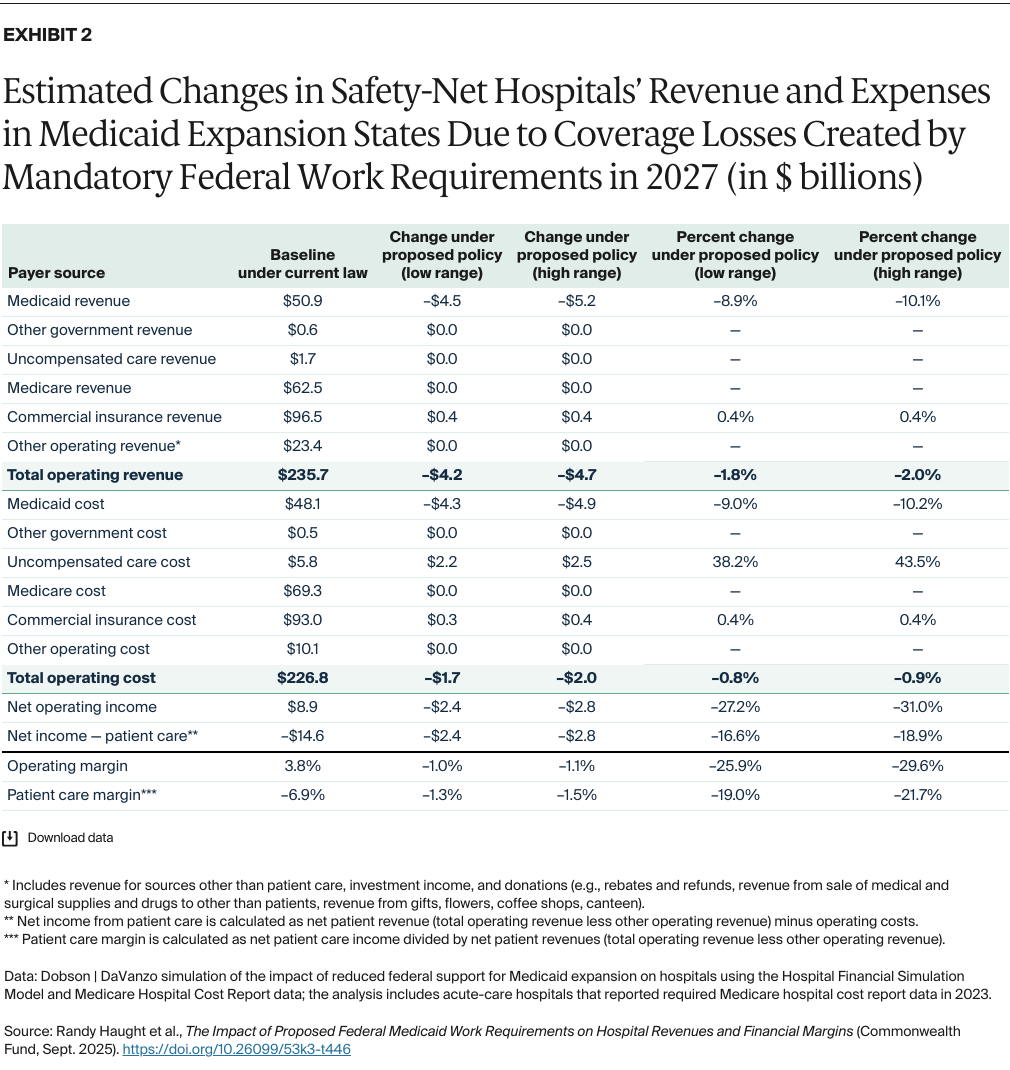
Net operating income for safety-net hospitals would decline by $2.4 billion to $2.8 billion, which would reduce operating margins by 25.9 percent to 29.6 percent (Exhibit 2).

Haught_impact_medicaid_work_requirements_hospitals_Exhibit_02

Safety-net hospitals are heavily dependent on revenues from treating Medicaid patients. As a result, the reduction in Medicaid revenues due to implementation of work requirements would have a larger impact on total operating revenue loss (−1.8% to −2.0%) compared to the average across all hospitals (−0.9% to −1.0%). Because most of these Medicaid patients would likely become uninsured, safety-net hospitals would experience a larger increase in uncompensated care costs (38.2% to 43.5%) compared to the average across all hospitals (29.5% to 33.6%).

Net operating income would decline by $2.4 billion to $2.8 billion (a reduction of 27.2% to 31.0%), which would result in a 25.9 percent to 29.6 percent decrease in operating margins for safety-net hospitals compared to 11.7 percent to 13.3 percent across all acute-care hospitals.

State-Level Impacts of Medicaid Coverage Losses on Safety-Net Hospitals

While all expansion states would be impacted by the introduction of mandatory federal work requirements for expansion populations, the financial impact on hospitals would vary across states depending on the size of the state’s Medicaid expansion population. Additionally, safety-net hospitals in expansion states have benefited from reduced uncompensated care costs, a benefit that would be reversed.

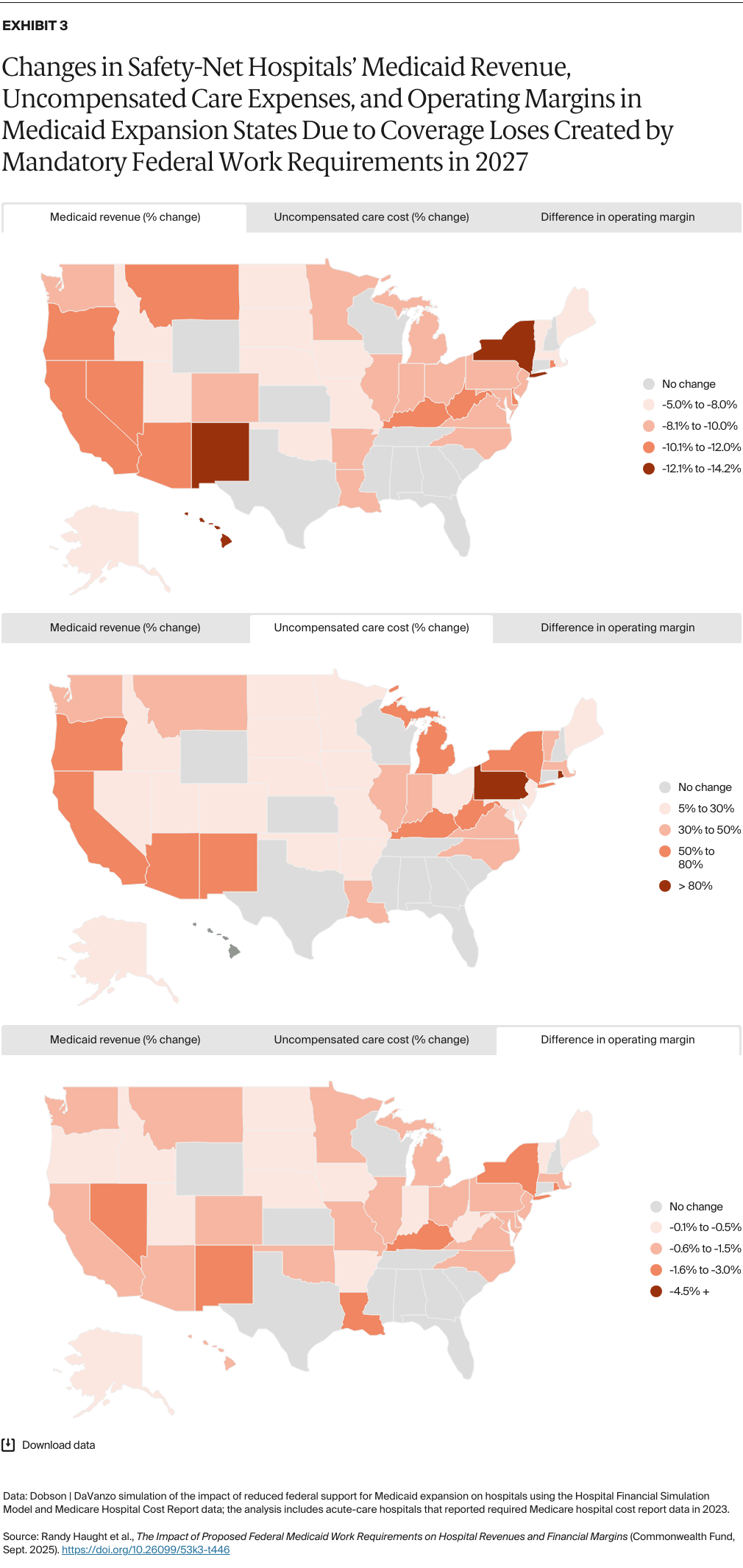
Safety-net hospitals in 14 states could see Medicaid revenues decline by 10 percent or more, and safety-net hospitals in 11 states could see uncompensated care costs increase by 50 percent or more (Exhibit 3). (Appendix A1 and Appendix A2 contain additional information about the impacts on safety-net hospitals and rural hospitals in each state.) We estimate that safety-net hospitals in the District of Columbia and Nevada will see the largest reductions in operating margins, because these hospitals are heavily dependent on revenues from Medicaid patients, where nearly 40 percent of their total revenues comes from Medicaid patients. The large coverage losses predicted in these two states will result in large declines in both Medicaid and total revenues for safety-net hospitals, which will have an adverse impact on operating margins.

Haught_impact_medicaid_work_requirements_hospitals_Exhibit_03

How Medicaid Coverage Losses Impact Rural Safety-Net Hospitals

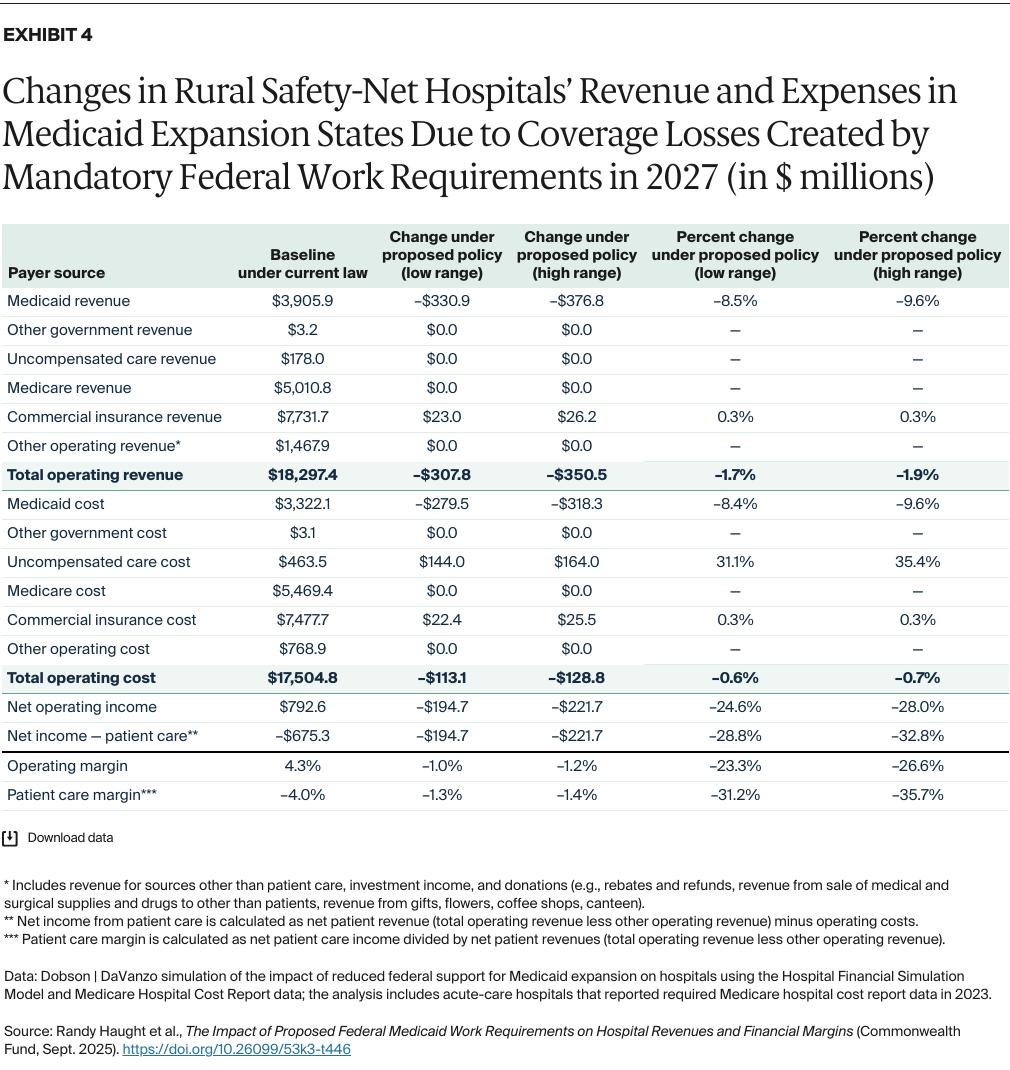
Among safety-net hospitals, those in rural areas would be most severely impacted by mandatory federal work requirements for the Medicaid expansion population.6 Rural hospitals already run on slim operating margins and operate at a loss with respect to patient care margins. Negative patient care margins mean that payments to hospitals for treating patients are insufficient to cover operating costs. Therefore, hospitals need to find other revenue sources (such as the sale of medical and surgical supplies and drugs to people other than patients) to cover these losses, which may or may not be sustainable in the long term. For the 316 rural safety-net hospitals in expansion states, the proposed work requirement policy would reduce net operating income by 24.6 percent to 28.0 percent, further eroding operating margins for these already struggling hospitals (Exhibit 4).

Haught_impact_medicaid_work_requirements_hospitals_Exhibit_04

Hospitals in rural communities have been closing at an alarming rate. Since 2005, 194 rural hospitals have either closed or converted to providing only outpatient services, and a further reduction in operating margins would likely intensify this trend.7 More than 700 rural hospitals (a third of all rural hospitals) are currently at risk of closing because of serious financial problems, including losses on patient services, insufficient revenues from other sources to offset these losses, and low financial reserves, and more than 300 are at immediate risk of closure.8

Discussion

The Affordable Care Act’s Medicaid expansion improved many hospitals’ financial stability, allowing them to hire new staff and maintain or offer new services to their communities. These improvements would be jeopardized if people enrolled through the expansion were to lose health insurance coverage because of mandatory federal work requirements.

Between 5.1 million and 5.8 million people could lose their Medicaid coverage and become uninsured as a result of the federal work requirements. The 2027 implementation date means that states may not have sufficient time to modify their systems to automatically verify whether people are employed or exempt at the same rates seen previously in Arkansas and New Hampshire. Without this infrastructure, many Medicaid expansion enrollees will be forced to manually verify their community engagement activity or exemption status, increasing the likelihood that eligible people will lose coverage because of the reporting process.

Alongside impacting hospital and Medicaid enrollees, the work requirement policy also will affect each hospital’s surrounding community, particularly hospitals in poor or rural areas. The combined effects of Medicaid work requirements on safety net hospitals and community health centers could leave communities with little to no access to primary, specialty, or emergency care, significantly increasing travel times for routine and emergency health needs.9

With many rural hospitals already experiencing negative operating margins, further reductions in Medicaid revenue and increases in uncompensated care could force hospitals to reduce costs by eliminating services that would affect all members of their community; cause them to offset the loss of revenue in part by increasing rates to privately insured patients; or accelerate hospital closures.10

The direct effect on hospitals is just one aspect of the economic impact work requirements could have on Medicaid expansion states.11 The policy also could reduce access to health care for all people in the community and increase the costs for everyone, as hospitals raise rates to make up the lost revenue.

HOW WE CONDUCTED THIS STUDY

This analysis uses the Dobson | DaVanzo Hospital Finance Simulation Model to produce estimates of the financial impact of Medicaid policy changes on hospitals. The model is built using 2023 Medicare Hospital Cost Reports (MCRs) as its primary data source, allowing us to determine each U.S. general acute-care hospital’s revenues and expenses by payer (including Medicare, Medicaid, other government payers, and all other payers). For this analysis, we used MCR data for 2,958 acute-care hospitals in Medicaid expansion states that met our data quality requirements.12 Hospital revenues and costs for each payer category were projected from 2023 through 2027 based on National Health Expenditure projections for hospital services.

The HFSM uses these hospital-level revenue and cost data by payer source along with estimates of the policy’s impact on Medicaid coverage loss — data estimated in a recent study by the Urban Institute.13 The legislation requires states to implement work requirements by December 31, 2026, with the ability for individual states to begin implementation earlier or request a delay through December 31, 2028. However, for illustrative purposes we show the potential impact on hospitals assuming that the work requirement policy is fully implemented and rolled out by all states in 2027.

This analysis builds on Urban Institute projections of Medicaid coverage loss due to work requirements. These differ from Congressional Budget Office (CBO) estimates. The Urban Institute estimated that between 5.5 million and 6.3 million Medicaid expansion enrollees ages 19 to 64 would lose federally funded Medicaid coverage, assuming full implementation in 2026, while the CBO estimated total Medicaid expansion coverage would decrease by 5.2 million by 2034. One of the major differences is that the Urban Institute analysis was modeled on the Limit, Save, Grow Act of 2023, a bill that targeted Medicaid expansion enrollees ages 19 to 55 (although the Urban Institute also examined potential coverage losses if the policy applied to adults ages 19 to 64), while the CBO’s estimate focuses on the House reconciliation bill, H.R. 1, which not only imposes work requirements on those currently enrolled in Medicaid but also requires verification of meeting work requirements when newly applying for Medicaid. The Urban Institute analysis predated H.R. 1, which was introduced in the House in May 2025.

A second major difference between the two sets of estimates is that, for illustrative purposes, the Urban Institute analysis presented coverage losses for adults enrolled in Medicaid expansion assuming the policy takes effect in 2026, while the CBO’s projected coverage losses are in 2034. Thus, the total number of Medicaid enrollees subject to the work requirements differs between the two estimates, owing to the differences in years on which the projections are based. The CBO’s estimates also reflect a recent update to its Medicaid enrollment projections based on administrative data showing higher-than-expected enrollment following the unwinding of the pandemic-era Medicaid continuous coverage requirement.14

We do not have insight into the CBO’s methodology for producing their estimates. The Urban Institute assumed that state Medicaid agencies would rely on existing state databases to automatically determine whether enrollees are meeting work requirements or are exempt from the policy, using data-matching processes similar to those that Arkansas and New Hampshire employed previously. The Urban Institute also assumed that noncompliance rates for people not automatically exempted from the reporting requirement are consistent with the noncompliance rates observed in Arkansas and New Hampshire. Therefore, many people would lose coverage because of the reporting burden even though they may qualify for an exemption or meet the community engagement activity requirement.

The CBO estimated that, of the 5.2 million people who lose Medicaid coverage, 4.8 million (92%) would become uninsured in 2034. CBO assumed that few of those disenrolled from Medicaid would have access to and enroll in employment-based coverage and none would be eligible for the premium tax credit. The Urban Institute report did not attempt to estimate the number of people losing Medicaid coverage because of the policy who would become uninsured. For this analysis, we applied the CBO assumption — that 92 percent of those losing Medicaid coverage would become uninsured — to the Urban Institute’s state-level Medicaid coverage loss estimates under this policy. These estimates are subject to substantial uncertainty, since the availability of data on the employer coverage offered to current Medicaid enrollees is limited, and behavioral responses are difficult to predict.

The HFSM model shifts hospital costs across payers, mirroring how people shift from one insurance coverage type to another. For example, as Medicaid coverage is reduced because of the policy change, people will move to other coverage sources, such as employer coverage or nongroup coverage, or become uninsured. The model similarly shifts hospital costs from Medicaid to uncompensated care or commercial payers. Hospital revenues are then recomputed based on this change in costs, using the hospital’s payment-to-cost ratio for each payer.

Research has consistently shown that uninsured people get far fewer health care services than insured people with similar economic and demographic characteristics. Multiple studies have estimated the potential utilization increase as uninsured people become insured, and we assume the opposite effect on utilization of hospital services as people become newly uninsured.15 Thus, the model reduces hospital costs by about 44 percent when shifting from an insured payer to uncompensated care.

There is no universal standard method to identify safety-net hospitals. Similar to our prior studies on safety-net hospitals for the Commonwealth Fund, we use the criteria for “Deemed Disproportionate Share Hospital (DSH) Hospitals” as our definition for safety-net hospitals. A deemed DSH hospital is one that is required to receive Medicaid DSH payments because it serves a high number of low-income patients. To meet the deemed DSH hospital criteria, hospitals must have a Medicaid inpatient utilization rate of at least one standard deviation above the mean for hospitals in the state that receive Medicaid payments, or a low-income utilization rate that exceeds 25 percent.16 We used 2023 Medicare Hospital Cost Report data to apply these criteria to identify safety-net hospitals for this study.

ACKNOWLEDGMENTS

The authors thank Michael Karpman, Jennifer Haley, and Genevieve Kenney of the Urban Institute and Sara Collins of the Commonwealth Fund for their support of this project.

NOTES
  1. Aimee Picchi, “Medicaid Recipients Could Face Work Requirements Under GOP Bill. Here Are the Details.,” CBS News, last updated May 13, 2025.
  2. See KFF, “Medicaid Expansion Enrollment,” Dec. 2024, for analysis of Medicaid enrollment data collected from the Centers for Medicare and Medicaid Services (CMS) Medicaid Budget and Expenditure System (MBES).
  3. The estimated impact on hospital operating margins presented in this brief is meant to illustrate the financial pressure on hospitals due to reduced Medicaid revenue and increased uncompensated care costs resulting from Medicaid coverage losses. However, hospital managers will likely react to the pressures identified in our study to remain financially viable, which may include reducing costs through labor or wage reductions, eliminating unprofitable service lines, lowering the amount of charity care delivered, and/or seeking increased payment from private insurers.
  4. Michael Karpman, Jennifer M. Haley, and Genevieve M. Kenney, Expanding Federal Work Requirements for Medicaid Expansion Coverage to Age 64 Would Increase Coverage Losses: National and State Estimates for Adults Ages 19 to 64 (Urban Institute and Robert Wood Johnson Foundation, Apr. 2025).
  5. Philip L. Swagel, director, Congressional Budget Office, Letter to Sen. Wyden and Reps. Pallone and Neal, “Estimated Effects on the Number of Uninsured People in 2034 Resulting from Policies Incorporated Within CBO’s Baseline Projections and H.R. 1, the One Big Beautiful Bill Act,” June 4, 2025.
  6. Rural hospitals are defined as those physically located in a state and county not designated as a Core Based Statistical Area by the Office of Management and Budget at the beginning of the hospital’s 2023 Medicare cost-reporting period.
  7. Rural Hospital Closures,” Cecil G. Sheps Center for Health Services Research, University of North Carolina, 2014.
  8. Center for Healthcare Quality and Payment Reform, Rural Hospitals at Risk of Closing (CHQPR, Aug. 2025).
  9. Sara Rosenbaum, Feygele Jacobs, and Kay Johnson, “Nearly 5.6 Million Community Health Center Patients Could Lose Medicaid Coverage Under New Work Requirements, with Revenue Losses Up to $32 Billion,” To the Point (blog), Commonwealth Fund, May 30, 2025.
  10. Allen Dobson, Joan DaVanzo, and Namrata Sen, “The Cost-Shift Payment ‘Hydraulic’: Foundation, History, and Implications,” Health Affairs 25, no. 1 (Jan./Feb. 2006): 22–33; and James Robinson, “Hospitals Respond to Medicare Payment Shortfalls by Both Shifting Costs and Cutting Them, Based on Market Concentration,” Health Affairs 30, no. 7 (July 2011): 1265–71.
  11. Leighton Ku et al., How National Medicaid Work Requirements Would Lead to Large-Scale Job Losses, Harm State Economies, and Strain Budgets (Commonwealth Fund, May 2025).
  12. To be included in the study, hospitals must have reported total operating expenses, Medicaid revenues and costs, uncompensated care costs, and had an operating margin within two times the interquartile range of all hospitals. These edits excluded 124 acute-care hospitals in Medicaid expansion states.
  13. Michael Karpman, Jennifer M. Haley, and Genevieve M. Kenney, Expanding Federal Work Requirements for Medicaid Expansion Coverage to Age 64 Would Increase Coverage Losses: National and State Estimates for Adults Ages 19 to 64 (Urban Institute and Robert Wood Johnson Foundation, Apr. 2025).
  14. Congressional Budget Office, The Budget and Economic Outlook: 2025 to 2035 (CBO, Jan. 17, 2025).
  15. Allen Dobson, Joan DaVanzo, and Randy Haught, The Financial Impact of the American Health Care Act’s Medicaid Provisions on Safety-Net Hospitals: Technical Appendix (Commonwealth Fund, June 2017); and Edward Levine, Noam Bauman, and Bowan Garrett, The Impact of Coverage Shifts on Hospital Utilization (McKinsey and Company, May 2013).
  16. Medicaid and CHIP Payment and Access Commission, Report to the Congress on Medicaid and CHIP (MACPAC, June 2016).

Publication Details

Date

Contact

Randy Haught, Senior Data Manager, Dobson DaVanzo & Associates, LLC

randy.haught@dobsondavanzo.com

Citation

Randy Haught et al., The Impact of Proposed Federal Medicaid Work Requirements on Hospital Revenues and Financial Margins (Commonwealth Fund, Sept. 2025). https://doi.org/10.26099/53k3-t446