Advanced Search

Advanced Search

Current Filters

Filter your query

Publication Types

Other

to

Explainer

/

The 340B Drug Pricing Program: How It Works and Why It’s Controversial

Man stands in front of pharmacy pickup window

A patient picks up a prescription from the pharmacy at Brockton Neighborhood Health Center, a federally qualified health center (FQHC) in Massachusetts. The 340B Drug Pricing Program requires drug manufacturers to provide significant price discounts on outpatient drugs purchased by certain federal government grantees, including FQHCs. Photo: Jessica Rinaldi/Boston Globe via Getty Images

A patient picks up a prescription from the pharmacy at Brockton Neighborhood Health Center, a federally qualified health center (FQHC) in Massachusetts. The 340B Drug Pricing Program requires drug manufacturers to provide significant price discounts on outpatient drugs purchased by certain federal government grantees, including FQHCs. Photo: Jessica Rinaldi/Boston Globe via Getty Images

Toplines
  • The federal 340B Drug Pricing Program was created to improve access to care at safety-net hospitals and clinics, but some critics say the program has failed to meet this goal and even produced unintended consequences

  • Policymakers have considered a number of changes to ensure the 340B program works as intended, by improving oversight, increasing transparency, addressing duplicate discounts, and clarifying definitions

Toplines
  • The federal 340B Drug Pricing Program was created to improve access to care at safety-net hospitals and clinics, but some critics say the program has failed to meet this goal and even produced unintended consequences

  • Policymakers have considered a number of changes to ensure the 340B program works as intended, by improving oversight, increasing transparency, addressing duplicate discounts, and clarifying definitions

Authors

The 340B Drug Pricing Program was created to improve access to care for low-income and uninsured patients at safety-net hospitals and clinics. Over the years, however, critics have argued that the program hasn’t met this goal — and has even produced unintended consequences.

Since its inception, the 340B program has been a pillar of the health care safety net for people with low income. Studies have shown that the revenue the program generates helps subsidize the uncompensated care that hospitals deliver to uninsured patients and allows patients to receive free or low-cost medications.

Still, some believe the 340B program’s growth has contributed to consolidation in the health care industry, with more and more hospitals acquiring provider practices and specialty pharmacies. The program also has been criticized for worsening generic drug shortages and for incentivizing hospitals to shift care from underserved areas to wealthier communities in a bid to raise revenue.

How does the 340B Drug Pricing Program work?

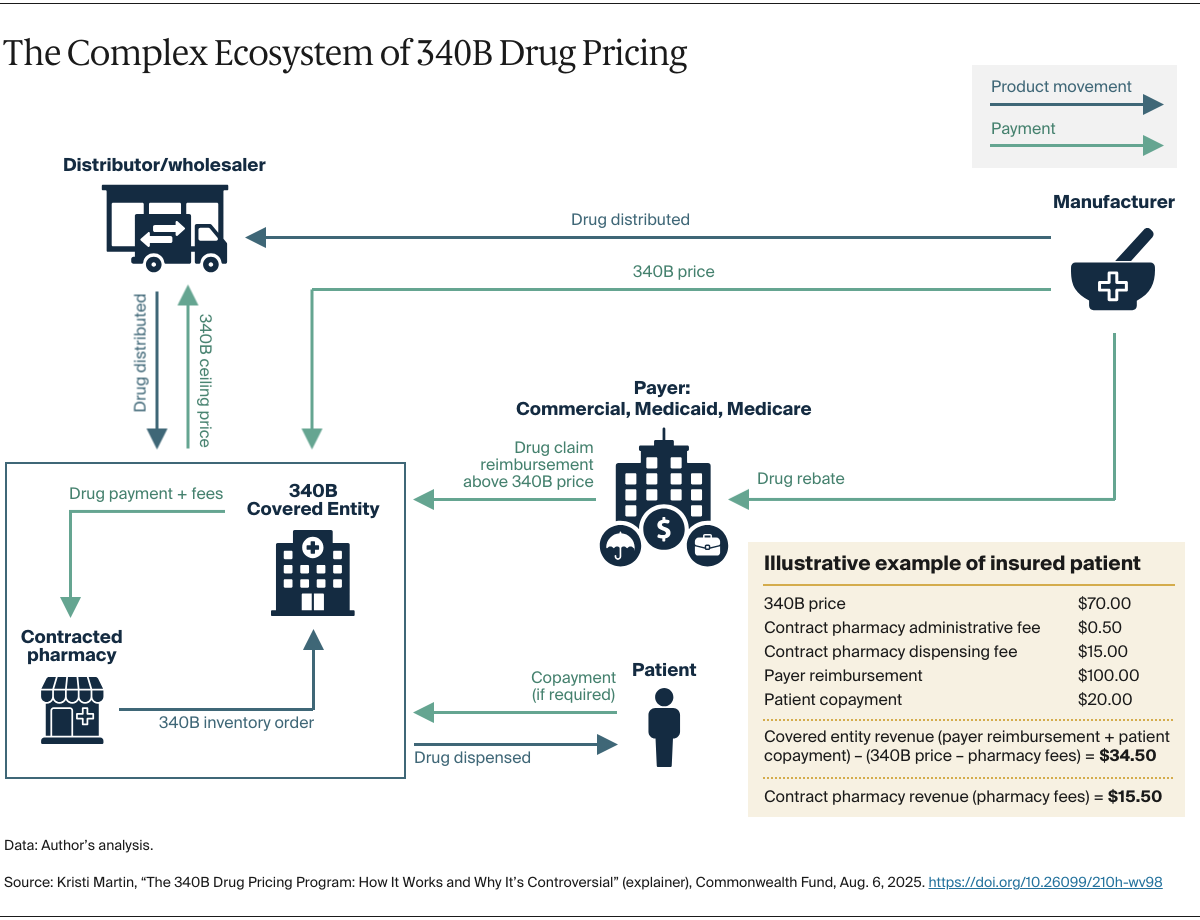
Enacted in 1992, the 340B Drug Pricing Program requires drug manufacturers to provide significant price discounts on outpatient drugs purchased by certain federal government grantees. These include federally qualified health centers and disproportionate share hospitals, which receive federal payments to offset the costs of providing a large amount of uncompensated care. The 340B program allows these providers, known as covered entities, to buy discounted outpatient prescription drugs from manufacturers and bill payers at the nondiscounted price. In this way, the program generates revenue for these hospitals and clinics so they can expand care for low-income and uninsured patients.

Why was the 340B program developed?

The 340B program was designed to fix an unintended consequence of the Medicaid Drug Rebate Program, which requires drug manufacturers to provide state Medicaid programs with discounts and the “best price” they offer in the market. When the Medicaid rebate program went into effect in 1990, this “best price” also included voluntary discounts to community health centers and public hospitals. Consequently, drug manufacturers stopped offering voluntary discounts. To address the drastic price increases that resulted, Congress enacted the 340B program.

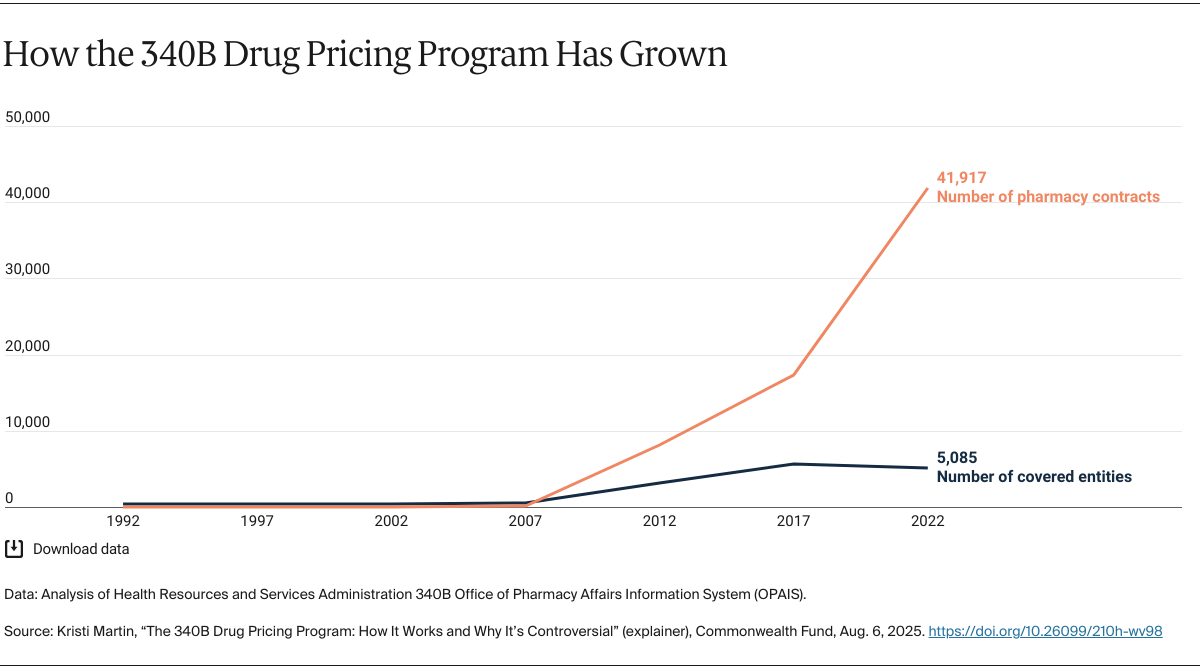
Over time, the 340B program has expanded to include more than 53,000 care sites affiliated with nearly 42,000 covered entities. In 2023 (the most recent data available), covered entities purchased $66.3 billion in outpatient drugs under the 340B program.

Martin_340B_drug_pricing_explainer_Exhibit_01

Who are the stakeholders of the 340B program?

The 340B program is currently administrated by the Health Resources and Services Administration (HRSA), which audits covered entities and resolves certain disputes they may have with drug manufacturers. However, the agency has limited ability to regulate and address issues facing the program. As part of the U.S. Department of Health and Human Services’ proposed budget for fiscal year 2026, oversight of the 340B program will be moved from HRSA to the Centers for Medicare and Medicaid Services (CMS).

Other stakeholders include:

  • Drug manufacturers: To participate in the Medicaid Drug Rebate Program and guarantee that Medicaid covers their drugs, manufacturers also must enter a pharmaceutical pricing agreement for the 340B program. Manufacturers are required to offer covered entities 340B drugs at or below the deeply discounted 340B ceiling price.

    Manufacturers, however, have argued that the 340B program is not delivering on the congressional intent to expand and improve care for low-income and uninsured patients. They argue that hospitals and contract pharmacies are using revenues to maximize profits and not passing program savings on to patients.

  • Covered entities: Certain hospitals and federally supported community clinics rely on the funds generated from 340B drugs, which allow them to offer more services to patients.
  • Contract pharmacies: Covered entities provide pharmacy services and 340B drugs via in-house pharmacies but can also contract with outside pharmacies, such as CVS and Walgreens, to provide 340B drugs to eligible patients. Relatively new to the 340B program, contract pharmacies have grown significantly in recent years, following a HRSA policy change, as have concerns that they don’t add significant value to the program and may even detract from its mission.
  • Patients: Patients are not well represented in the debate over the 340B program. Often, they are left out of discussions occurring among policymakers, covered entities, and manufacturers.
Martin_340B_drug_pricing_explainer_Exhibit_02_v2

What are the controversies surrounding the 340B program?

The 340B program has become controversial for several reasons:

Transparency and oversight. The program lacks transparency in many areas, including the actual 340B prices and whether manufacturers are providing the required discounts. It’s also unclear how much revenue covered entities receive from 340B drugs and how they use that revenue. Over the years, Congress has granted HRSA regulatory authority to conduct limited oversight, including auditing covered entities and manufacturers. HRSA also established an administrative dispute resolution process to resolve claims by covered entities that they have been overcharged, as well as claims by manufacturers that they provided duplicate discounts by supplying a drug at the 340B price while also paying a Medicaid rebate. Regardless of whether the 340B program is overseen by HRSA or CMS, these issues are the same.

Duplicate discounts. The longest-standing issue in the 340B program is ensuring that drugs sold at the 340B price are not subject to other statutory discounts in federal health programs, such as Medicaid’s Drug Rebate Program. For example, if a drug were sold to a covered entity at the 340B price and a state Medicaid program were to collect a rebate from the manufacturer for that medication, this would be a “duplicate discount” — something that’s prohibited by law. A similar provision exists for Medicare drugs under the Medicare Drug Price Negotiation Program.

However, tracking whether a duplicate discount has occurred is complicated, because there is a lack of transparency and coordination among covered entities, contract pharmacies, Medicare and Medicaid, and manufacturers. One analysis suggests that 3 percent to 5 percent of 340B drugs and Medicaid-purchased drugs receive duplicate discounts. HRSA recently announced a voluntary pilot program to test such a rebate model with manufacturers.

Patient definition. Because Congress did not specifically define “patient” in the statute, HRSA established a patient definition through guidance. However, this has created inconsistencies. For example, while community clinics that participate in the program can purchase 340B drugs only for patients who receive health care services within the scope of a federal grant, hospitals do not have this same requirement. As a result, manufacturers and some academic researchers have raised concerns that certain hospitals could take advantage of the program — in particular, by shifting care from underserved areas to wealthier communities in a bid to raise revenue.

Who reaps the “savings.” Congress specified that 340B revenue is intended for covered entities. There are questions, however, about how this revenue is being used. While some hospitals and clinics use it to expand services for their low-income patients, they are not required to pass along the 340B discounted price or offer reduced cost sharing for drugs. As a result, there are cases where covered entities do not provide discounts on 340B drugs to patients with low income or no insurance.

Program growth. The number of hospitals eligible to participate in the program increased dramatically because of the Affordable Care Act (ACA), which expanded the types of hospitals eligible (such as critical access hospitals and rural treatment centers). The ACA also expanded Medicaid, which resulted in more hospitals qualifying as disproportionate share hospitals. Originally, there were 1,000 covered entities, including their registered sites in the program in 1992. Today there are more than 53,000 sites, representing more than 40 percent of the hospitals in the country.

While the use of contract pharmacies has been permitted since the early days of the program, their involvement has grown since 2010. That year, HRSA amended rules that permitted a covered entity to use an unlimited number of contract pharmacies rather than a single pharmacy. Since then, the number of contract pharmacies, predominantly for-profit companies that retain revenue generated from the program, increased from roughly 1,000 in 2010 to more than 25,000 in 2022, with many having 10 or more contracts. With some contract pharmacies charging fees ranging from $15 to more than $1,700 per drug, these pharmacies’ expanded involvement in 340B has drawn scrutiny, including recent litigation.

What reforms have been proposed to address concerns about the 340B program?

Policymakers at the federal and state level have considered a number of reforms, many of which have bipartisan support, to improve oversight and implementation of the 340B program:

Enhance oversight. A common theme with the controversies surrounding the program is HRSA’s lack of regulatory authority. Congress could consider providing HRSA rulemaking authority to set clear, enforceable standards for participation in all aspects of the 340B program.

Increase transparency. One option is allowing a federal and/or state agency to collect data from covered entities annually to quantify the net revenue generated from the program and understand how covered entities use it. Similarly, providing additional resources to HRSA could help ensure more covered entities and manufacturers follow the program requirements. In fiscal year 2024, HRSA performed 144 audits of covered entities and five audits of manufacturers.

Address duplicate discounts. Some states have “carved in” 340B, meaning their Medicaid programs allow a covered entity to purchase a drug at 340B pricing to dispense to a Medicaid patient, but the states don’t claim a Medicaid rebate from the manufacturer. Other states have “carved out” 340B, meaning their Medicaid programs prohibit a covered entity from using 340B pricing for a Medicaid patient, and the states claim a Medicaid rebate from the manufacturer.

Manufacturers are pushing to apply the retrospective rebate model for generating the 340B discount. Policymakers could specify what models are acceptable to avoid duplicate discounts.

Clarify definitions and provisions in the existing 340B law. First, policymakers could clarify the definition of “patient” for hospitals, similar to how the definition applies to community clinics. Second, policymakers could better define the role contract pharmacies should play in the 340B program. Finally, policymakers could consider clarifying how the revenue generated from 340B drugs should be used by covered entities (such as requiring the use of a sliding scale for patient cost sharing for a 340B drug or specifying that a minimal amount of 340B revenue is used for charity care).

By implementing such reforms, policymakers could reduce some of the controversy surrounding the 340B program, increase transparency, and help promote its original intent to improve patient access to affordable care.


Publication Details

Date

Contact

Kristi Martin, Principal, Highway 136 Consulting

kristi@highway136.com

Citation

Kristi Martin, “The 340B Drug Pricing Program: How It Works and Why It’s Controversial” (explainer), Commonwealth Fund, Aug. 6, 2025. https://doi.org/10.26099/210h-wv98