



Advanced Search

Advanced Search

Current Filters

Filter your query

Publication Types

Other

to

Blog

/

Value-Based Payments Are Catching On, but Rural and Small Practices Lag

Clinic exterior

A Rural Health Group clinic serves many patients in Stovall, N.C. There has been low participation in value-based payment among primary care practices, especially rural, small, and independent ones. Photo: Matt Ramey for the Washington Post via Getty Images

A Rural Health Group clinic serves many patients in Stovall, N.C. There has been low participation in value-based payment among primary care practices, especially rural, small, and independent ones. Photo: Matt Ramey for the Washington Post via Getty Images

Authors
  • Celli Horstman
    Celli Horstman

    Senior Research Associate, Improving Care Delivery, The Commonwealth Fund

  • Corinne Lewis
    Corinne Lewis

    Assistant Vice President, Improving Care Delivery, The Commonwealth Fund

Authors
  • Celli Horstman
    Celli Horstman

    Senior Research Associate, Improving Care Delivery, The Commonwealth Fund

  • Corinne Lewis
    Corinne Lewis

    Assistant Vice President, Improving Care Delivery, The Commonwealth Fund

Toplines
  • Value-based payment models can improve patients’ outcomes, reduce avoidable hospitalizations, and expand access to team-based care and care management

  • Rural and small practices stand to benefit from value-based payment but may need upfront investments to ensure successful participation

Changing how we pay for primary care can incentivize clinicians to deliver the right care at the right time. Historically, clinicians have been retroactively paid a fee for each service they provide. Known as fee-for-service (FFS), this practice encourages clinicians to provide more services, rather than efficiently deliver comprehensive care. Although it can lead to more care, it may not lead to better health outcomes.

Instead, we could use payment to encourage primary care clinicians to deliver appropriate, efficient care in coordination with other clinicians. An increasingly common way to do this — value-based payment (VBP) — ties clinicians’ payments to their performance on outcomes, including the cost and quality of care. Specific outcomes include the way clinicians manage patients’ chronic conditions or the minimization of avoidable hospitalizations. The evidence shows that changing how we pay for primary can improve patients’ outcomes, including reducing avoidable hospitalizations and increasing access to coordinated care.

Despite the promise of VBP, some primary care practices have been left behind, and their patients haven’t been able to benefit. Policymakers and payers are particularly worried about low participation among rural, small, and independent practices, as well as community health centers (CHCs) that face unique barriers to participation.

In this blog post, we assess current rates of primary care physician (PCP) participation in VBP, using data from the 2025 Commonwealth Fund International Health Policy Survey of Primary Care Physicians. We also highlight opportunities to design value-based models to account for the needs of different practice settings, such as small or rural practices.
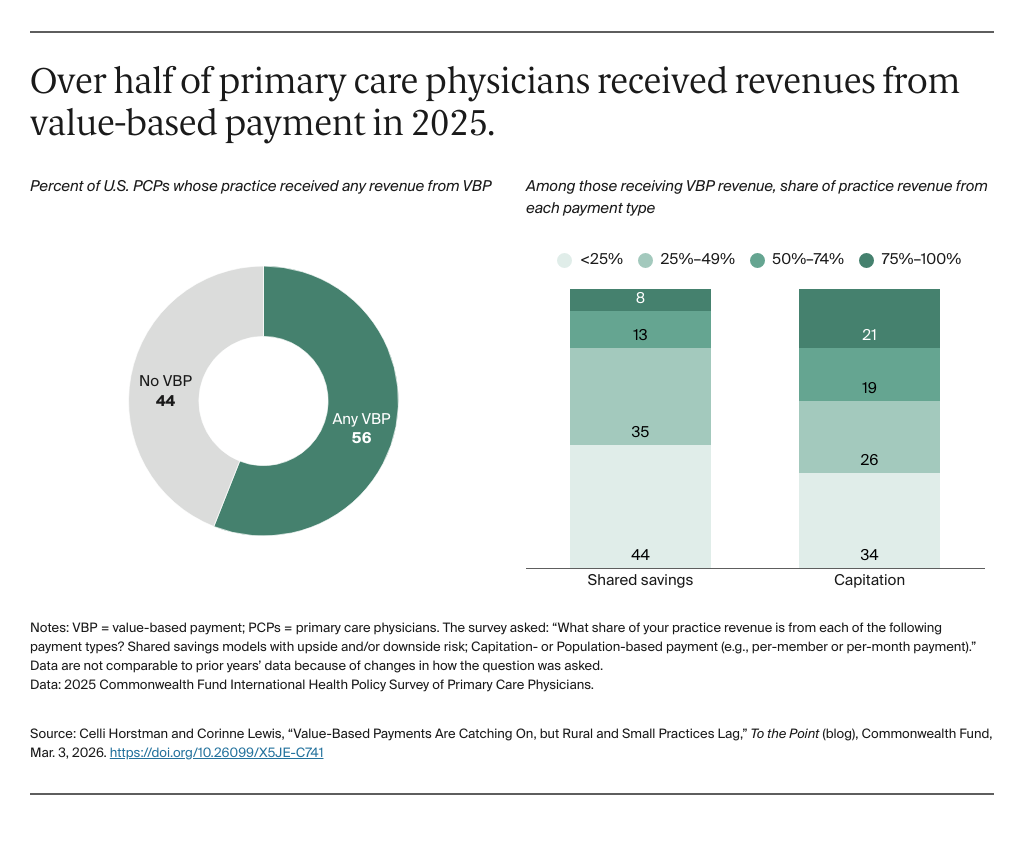
Charts: Over half of primary care physicians received revenues from value-based payment in 2025.

In 2025, 56 percent of U.S. PCPs reported their practice received revenue from value-based payment. Among them, over half reported that up to 49 percent of their practice revenue came from VBP.

There are two common approaches to VBP. The first is shared savings, where clinicians experience financial gains or losses based on their performance on clinical or spending outcomes. The second is capitation, where physicians are paid an upfront sum to cover the cost of patient care but must actively manage their spending.

More PCPs reported that shared savings accounted for up to 49 percent of their practice revenue compared to capitation (79% and 60%, respectively). Shared savings payments often rely on an FFS structure, making participation less of a change than capitation, where a single prospective payment covers all care for a population.

These results represent a yearslong shift toward paying for value. However, despite today’s high rates of VBP revenues, a significant share of PCPs (44%) still report they are still not receiving value-based payments.

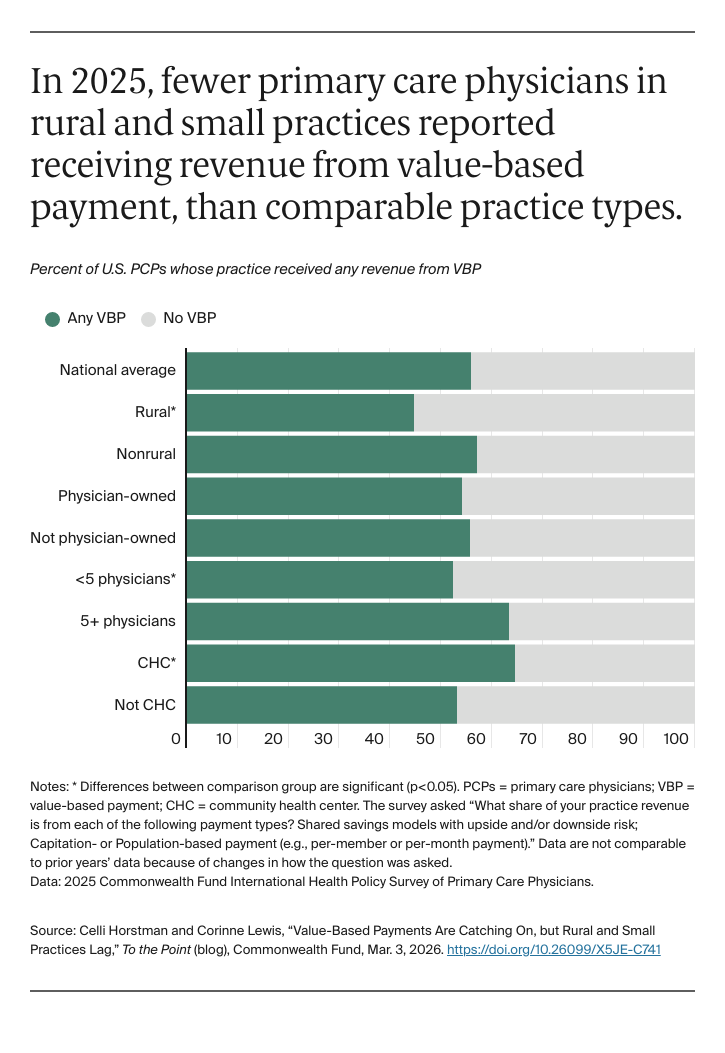
Chart: In 2025, fewer primary care physicians in rural and small practices reported receiving revenue from value-based payment, than comparable practice types.

To understand where uptake is lagging and to inform policymakers’ efforts to increase VBP participation, we examined participation among practices that may face barriers in adopting value payments.

Less than half of rural practices receive any revenues from VBP, significantly less than nonrural practices and 11 percentage points lower than the national average. Fewer physicians in small practices (i.e., those with fewer than five physicians) reported receiving VBP compared to those in large practices. Low participation in rural and small practices means their patients may not experience the benefits of value-based payment, like improved care coordination.

Ownership plays less of a role. PCPs in independent, physician-owned practices participate at similar rates as those in nonindependent practices (56%).

Finally, physicians in community health centers reported receiving VBP at higher rates than those not in CHCs. CHCs may be well-positioned to engage with value-based payment because of their funding structure, where Medicaid is the predominant payer and a quarter of their Medicaid reimbursements may be capitated payments. CHCs are also subject to regulatory requirements to track and report clinical outcomes, a key component of VBP.

Designing Payment Models to Increase Participation Among Rural and Small Practices

Given policymakers’ interest in increasing clinicians’ engagement in VBP, it is important to understand barriers and identify where models could be refined. PCPs have previously described various barriers to VBP participation, as well as potential solutions, including:

  • Transitioning from FFS to VBP can require significant upfront investments to cover staff training and establish systems to measure, track, and report financial and clinical outcomes. Rural and small practices may not have adequate financial resources to cover these costs. Physicians recommend upfront investment payments, potentially targeted toward rural and small practices, to ensure successful participation.
  • Historically, participation by private payers has lagged Medicaid and Medicare. This means that practices may invest in transitioning to VBP, but only a small share of their payments are value-based. Physicians recommend aligning public and private payers’ VBP efforts, both in terms how PCPs are paid and what they are paid to do.
  • VBP models inherently introduce financial risk to encourage more efficient care delivery, but not all practices are equipped to assume that risk, particularly rural or small practices with narrower margins. Physicians recommend beginning with opportunities for savings, then incrementally introducing financial risk.

Publication Details

Date

Contact

Celli Horstman, Senior Research Associate, Improving Care Delivery, The Commonwealth Fund

ceh@cmwf.org

Citation

Celli Horstman and Corinne Lewis, “Value-Based Payments Are Catching On, but Rural and Small Practices Lag,” To the Point (blog), Commonwealth Fund, Mar. 3, 2026. https://doi.org/10.26099/X5JE-C741