



Advanced Search

Advanced Search

Current Filters

Filter your query

Publication Types

Other

to

Blog

/

Is Employer Coverage Affordable? How the States Stack Up

Two lab coat-wearing employees work on computer

Dr. Dympna Gallagher (left) and a technician perform a dual-energy X-ray absorptiometry test at the New York Nutrition and Obesity Research Center in New York on March 24, 2025. Most people under age 65, about 167 million, get their health insurance through an employer or a family member’s employer, and share the cost of the premium with that employer. Photo: Bryan Anselm for the Washington Post via Getty Images

Dr. Dympna Gallagher (left) and a technician perform a dual-energy X-ray absorptiometry test at the New York Nutrition and Obesity Research Center in New York on March 24, 2025. Most people under age 65, about 167 million, get their health insurance through an employer or a family member’s employer, and share the cost of the premium with that employer. Photo: Bryan Anselm for the Washington Post via Getty Images

Authors
  • Kristen Kolb
    Kristen Kolb

    Research Associate, Tracking Health System Performance and Expanding Coverage and Access, The Commonwealth Fund

  • David Radley
    David C. Radley

    Senior Scientist, Tracking Health System Performance, The Commonwealth Fund

  • Sara Collins
    Sara R. Collins

    Senior Scholar, Expanding Coverage and Access and Tracking Health System Performance, The Commonwealth Fund

Authors
  • Kristen Kolb
    Kristen Kolb

    Research Associate, Tracking Health System Performance and Expanding Coverage and Access, The Commonwealth Fund

  • David Radley
    David C. Radley

    Senior Scientist, Tracking Health System Performance, The Commonwealth Fund

  • Sara Collins
    Sara R. Collins

    Senior Scholar, Expanding Coverage and Access and Tracking Health System Performance, The Commonwealth Fund

Toplines
  • Workers with employer-sponsored coverage can pay a large share of their income in premium contributions and deductibles

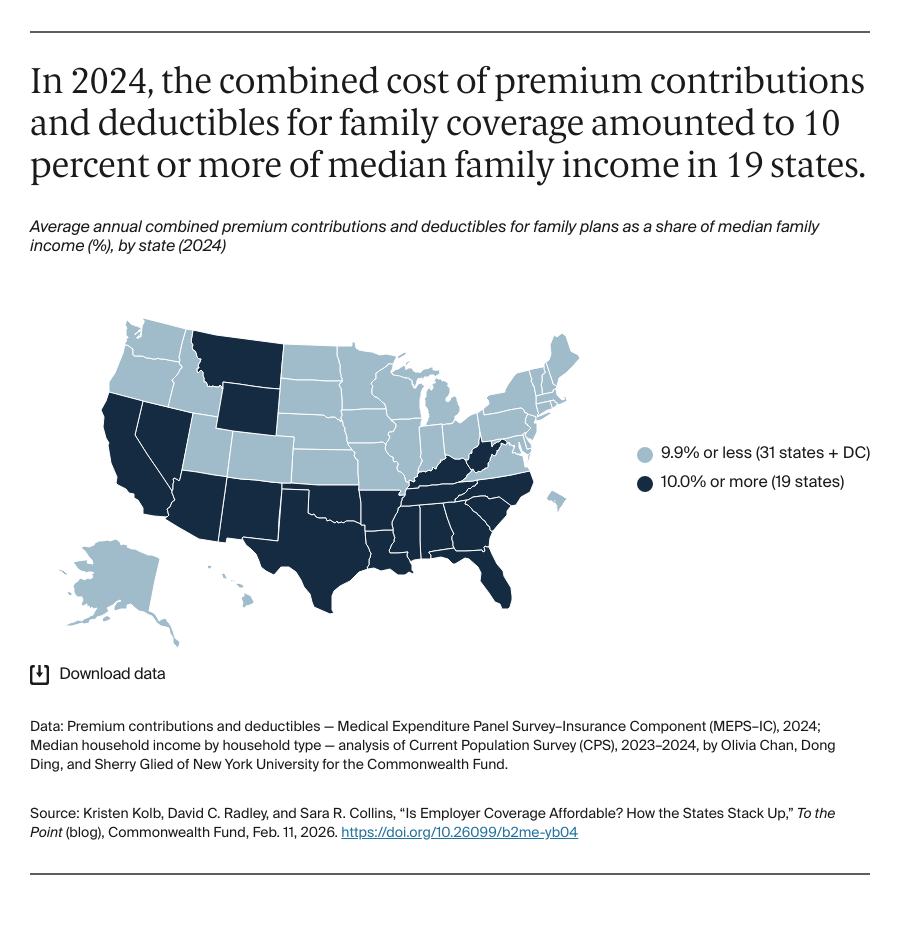
  • In 19 states, the combined cost of premium contributions and deductibles for family coverage amounts to 10 percent or more of median household income

Health costs in 2026 are projected to grow at a faster pace than in recent years for the third year in a row, driven by hospital consolidation that increases the price of medical services; ongoing hospital labor shortages; overall inflation in the cost of supplies, GLP-1 drugs, and other specialty medications; and increased use of behavioral health services. Consumers see the effects of these increases in what they pay toward their premiums and in how much they pay when they go to the doctor, fill a prescription, or have surgery.

Most people under age 65, about 167 million people, get their health insurance through an employer or a family member’s employer, and share the cost of the premium with their employer. Employers pay on average around 70 percent of the cost of total premiums for family coverage. Employees pay the remaining portion, called a premium contribution, along with other costs like deductibles and copayments. Family coverage premiums averaged $24,540 in 2024, with employees contributing $7,216 annually.

Given the increases in costs, how affordable is employer coverage for the 63 percent of working-age adults who get their coverage this way? To assess affordability, we looked at the most recent available national data from 2024 on what employees paid for premiums and deductibles in all 50 states and the District of Columbia compared to state median income. We found that the share of income spent on premium contributions and deductibles together for family coverage ranged from a high of 15.6 percent in Louisiana to a low of 5.7 percent in the District of Columbia. Generally, employees in states with lower median incomes spent a relatively larger share of their income on these costs than those living in states with higher median incomes. If incomes don’t keep pace with the increase in health care costs over the next few years, paying for employer coverage and getting health care could consume increasingly higher shares of people’s incomes.
Kolb_2026_premium_trends_Exhibit_01_v2

The combined cost of premium contributions and deductibles for family plans amounted to 10 percent or more of median family household income in 19 states, averaging 10.1 percent nationally. In other words, middle-income employees and their families in these states faced spending, on average, 10 percent or more of their household income toward the cost of premium contributions and deductibles alone. This figure does not include additional costs for health insurance like copayments.

In dollars, the average cost of premium contributions for family coverage in 2024 ranged from $5,584 in Oregon to $9,148 in California (Appendix Table 2B). Meanwhile, the average per-enrollee deductible ranged from $1,275 in Hawaii to $2,785 in Nevada (Appendix Table 2A). Health insurance costs vary depending on the industry and size of the employer. Health care costs also vary regionally, influencing the cost of health care, premium growth, and the generosity of plan benefits.

The cost of premium contributions alone for family coverage exceeded 8.39 percent of median household family income, above the Affordable Care Act’s 2024 threshold at which an offer of employer coverage is considered unaffordable, in five states: West Virginia (8.6%), Mississippi (8.8%), North Carolina (8.8%), Florida (9.3%), and Louisiana (10.7%) (Appendix Table 1B). An unaffordable offer of employer coverage may qualify the employee and their family members — or, in some cases, just the family members — for premium tax credits toward coverage with a marketplace plan.

Kolb_2026_premium_trends_Exhibit_02_v2

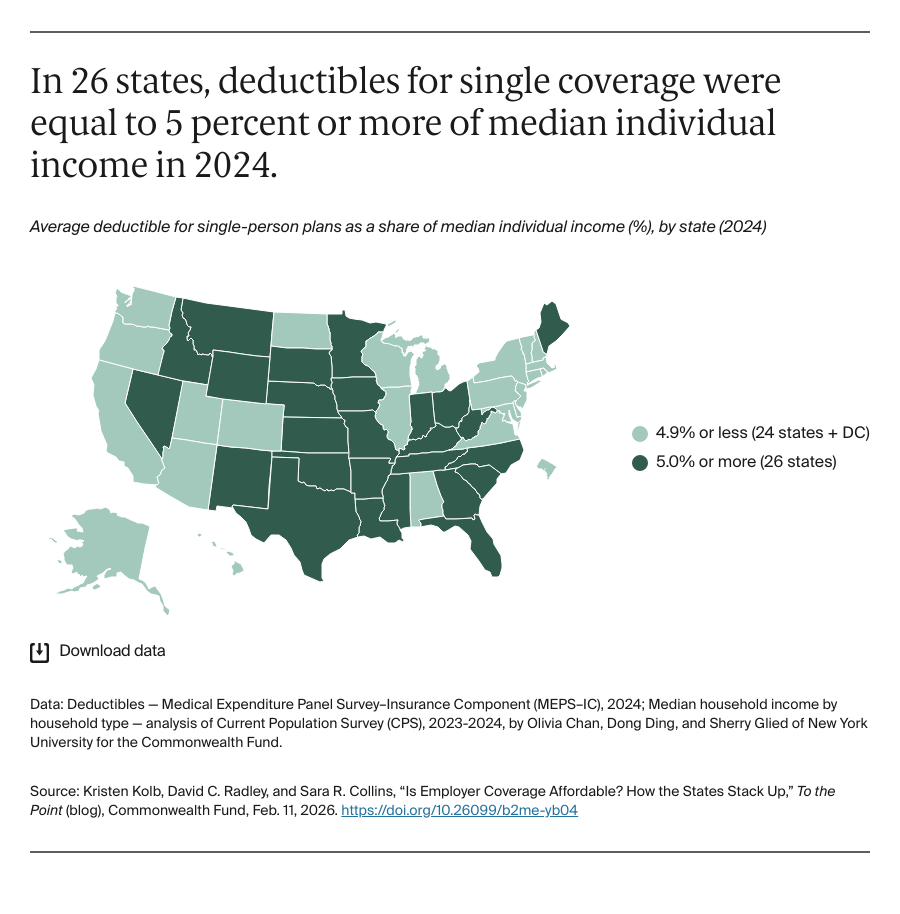
In half of the states, deductible costs for single coverage averaged 5 percent or more of median individual household income in 2024. This ranged from 1.8 percent in D.C. to 6.4 percent in Kentucky (Appendix Table 1A). A deductible equal to 5 percent of more of household income is a marker of underinsurance, indicating that workers do not have adequate financial protection against health care costs. Deductibles must be paid first before health insurance starts to pay the cost for most health care services. Large deductibles can lead to workers going without care due to the cost and increases the risk of taking on medical debt.

Looking Forward

Higher employer premiums in 2026 could mean higher premium contributions and deductibles for employees. If these higher costs are combined with sluggish income growth, the cost of coverage and health care could take a larger bite out of workers’ incomes at a time when they are also dealing with higher prices for other household goods. It may be particularly difficult for middle-income workers in states with lower median household incomes to absorb these increased costs. To improve affordability for lower-income workers, employers could consider adjusting premium contributions and out-of-pocket costs based on employee income. Ultimately, the nation must address the underlying drivers of health care cost growth to improve the affordability of coverage and health care.


How We Conducted Our Analysis

Using data from the federal Medical Expenditure Panel Survey-Insurance Component (MEPS-IC) for private-sector employer-sponsored insurance, we explored the costs of employee premium contributions and deductibles for both single and family coverage plans across all states and the District of Columbia in 2024. We compared these costs with the median household income in each state: using 2023–2024 data from the federal 2024–2025 Current Population Survey (CPS), adjusted for the distribution of households purchasing single and family coverage plans, we determined the percentage of state median household income consumed by premium contributions and deductibles.1 Two years of CPS data are combined to generate reliable state-level income estimates.

Notes
  • 1
    Analysis of Current Population Survey, 2024–2025, by Olivia Chan, Dong Ding, and Sherry Glied of New York University for the Commonwealth Fund.

Publication Details

Date

Contact

Kristen Kolb, Research Associate, Tracking Health System Performance and Expanding Coverage and Access, The Commonwealth Fund

kkolb@cmwf.org

Citation

Kristen Kolb, David C. Radley, and Sara R. Collins, “Is Employer Coverage Affordable? How the States Stack Up,” To the Point (blog), Commonwealth Fund, Feb. 11, 2026. https://doi.org/10.26099/b2me-yb04