



Advanced Search

Advanced Search

Current Filters

Filter your query

Publication Types

Other

to

Blog

/

Some States Blunted the Impact of Lost Federal Marketplace Subsidies, But Efforts Will Be Hard to Sustain

Pedestrian silhouette in front of US Capitol building

Pedestrians walk along Pennsylvania Avenue near the U.S. Capitol at sunrise on November 5, 2025. Washington, D.C., and 11 states administer their own health insurance marketplace subsidies to make coverage more affordable for residents. Photo: Tom Brenner via Getty Images

Pedestrians walk along Pennsylvania Avenue near the U.S. Capitol at sunrise on November 5, 2025. Washington, D.C., and 11 states administer their own health insurance marketplace subsidies to make coverage more affordable for residents. Photo: Tom Brenner via Getty Images

Authors
  • Headshot of Stacey Pogue
    Stacey Pogue

    Senior Research Fellow, Center on Health Insurance Reforms, Health Policy Institute, McCourt School of Public Policy, Georgetown University

  • Justin_Giovannelli_Headshot
    Justin Giovannelli

    Associate Research Professor, Center on Health Insurance Reforms, Health Policy Institute, McCourt School of Public Policy, Georgetown University

  • Headshot of Jalisa Clark
    Jalisa Clark

    Research Fellow, Center on Health Insurance Reforms, Health Policy Institute, McCourt School of Public Policy, Georgetown University

Authors
  • Headshot of Stacey Pogue
    Stacey Pogue

    Senior Research Fellow, Center on Health Insurance Reforms, Health Policy Institute, McCourt School of Public Policy, Georgetown University

  • Justin_Giovannelli_Headshot
    Justin Giovannelli

    Associate Research Professor, Center on Health Insurance Reforms, Health Policy Institute, McCourt School of Public Policy, Georgetown University

  • Headshot of Jalisa Clark
    Jalisa Clark

    Research Fellow, Center on Health Insurance Reforms, Health Policy Institute, McCourt School of Public Policy, Georgetown University

Toplines
  • The lapse of enhanced premium tax credits deprived marketplace consumers of about $35 billion in federal assistance in 2026 alone

  • State funding is only a stopgap for the loss of federal subsidies: ensuring marketplace coverage is affordable will ultimately depend on Congress

In 2025, there were a record-high 24 million people enrolled in the Affordable Care Act marketplaces. These gains were possible because of a 2021 law that made the ACA’s original premium tax credits (PTCs) more generous and extended eligibility to more people. The enhanced PTCs made comprehensive coverage much more affordable for millions of consumers, but Congress let them expire at the end of 2025. While initial PTCs remain in place, with the enhancements gone, consumers saw their out-of-pocket premiums more than double in 2026. Initial numbers show marketplace sign-ups down by more than 1 million people nationwide in 2026, with enrollment expected to decline further in the coming months as people struggle to afford premium payments.

A minority of states — 11 states and the District of Columbia in 2025 — administer their own marketplace subsidies, investing state dollars on top of the federal credits to make coverage more affordable for residents. Most of these states launched or substantially modified their marketplace subsidy programs after the federal PTC enhancements took effect in 2021 and designed them to complement the enhanced PTCs. As uncertainty about the survival of the enhanced PTCs dragged on into January 2026, seven states boosted or retooled their subsidy programs to shield residents from higher costs and to mitigate coverage losses.
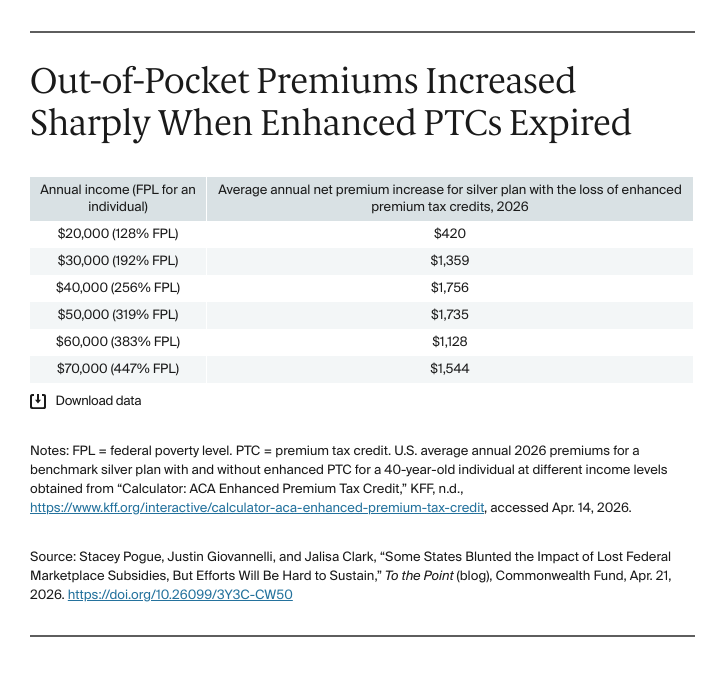
Table: Out-of-Pocket Premiums Increased Sharply When Enhanced PTCs Expired

Limited State Resources, Targeted Subsidy Strategies

The lapse of enhanced PTCs deprived marketplace consumers of about $35 billion in federal assistance in 2026 alone. States were ill-equipped to address a funding loss of this magnitude. The seven states that responded by modifying their subsidy programs mostly made targeted changes to maximize the impact of limited resources.

  • California and Colorado restructured their state subsidies, switching from a program that lowered out-of-pocket cost sharing (by reducing or eliminating deductibles and copayments) to one that lowers monthly premiums to help people purchase and maintain comprehensive coverage.
  • Connecticut and New Mexico extended their state subsidies to some middle-income people (individuals making more than $62,600/year) who, with the expiration of enhanced PTCs, lost all federal subsidies and faced significant net premium increases.
  • California, Connecticut, and Maryland fully replaced the loss of enhanced PTCs for people with incomes just over the poverty level ($15,650/year for an individual), who faced the highest percentage increase in net premiums. These states also provided premium help to some people with higher incomes to partially offset lost federal assistance.
  • New Mexico and Washington took steps to mitigate marketplace coverage losses among certain categories of lawfully present immigrants with incomes below the poverty level who, as of January 2026, lost eligibility for federal PTCs under last year’s tax and spending law.
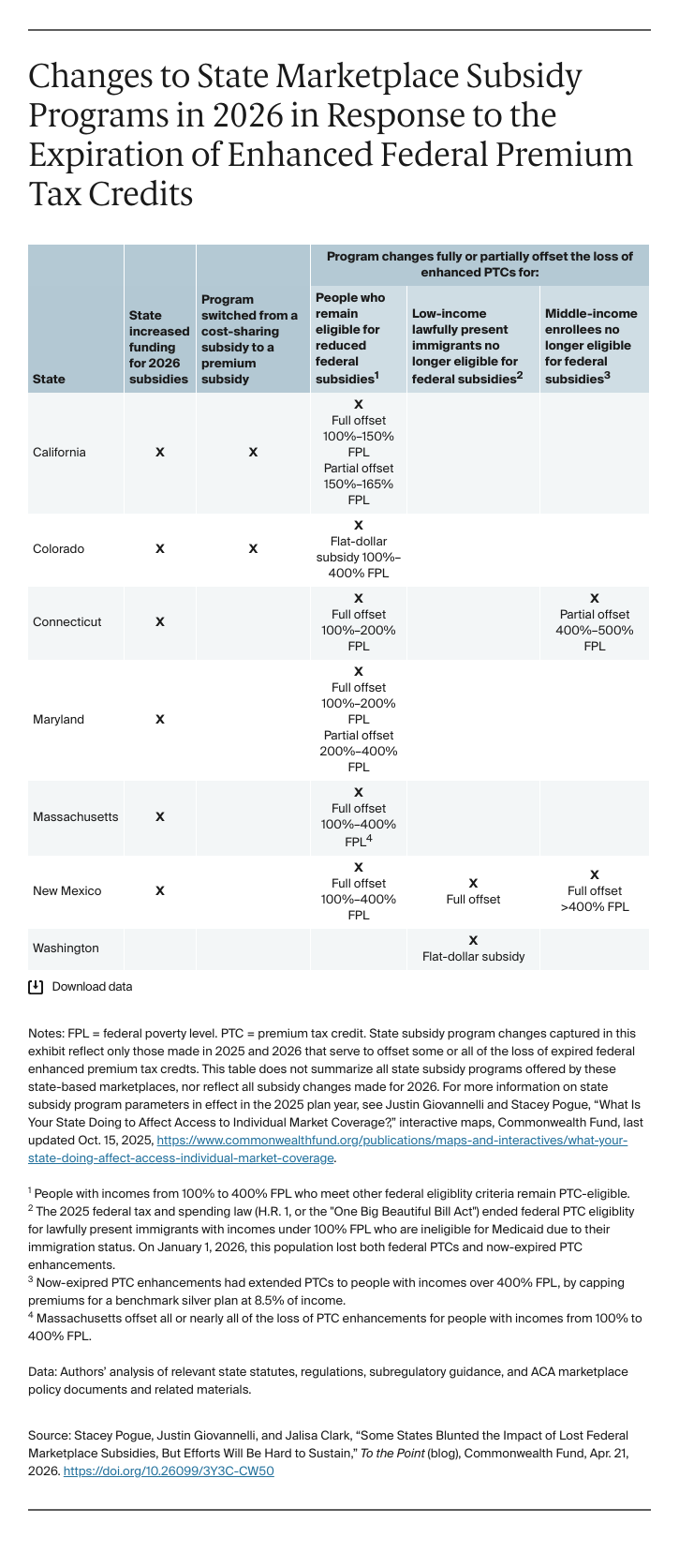
Table: Changes to State Marketplace Subsidy Programs in 2026 in Response to the Expiration of Enhanced Federal Premium Tax Credits

Only New Mexico Patched All Funding Gaps

Alone among states, New Mexico maintained affordability standards from 2025 for everyone with 2026 marketplace coverage. To do so, New Mexico fully replaced the loss of federal enhanced PTCs for all marketplace customers, including middle-income consumers. At the same time, the state retained its existing coverage subsidy initiatives, including its Native American Premium Assistance program and its “Turquoise” plans, which provide state cost-sharing subsidies on top of federal ones. Finally, New Mexico established the Puente Health Program, which extends state premium and cost-sharing subsidies to lawfully present immigrants with incomes below the poverty level to fully offset lost federal PTCs.

States Made Meaningful New Investments, but Only for 2026

Nearly all the states that amended their coverage subsidy programs to respond to the expiring enhanced PTCs concluded it was necessary to increase state funding for 2026. For example, Connecticut allocated an additional $51 million after a November 2025 special legislative session, and Massachusetts announced an additional $250 million investment. New Mexico’s state marketplace affordability programs are funded through its Health Care Affordability Fund, which is supported by a state surtax on health insurers. New Mexico authorized additional spending from this fund in its 2026 budget and during a special legislative session in October 2025.

Looking Ahead

Nationwide, marketplace sign-ups dropped 5 percent in 2026 as out-of-pocket premiums spiked. By contrast, enrollment in New Mexico’s marketplace grew 17 percent — the biggest gain in the nation — while several other states that made new investments in their coverage assistance programs also bucked the downward trend. These early results reaffirm that states have a vital role to play in preserving access to marketplace coverage.

Nevertheless, policymakers have warned that new state funding is only a stopgap and, except for New Mexico, a partial one. The sheer size of the funding deficit makes it impossible for any state to ensure their residents are held harmless indefinitely. Maryland, for example, recently closed its state subsidy programs to midyear enrollees because take-up was greater than expected and funding is running short. Ultimately, whether marketplace coverage is affordable for all consumers will depend on Congress.

Publication Details

Date

Contact

Stacey Pogue, Senior Research Fellow, Center on Health Insurance Reforms, Health Policy Institute, McCourt School of Public Policy, Georgetown University

stacey.pogue@georgetown.edu

Citation

Stacey Pogue, Justin Giovannelli, and Jalisa Clark, “Some States Blunted the Impact of Lost Federal Marketplace Subsidies, But Efforts Will Be Hard to Sustain,” To the Point (blog), Commonwealth Fund, Apr. 21, 2026. https://doi.org/10.26099/3Y3C-CW50