Advanced Search

Advanced Search

Current Filters

Filter your query

Publication Types

Other

to

Blog

/

How States Are Preserving Science-Backed Recommendations for Preventive Care and Vaccines

Woman prepares to get covid vaccine, while talking to nurse on computer.

Leilani Chan, right, answers questions before receiving a COVID-19 vaccination from Tamina Nassiri, a licensed practical nurse at Kaiser Permanente Venice Medical Office Building in Culver City, Calif., on Sept. 23, 2025. Recent shifts in how the federal government develops recommendations for vaccines and preventive care have disrupted longstanding scientific processes. Photo: Allen J. Schaben/Los Angeles Times via Getty Images

Leilani Chan, right, answers questions before receiving a COVID-19 vaccination from Tamina Nassiri, a licensed practical nurse at Kaiser Permanente Venice Medical Office Building in Culver City, Calif., on Sept. 23, 2025. Recent shifts in how the federal government develops recommendations for vaccines and preventive care have disrupted longstanding scientific processes. Photo: Allen J. Schaben/Los Angeles Times via Getty Images

Authors
  • Amy Killelea
    Amy Killelea

    Assistant Research Professor, Center on Health Insurance Reforms, Health Policy Institute, McCourt School of Public Policy, Georgetown University

  • Justin_Giovannelli_Headshot
    Justin Giovannelli

    Associate Research Professor, Center on Health Insurance Reforms, Health Policy Institute, McCourt School of Public Policy, Georgetown University

  • Madison Harden
    Madison Harden-Stein

    Assistant Research Professor, Center on Health Insurance Reforms, Health Policy Institute, McCourt School of Public Policy, Georgetown University

  • Abigail Knapp headshot
    Abigail Knapp

    Research Fellow, Center on Health Insurance Reforms, Health Policy Institute, McCourt School of Public Policy, Georgetown University

Authors
  • Amy Killelea
    Amy Killelea

    Assistant Research Professor, Center on Health Insurance Reforms, Health Policy Institute, McCourt School of Public Policy, Georgetown University

  • Justin_Giovannelli_Headshot
    Justin Giovannelli

    Associate Research Professor, Center on Health Insurance Reforms, Health Policy Institute, McCourt School of Public Policy, Georgetown University

  • Madison Harden
    Madison Harden-Stein

    Assistant Research Professor, Center on Health Insurance Reforms, Health Policy Institute, McCourt School of Public Policy, Georgetown University

  • Abigail Knapp headshot
    Abigail Knapp

    Research Fellow, Center on Health Insurance Reforms, Health Policy Institute, McCourt School of Public Policy, Georgetown University

Toplines
  • Amid growing concern about the credibility of recent federal preventive care and vaccine recommendations, states are exploring how to protect access to scientifically backed services

  • As states move away from federal recommendations for preventive care and vaccines, they risk creating a patchwork of standards and uneven access to services

Federal policy and personnel changes have sharply eroded the reliability of the federal expert bodies responsible for identifying high-value preventive and vaccine services.

ACIP, USPSTF, and HRSA have historically engaged in rigorous and transparent scientific review processes. State and federal policymakers have embedded their recommendations in laws and regulations governing insurance coverage and public health. But recent events have cast doubt on whether these bodies can continue to be relied on to provide science-backed recommendations. ACIP has experienced the most upheaval. In May, Health and Human Services Secretary Robert F. Kennedy Jr. announced changes to vaccine recommendations without ACIP’s input; in June, he fired its members en masse. The newly constituted ACIP — whose membership now includes vocal vaccine skeptics — promptly scaled back its measles, mumps, rubella, and varicella (MMRV) and COVID-19 recommendations at its September meeting.

Federal Recommending Bodies

The ACA requires insurance plans to cover the services recommended by the following bodies without cost sharing:

In December, ACIP voted to remove the recommendation that all babies receive a hepatitis B vaccine within 24 hours of birth, instead recommending parents confer with a provider about when to vaccinate. Many clinicians, epidemiologists, and researchers have criticized the recent changes ACIP has made — most vociferously, the removal of the hepatitis B birth dose recommendation — as representing a fundamental departure from rigorous scientific inquiry that will cause preventable disease and patient harm. Meanwhile, USPSTF — which makes recommendations for a range of preventive services, including cancer screenings, drug and alcohol use counseling, and HIV screening and preventive medication — has not met since last March amid news reports that the Secretary may fire its members.

These developments have prompted states to preserve scientifically backed services where they can: state-regulated private insurance plans, Medicaid, and public health programs. State policymakers must determine how to move away from federal recommending bodies without further damaging trust in public health.

Should states declare federal recommendations no longer credible?

As the federal bodies change their processes and recommendations, states should use data and evidence to determine whether to continue following those recommendations or chart a new course. Some states have chosen the latter and moved to delink all of their coverage and public health standards from ACIP, while others have done so only for COVID-19. A more focused approach, zeroing in on specific services one at a time, may be simpler in the short term and buy states time to identify a new recommending body. However, deeming some of ACIP’s recommendations credible, but others not, risks confusion and may erode trust in all recommendations over time.

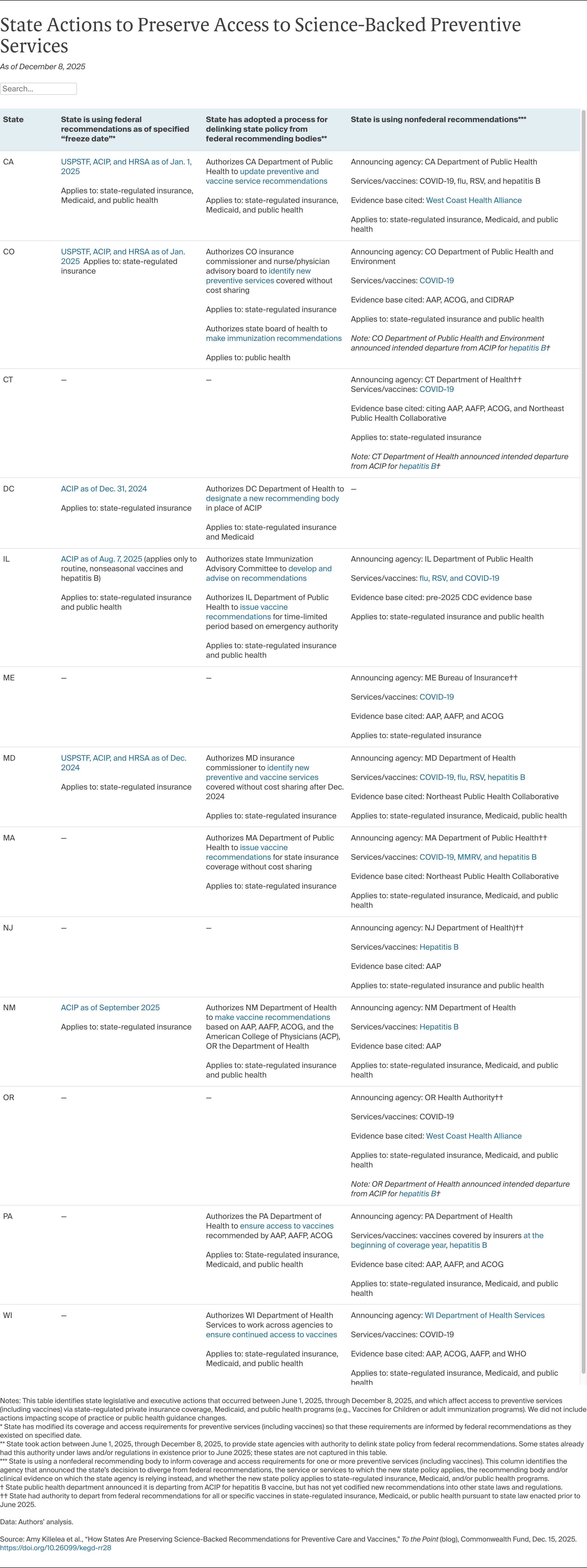
No state has yet announced its departure from USPSTF or HRSA recommendations, but some are laying the groundwork to do so if those bodies follow ACIP’s trajectory. For example, some states have opted to tie their coverage and public health requirements to the specific federal recommendations that were in place at the end of the Biden administration. This approach preserves the status quo in the short term. But these frozen-in-time recommendations can’t account for changes in science and will become obsolete. In addition, announcing a “freeze date” pegged to a prior administration runs the risk of further politicizing preventive services policy, especially if the reasons for doing so are not well communicated by policymakers or understood by the public.

What alternative clinical recommendations should states adopt?

If states stop using the federal recommending bodies, they must identify alternatives. Colorado, for instance, authorizes an existing health board to identify services to be covered without cost sharing if federal recommendations change, including for vaccines and preventive services currently recommended by USPSTF and HRSA. By identifying a health board with broad expertise and community connections to advise state health officials, the state may engender public trust in its recommendations. Other states have authorized regulators to unilaterally adopt different recommendations without specifying a process for evidence review and transparency. This approach facilitates quick action in an emergency, but may run into challenges when it comes to building public trust and provider buy-in.

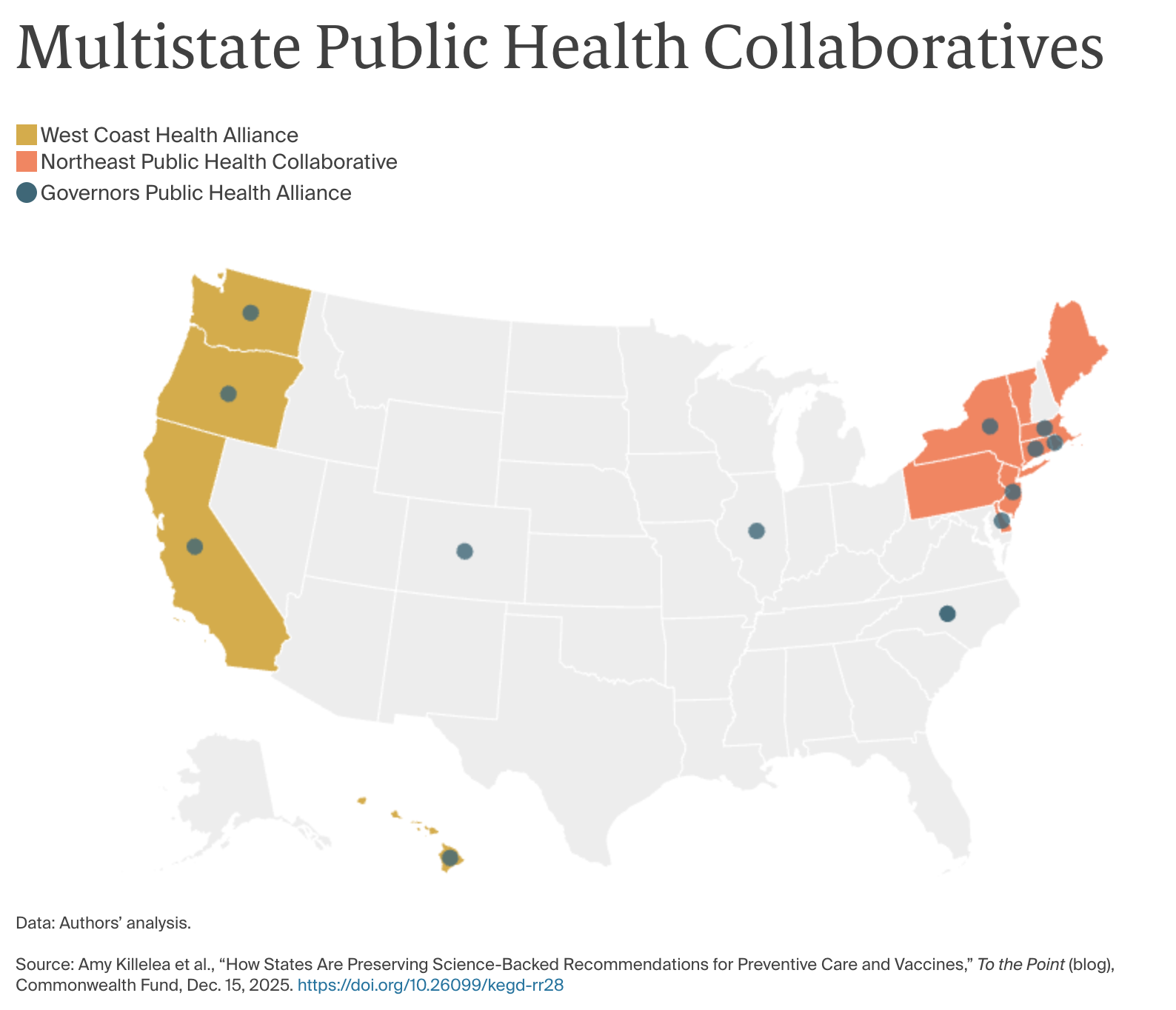
Still other states have formed regional collaboratives to develop vaccine recommendations and could use these bodies to implement regular, transparent reviews of clinical evidence on vaccines and other preventive services. Two prominent compacts — the West Coast Alliance and the Northeast Public Health Collaborative — have begun announcing vaccine recommendations, but are proceeding slowly and have provided limited information about the processes they will use to review evidence and make recommendations. So far, only Oregon has embedded the recommendations of its collaborative in state law, but as these compacts develop more transparent and intensive evidence review processes, more states may consider codifying reference to these collaboratives in state law. Meanwhile, a third collaborative has emerged — the Governors Public Health Alliance — to coordinate across regional compacts and states.


How States Are Preserving Science-Backed Recommendations for Preventive Care and Vaccines_ Map@2x

Finally, some states (and the regional collaboratives) are turning to existing medical society recommendations and other academic institutions as a source of clinical evidence. These recommendations are more limited in scope and rigorous review process than federal recommending bodies, but can serve as an important evidence base.

How can states ensure a cohesive approach to preventive services access?

All states have implemented federal preventive services recommendations, often in multiple contexts within states. ACIP recommendations, for instance, often set the coverage standard for state-regulated insurance, Medicaid/CHIP, the Vaccines for Children program, and public health immunization requirements. As states move away from uniform federal recommendations, they are grappling with how to ensure their new standards remain consistent across agencies and programs and align with state neighbors. The regional collaboratives may promote interstate uniformity. Within states, policymakers are seeking, where possible, to address multiple domains at once and avoid creating a patchwork of standards where access varies by coverage source.

Looking Ahead

The upcoming legislative sessions will shed more light on state solutions to preserving science-backed preventive and vaccine services in the face of significant and ongoing federal changes. States will need to consider the questions posed in this blog post when addressing these challenges to protect consumers and preserve public trust in prevention and public health.

How States Are Preserving Science-Backed Recommendations for Preventive Care and Vaccines_ Table@2x

Publication Details

Date

Contact

Amy Killelea, Assistant Research Professor, Center on Health Insurance Reforms, Health Policy Institute, McCourt School of Public Policy, Georgetown University

Citation

Amy Killelea et al., “How States Are Preserving Science-Backed Recommendations for Preventive Care and Vaccines,” To the Point (blog), Commonwealth Fund, Dec. 15, 2025. https://doi.org/10.26099/kegd-rr28