Advanced Search

Advanced Search

Current Filters

Filter your query

Publication Types

Other

to

India has a public-private health care system financed through government spending, private-sector investments, and significant patient out-of-pocket payments.1 In pursuit of universal coverage, the government has launched initiatives focused on low-income families. These include Ayushman Bharat Pradhan Mantri Jan Arogya Yojana, which offers free treatment for secondary and tertiary care.2 As of 2023, 50 percent of the population was covered through public health insurance programs, 20 percent was covered by private or social health insurance, and 30 percent was uninsured.3

Health outcomes, including maternal and infant mortality, have improved over the past 40 years, but systemic challenges persist.4 India’s per capita health expenditure ranks near the bottom among lower-middle-income countries, and public health spending accounts for less than 2.5 percent of gross domestic product, far below that of peer nations.5 This chronic underinvestment is further compounded by widespread lack of insurance: a large share of the population remains uninsured, and among those with coverage, nearly 75 percent are underinsured.6

In 2018, the central government approved the implementation of Ayushman Bharat Pradhan Mantri Jan Arogya Yojana (AB PM-JAY), which is the flagship public health insurance program. Covering the bottom 40 percent of the population, it’s the world’s largest health insurance program. As of 2024, it extends health coverage to all adults age 70 and over. AB PM-JAY is entirely government-funded, with costs shared between the central and state governments.

  • Public insurance coverage: 50% of population

  • Private insurance coverage: 20% of population

In 2022, total health care expenditure was about USD 111 billion. Of this, USD 50 billion was out-of-pocket spending by individuals, while government spending accounted for USD 43 billion. Per capita health spending during the same year was USD 77.

  • Out of pocket spending: 44% of total health care spend

Scheduled Castes, Scheduled Tribes, and Muslims consistently experience poorer health outcomes and shorter life expectancy than higher-caste Hindus. On average, Scheduled Tribes live about four years less, Scheduled Castes about three years less, and Muslims roughly one year less than their higher-caste Hindu counterparts. 

Nearly 67 percent of AB PM-JAY hospitals are concentrated in big cities, leaving rural Scheduled Castes and Scheduled Tribes underserved, especially in regions such as Bihar, Jharkhand, and the northeast states. Structural barriers, such as limited education, land, and jobs, along with caste discrimination, reinforce economic and health inequities.

Coverage and Access

Background and History

Over the decades, several government-funded health insurance programs have been introduced to improve coverage for specific populations, with variations across India’s 28 states and eight union territories.7 The Employees’ State Insurance Scheme (Karmachari Rajya Bima Yojana), launched in 1948, provided medical care and cash benefits to factory and wage-earning workers engaged in industrial labor.8 This was followed by the Central Government Health Scheme in 1954, offering comprehensive health care to government employees and their families.9

Private-sector involvement in health coverage started in 1986 with the General Insurance Corporation of India’s Mediclaim policy, which introduced voluntary insurance for hospitalization expenses up to a defined annual limit while excluding categories such as maternity care and preexisting health conditions.10 The sector was still heavily dominated by state-owned monopolies until 1994, when it was liberalized by the government.11 In 1999, the Insurance Regulatory and Development Authority of India was established to regulate the entire insurance sector and enable the participation of private health insurers.12

Initiatives to provide financial protection for unorganized workers lacking social security or health benefits and for people below the poverty line have included the National Illness Assistance Fund (Rashtriya Arogya Nidhi, 1997), Jeevandayee Yojana, the Universal Health Insurance Scheme (2003), and National Health Insurance Programme (Rashtriya Swasthya Bima Yojana [RSBY], 2008).13

In 2018, the central government approved the implementation of Ayushman Bharat Pradhan Mantri Jan Arogya Yojana (AB PM-JAY), which was positioned as a significant step toward achieving universal coverage.14 However, the program’s efficacy has been questioned: a study one year after its launch found that insured individuals had similar rates of out-of-pocket spending as uninsured individuals.15

The Role of Public Health Insurance

Public spending accounted for 48 percent of total health expenditure as of 2022.16

AB PM-JAY is the flagship public health insurance program.17 Previously known as the National Health Protection Scheme, it provides INR 500,000 (USD 5,975) per family per year for secondary and tertiary care hospitalizations.18 Covering the bottom 40 percent of the population — about 120 million poor and marginalized families, or some 550 million total beneficiaries — it’s the world’s largest health insurance program.19 A significant recent expansion under AB PM-JAY that extends health coverage to all adults age 70 and over, irrespective of income, was announced in 2024.20 AB PM-JAY is entirely government-funded, with costs shared between the central and state governments.21

AB PM-JAY subsumed RSBY in 2018, an earlier government-funded insurance initiative aimed at families below the poverty line, with a family cap of five members.22 RSBY provided coverage of up to INR 30,000 (USD 359) per family per year for inpatient hospitalization expenses but did not include outpatient care.23

Despite its limited scope, RSBY played a foundational role in shaping India’s approach to public health insurance for the informal sector. One example is the Central Government Health Scheme, which is operated by the Ministry of Health and Family Welfare (MoHFW, Swāsthya Aur Parivār Kalyān Mantrālaya) to cover current and retired central government employees and their dependents. Coverage includes homeopathic and alternative medicine treatments. It’s a subscription-based model where beneficiaries contribute a fixed monthly rate that ranges from INR 250 (USD 3) to INR 1,000 (USD 12) based on salary.24 About 4.6 million beneficiaries have been registered under the program.25

The Common Man Insurance Scheme (Aam Aadmi Bima Yojana) is a government social security program that provides death and disability coverage. It covers one earning member (ages 18 to 59) per family, with an annual premium of INR 200 (USD 2.4) per person, shared equally by the central and state governments.26

The only health insurance program that both employees and employers contribute to is the Employees’ State Insurance Scheme, run by the Ministry of Labour and Employment for companies with 10 or more workers.27 Employees contribute 0.75 percent of their wages, and employers contribute 3.25 percent. To be eligible, a worker must earn up to INR 21,000 (USD 251) per month.28 Coverage for workers and their families includes maternity care and disability and death benefits for employment-related injuries. State governments contribute one-eighth of the medical benefit expenditures, up to an annual per capita ceiling of INR 1,500 (USD 18).29 As of 2024, the program had about 144 million beneficiaries.30

Many Indian states run their own health insurance programs to address regional needs. For example, Maharashtra operates the Mahatma Jyotiba Phule Jan Arogya Yojana, Tamil Nadu offers the Chief Minister's Comprehensive Health Insurance Scheme, and Andhra Pradesh runs the Dr. YSR Aarogyasri Health Insurance Scheme, launched to support low-income families.31

Despite government initiatives such as AB PM-JAY, about 30 percent of Indians remain uninsured.32 This gap stems mainly from outdated eligibility data, low awareness among eligible families, and fragmented state-level program implementation.33 Even among those covered, underinsurance persists, as coverage limits often fall short of actual treatment costs, leaving many exposed to significant out-of-pocket spending.34

Services Covered by Public Health Insurance

The following services are covered by public health insurance:35

  • Preventive care
  • Inpatient care
  • Outpatient care
  • Maternity care
  • Primary care
  • Pharmaceuticals
  • Dental care
  • Eye care
  • Mental health care
  • Palliative care
  • Long-term care
  • Rehabilitative care.

Safety Nets

India’s various health coverage programs subsidize care for different populations.36 AB PM-JAY is the largest among them. The core principle of the program is to eliminate user charges at the point of service, as the government directly reimburses empaneled hospitals.37 However, implementation of this policy, particularly in the private sector, has often been inconsistent. While the program is promoted as providing fully free care, many patients end up paying out of pocket when package limits are exceeded.38

In addition to AB PM-JAY, other government initiatives aim to shield beneficiaries from user charges. For instance, the Employees’ State Insurance Scheme for workers in the organized sector and the Central Government Health Scheme for central government employees both offer subsidized care with no upfront payments.39

To help make medicines affordable, the Pradhan Mantri Bhartiya Janaushadhi Pariyojana (PMBJP) ensures access to essential generic drugs at lower prices.40 Several states also operate their own health insurance programs. Notably, Tamil Nadu and Andhra Pradesh were among the first to launch large-scale programs, providing inpatient coverage for low- and even some middle-income populations.41

Limited financial protection is a barrier to equitable health care. With minimal risk-pooling, households often face high out-of-pocket costs.42 Some programs, including the Employees’ State Insurance Scheme, exempt low earners (earning up to INR 176/USD 2 per day) from contributions. However, these safeguards aren't a feature of every program.43

The Role of Private Health Insurance

The Insurance Regulatory and Development Authority Act of 1999 allowed private companies to enter the health insurance market. It also allowed individuals who aren’t eligible for sponsored insurance programs to purchase a private policy.44

Since 2020, the Insurance Regulatory and Development Authority of India required employers operating during the COVID-19 lockdown to provide group health insurance to their employees, a measure that has since encouraged wider adoption of employer-sponsored health coverage.45

People are increasingly turning to personal private health insurance plans to supplement their employer-provided coverage, signaling a growing demand for more comprehensive and customizable protection.46 As of 2022, private insurance accounted for 7.4 percent of total health expenditures.47

The Role of Government

Responsibility for the governance, financing, and operation of the health system is divided between the central and state governments. At the federal level, the MoHFW has regulatory power over most health policy decisions, although the ministry isn’t directly involved in health care delivery.48 It comprises two departments:

  • The Department of Health and Family Welfare, which is responsible for organizing and delivering all national health programs, with each program headed by its own administrative body.49
  • The Department of Health Research, which is responsible for health promotion and clinical research, the development of health research and ethics guidelines, outbreak investigations, and the provision of advanced research training and grants for such training.50

The Directorate General of Health Services, under the MoHFW, provides technical guidance on public health and medical education. It oversees national health programs and central hospitals and supports states and union territories (territories directly governed by the central government) in enhancing public health services.51

At the state level, the Directorate General of Health Services and the Department of Health and Family Welfare are responsible for organizing and delivering all health care services, from primary care and pharmaceutical services to secondary and tertiary hospital care.52

States are independently responsible for health care activities, so there’s significant nationwide variation in service delivery models, insurance coverage, availability, and access. Certain initiatives, such as the National Health Mission are governed or financed jointly by the central and state governments.53

At the district level, local government (Panchayati Raj) institutions are responsible for grassroots governance and administration in rural villages. These government bodies play a significant role in establishing primary health centers and contributing to social policies related to education, agriculture, and transportation.54 The chief medical and health officer of each district is primarily responsible for the implementation of health and welfare programs at the district level.55

Service provision by Panchayati Raj institutions is uneven. Residential segregation, shaped by caste and religion, strongly influences distribution. Areas dominated by marginalized groups, such as Scheduled Castes and Muslims, often receive poorer infrastructure and weaker service delivery than majority communities.56

All programs under the National Health Mission are organized on a local level through District Health Missions in rural areas or City Health Missions in urban centers. These initiatives are headed up by the chairperson of the district council or the city mayor.57

The National Health Authority implements national health initiatives, most notably AB PM-JAY.58

Integration and Care Coordination

Patient care in India is fragmented. Although a patient referral mechanism exists, it’s rarely utilized, owing to a lack of coordination across health care levels, a lack of awareness among patients about the referral process, and limited trust in primary or secondary facilities. Many bypass the system and head straight to tertiary hospitals, overloading them. Meanwhile, rural and low-income populations continue to struggle with communication gaps associated with language differences and illiteracy, under-resourced primary care, affordability issues, and geographic barriers. This worsens health care inequities (See Addressing Health Inequities).59

The National Health Authority is working to improve care coordination by integrating the Central Government Health Scheme, AB PM-JAY, the Employees’ State Insurance Scheme, and other public programs under a unified digital platform. This allows real-time updates on patients and cross-utilization of hospitals between programs.60 For example, AB PM-JAY beneficiaries can access Employee’s State Insurance hospitals, and vice versa, and reimbursements are based on eligibility and are at AB PM-JAY rates.61

Cancer care is provided under a hub-and-spoke model that improves integration and coordination by linking primary care centers (spokes) with specialized tertiary hospitals (hubs). It’s a patient-centric approach that speeds up referrals and streamlines follow-up appointments.62

Operations and Resources

Overview of the Delivery System

The health care delivery system operates through a three-tiered structure:63

  • Primary care. Preventive, curative, and maternal services are offered in primary health centers and community health centers. These facilities are patients’ first point of contact with the health system.
  • Secondary care. Primary and community health centers refer patients with complex health conditions to subdistrict and district hospitals for specialized diagnostics, surgeries, and inpatient care.
  • Tertiary care. Highly specialized health care for complex conditions is provided by advanced facilities, such as medical colleges and specialty hospitals.

Coverage programs, such as the Central Government Health Scheme and AB PM-JAY, provide free treatment: beneficiaries can obtain care at participating facilities by using digitally enabled identification cards or smart cards.64 Under AB PM-JAY, beneficiaries get an Ayushman card to access services at any public or private empaneled hospital (one recognized and approved by an insurance company or government program).65

Provider payments made by AB PM-JAY follow a case-based bundled pricing model in which health care providers are reimbursed at a fixed rate for a defined set of services under specific health benefit packages. To increase efficiency and care quality, the program is transitioning to a diagnosis-related, group-based payment system, which considers case severity.

Primary Care

By July 2025, 178,154 Ayushman Bharat health and wellness centers had been established. These are also known as Ayushman Arogya Mandirs (AAMs).66 The centers provide comprehensive primary health care — including preventive, promotive, curative, rehabilitative, and palliative services — free of charge to all age groups.67

Residents aren’t required to register with a general practitioner (GP), as the concept of GPs does not formally exist within the public health system.68 Primary care is provided by a network of government health facilities and community health workers or mid-level health care providers.69 Primary health care was originally structured as a three-tiered system — sub-health centers, primary health centers, and community health centers — each serving different population sizes with specific services.70 Each primary health center provides curative and preventive services to between 20,000 and 30,000 people. Sub-health centers, the first point of contact for patients, are designed to handle maternal and child health, disease control, and health counseling for a population of 3,000 to 5,000.71 Initially upgraded to health and wellness centers in 2018, these facilities have now been further enhanced and rebranded as AAMs for broader and improved primary health care services.72

All medical personnel working at public outpatient or inpatient facilities, including primary and specialty physicians, are paid salaries, which vary based on the area of work and level of specialization. However, several state governments are enhancing service delivery by introducing performance-based payments for Accredited Social Health Activists.73 Studies highlight that well-designed performance-based payments that follow clear guidelines and are made electronically have strengthened the performance of health workers.74 In addition to the fixed monthly incentive of INR 2,000 (USD 24), a number of states have proposed increasing payments based on performance.75

Physicians are generally prohibited from engaging in private practice during their official hours. However, the enforcement and specifics of this rule vary by state.76

Traditionally, primary health centers operated during standard daytime hours. However, recent initiatives aim to enhance accessibility by converting primary health centers into 24/7 facilities. As of 2023, more than 12,000 primary health centers have been upgraded to provide around-the-clock services, particularly to improve emergency care in rural and underserved regions.77

There are no data available on the number of GPs in the country.

Outpatient/Specialist Care

Community health centers also provide outpatient specialist care delivered by surgeons, obstetricians, pediatricians, and anesthesiologists, among others, as well as necessary infrastructure, such as an operating theater and a blood storage unit.78 Each center covers between 80,000 and 120,000 people.79

All outpatient specialized services not provided at community health centers are referred to district hospitals. The government plans to establish day care cancer centers in all district hospitals over the next three years, targeting 200 centers in fiscal year 2025–26 to enhance access to cancer care at the district level.80

First referral units (FRUs) are upgraded community health centers equipped to provide comprehensive emergency obstetric and newborn care, including cesarean sections, emergency treatment for sick children, and referral transport.81 The number of operational FRUs increased from 940 in 2005 to more than 3,000 in 2024.82 In urban areas, community health centers serve as FRUs by default.83

In outpatient care, 64 percent of patients sought treatment from private facilities in 2022, whereas only 22.8 percent accessed services through public health care institutions.84

Physician Education and the Workforce

Medical education is provided by both government-led institutions and private colleges. The fee structure for an undergraduate medical degree depends on whether it's a government or private college.85 Government institutions offer more affordable education, with annual fees typically ranging from INR 75,000 to 220,000 (USD 896 to 2,629) in 2024, compared with INR 400,000 to INR 4 million (USD 4,780 to 47,803) at private colleges.86

The National Medical Commission sets medical education standards, accredits programs, recognizes foreign degrees, and maintains a national physician register.87 It also has a remit to improve access to affordable quality medical education, work toward equitable workforce distribution, and promote universal health care.88

Between 2019 and 2025, the number of medical colleges rose from about 500 to nearly 800. However, physician migration is high: more than 2,800 doctors left the country in 2021 alone.89

There are no data available for the number of medical graduates in the country.

Hospitals

BY THE NUMBERS

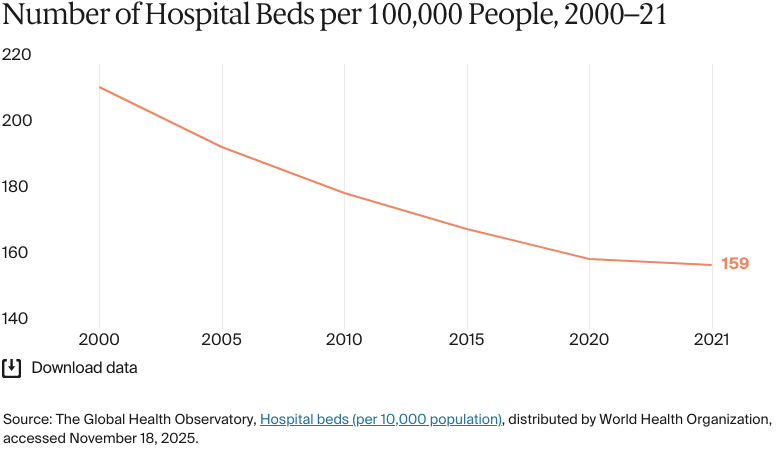
  • In 2021, there were 159 hospital beds per 100,000 people.90
  • In 2020, there were 172 nurses and midwives per 100,000 people (compared with an average of 206 in Southeast Asia in 2022).91
Line chart: Number of Hospital Beds per 100,000 People, 2000–21Number of Hospital Beds per 100,000 People, 2000–21Number of Hospital Beds per 100,000 People, 2000–21

Patients using the public health system can be referred to a district hospital. District hospitals offer services that are similar to those of community health centers, such as emergency care, maternity services, and newborn care, but they serve larger urban centers. As of 2024, India had a total of 759 district hospitals.92 Numbers have increased, but 17 states and union territories didn’t have a district hospital in each district as of 2022.93

Research hospitals and education centers funded by the central and state governments offer specialized care.94 In addition, the government has been working on enhancing health care infrastructure by converting district hospitals into medical colleges to bolster the physician workforce and improve tertiary care access. As of 2024, 157 district hospitals had been converted into medical colleges.95

There are about 70,000 hospitals, of which about 44,000 are privately operated, and about 26,000 are in the public sector.96 Private hospitals are largely concentrated in urban cities, while rural areas — home to over 65 percent of the population — depend more on public hospitals.97 The private sector is undergoing rapid expansion, with 10,000 beds expected to be added in the 2025 and 2026 financial years — equal to the number that was added in the financial years between 2020 and 2024.98

Mental Health Care

BY THE NUMBERS

  • 0.8 psychiatrists per 100,000 people in 2021 (compared with 0.4 across lower-middle-income countries in 2020).99
  • There were 1.4 psychiatric beds per 100,000 people in 2020.100

Mental health services have been incorporated into the comprehensive primary health care package under health and wellness centers, and operational guidelines have been released for managing mental, neurological, and substance use disorders at these centers. Additionally, the National Tele Mental Health Programme (Tele MANAS) aims to provide 24/7 mental health services across all states and union territories via a toll-free helpline.101 Nationwide, the program is supported by 23 mentoring institutes and five regional coordinating centers.102

To address the shortage of mental health professionals, the government has established digital academies at central mental health institutes to provide online training to general health care and paramedical professionals.103

However, resources are limited. As of 2020, India had 136 psychiatric institutions, including 46 run by the government, with just 1.4 psychiatric beds for every 100,000 people.104 In 2021, there were only 0.8 psychiatrists for every 100,000 people, reflecting a critical shortage in mental health infrastructure.105

Following a mandate by the Insurance Regulatory and Development Authority of India in 2023, some private insurers now cover mental illness treatments, including hospitalization, outpatient care, and counseling.106 However, most exclude coverage for substance use disorders, neurodevelopmental conditions, suicide attempts, preventive care, psychological assessments, and outpatient consultations.107

Long-Term Care and Social Support

In 2011, the central government launched the National Programme for Health Care of the Elderly to provide dedicated health care facilities and services to senior citizens (age 65 and over) at all levels of the health care delivery system. In 2022–23, 725 districts, 17 regional geriatric centers, and two national centers for aging were sanctioned under the program. In 2023, AB PM-JAY health insurance coverage was universally extended to all citizens age 70 and over, giving the oldest seniors access to secondary/tertiary hospitalization through their smart cards.108

Atal Vayo Abhyuday Yojana, launched by the Ministry of Social Justice and Empowerment in 2021, is an initiative to improve the welfare of senior citizens by providing basic amenities, such as shelter, food, medical care, and entertainment opportunities. It also aims to promote active aging by encouraging seniors to take part in social activities and make the most of community groups and resources.109

Some states have launched their own initiatives to increase access to palliative care. In Kerala, for example, the government is connecting services offered by public hospitals and nongovernmental organizations (NGOs) through a palliative care grid. It plans to link the palliative care services of more than 1,000 government hospitals and more than 250 NGOs. This means patients should experience continuity of care even if they move between locations, such as from receiving care at a large urban hospital to receiving care at home.110

Cost and Affordability

Health Care Spending Overview

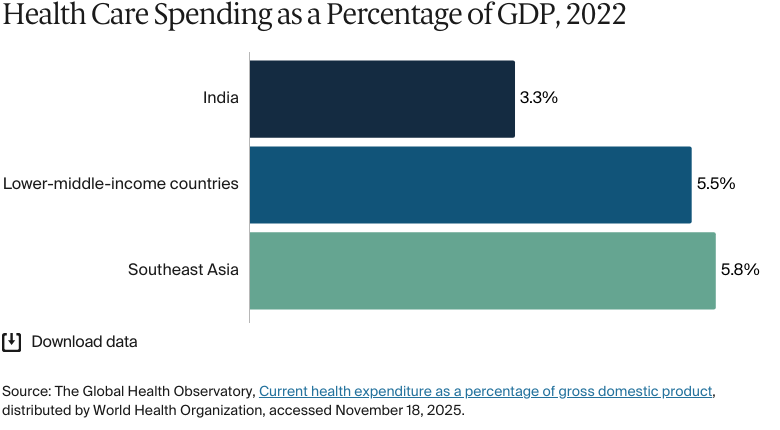
In 2023, health care spending accounted for 3.3 percent of gross domestic product (GDP). This figure was significantly lower than the average for lower-middle-income countries (5.5%) and the regional average for Southeast Asia (5.8%).111

Bar chart: Health Care Spending as a Percentage of GDP, 2022

In 2022, total health care expenditure was about USD 111 billion. Of this, USD 50 billion was out-of-pocket spending by individuals, while government spending accounted for USD 43 billion.112 Per capita health spending during the same year was USD 77, lower than the average of USD 92 for lower-middle-income countries.113

Pharmaceutical Spending

The National Pharmaceutical Pricing Authority regulates drug prices by setting ceiling prices for essential medicines in the National List of Essential Medicines (NLEM).114 Manufacturers must comply with these ceiling prices, and no manufacturer is allowed to increase the maximum retail price of a nonscheduled drug (which does not usually need to be prescribed by a doctor) by more than 10 percent over the price charged in the preceding 12-month period.115 Some measures under the 2022 NLEM led to an average 21 percent price reduction and an estimated annual saving of INR 2,943 million (USD 35 million) for patients.116

To reduce out-of-pocket expenditure on medicines and improve the availability of essential drugs, the government has implemented the Free Drugs Service Initiative under the National Health Mission. This provides free essential medicines at public health facilities across the country. The MoHFW has recommended a facility-wise Essential Medicines List to ensure drug availability across different levels of care. States have the flexibility to adapt and expand this list by incorporating their own essential drugs list based on local needs and priorities.117

Complementing this, the Free Diagnostics Service Initiative has expanded access to essential diagnostic tests at public facilities. As of 2024, this initiative had been implemented in most states and union territories.118

Cost Sharing and Out-of-Pocket Spending

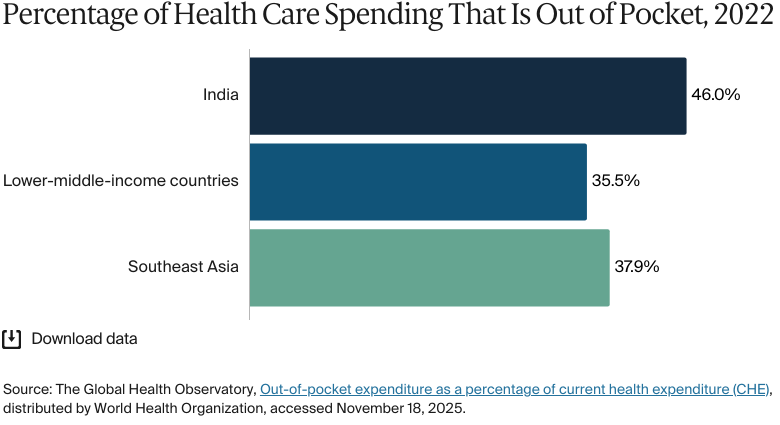
In 2023, out-of-pocket spending accounted for 44 percent of total health spending, higher than the 36 percent average for lower-middle-income countries in 2022.119

There’s no universal out-of-pocket expenditure cap. Beneficiaries are protected within the coverage limits of programs or insurance policies but not beyond.120 Several studies highlight that a large portion of out-of-pocket spending is on medicines, particularly for outpatient care that is often not covered by major programs, such as AB PM-JAY.121 For many households, purchasing medicines from private pharmacies is the primary driver of catastrophic health expenditure.122

Bar chart: Percentage of Health Care Spending That Is Out of Pocket, 2022

Citizens can access free care in public health facilities with no deductibles or coinsurance. Inpatient stays typically involve copayments, with fixed rates applied for beds and surgeries. For dental care, copayments are required for surgeries and procedures, but routine visits are generally exempt from charges. Copayments for medical devices are common, but some states offer programs that provide free diagnostics if the services are available within the relevant facility.123

With limited government funding for health care as well as accessibility challenges in many areas, a significant portion of outpatient and inpatient care is delivered at private facilities, and costs are typically paid out of pocket.124 As a result, out-of-pocket payments are the primary means of funding health care, accounting for 44 percent of total health expenditures in 2023.125

Between 2021 and 2022, out-of-pocket spending decreased. This was achieved through increased government spending, a strengthened public health care system, and targeted responses to both immediate and long-term health challenges — including the rising burden of noncommunicable diseases and the COVID-19 pandemic.126

How Are Costs Contained?

Value-based health care is increasingly used to improve outcomes and control costs, especially within AB PM-JAY. It shifts away from a traditional fee-for-service model toward performance-based payments, where providers are rewarded for delivering high-quality, patient-centered care. Under value-based health care, clinician incentives are linked to outcomes such as zero out-of-pocket costs for patients, and providers earn points for grievance-free service delivery.127

Quality and Outcomes

Health Outcomes

BY THE NUMBERS

  • Life expectancy was 67.3 years in 2021 (compared with 68.4 years in Southeast Asia) – 65.8 years for men and 69 years for women.128
  • The top three causes of death in 2021 were:129
    • COVID-19: 221 deaths per 100,000 people
    • Ischemic heart disease: 111 deaths per 100,000 people
    • Chronic obstructive pulmonary disease: 70 deaths per 100,000 people.
  • The maternal mortality rate was 80 deaths per 100,000 live births in 2023 (compared with 96 on average in Southeast Asia).130
  • The infant mortality rate was 25 deaths per 1,000 live births in 2023 (compared with 23 on average in Southeast Asia).131
  • In 2021, the share of the population with mental health disorders was 15 percent (compared with 14% on average in lower-middle-income countries).132
  • The suicide rate was 14 deaths per 100,000 people in 2023 (compared with nine deaths per 100,000 people on average across lower-middle-income countries).133
  • Guns are responsible for two deaths per 100,000 people.134
  • 7.3 percent of adults were affected by obesity in 2022.135

There are no data available on avoidable mortality.

In 2021, life expectancy was slightly lower than in Southeast Asia for both men and women. It was, however, in line with the averages for lower-middle-income countries (65.3 for men and 69.2 for women).136

In 2021, the leading cause of death was noncommunicable diseases, accounting for 49.1 percent of all deaths. This was followed by communicable, maternal, perinatal, and nutritional conditions at 38.4 percent, injuries at 7 percent, and COVID-19-pandemic-related outcomes at 5.5 percent.137

Addressing Health Inequities 

Health outcomes in India continue to reflect entrenched social and structural disparities. Caste and religion significantly influence access to health care services, utilization patterns, and overall life expectancy. These inequities highlight persistent gaps in the country’s health system, as marginalized communities remain disproportionately disadvantaged.138

Scheduled Castes, Scheduled Tribes, and Muslims consistently experience poorer health outcomes and shorter life expectancy than higher-caste Hindus. On average, Scheduled Tribes live about four years less, Scheduled Castes about three years less, and Muslims roughly one year less than their higher-caste Hindu counterparts.139

Private facilities make up about 62 percent of India’s health infrastructure, yet they serve only 4 percent of STs and 15 percent of Scheduled Castes.140 Under AB PM-JAY, SCs and Scheduled Tribes account for just 1.6 percent and 4 percent of private hospital admissions, respectively, despite representing 19.7 percent and 15.4 percent of the population.141

Nearly 67 percent of AB PM-JAY hospitals are concentrated in big cities, leaving rural Scheduled Castes and Scheduled Tribes underserved, especially in regions such as Bihar, Jharkhand, and the northeast states.142 Structural barriers, such as limited education, land, and jobs, along with caste discrimination, reinforce economic and health inequities.143

There have been multiple initiatives to centralize health data collection and monitor health indicators more effectively. The Health Management Information System collects real-time data from public health facilities nationwide, covering health indicators and monitoring health system performance.144 The Integrated Disease Surveillance Programme, meanwhile, monitors disease trends for early detection.145

Initiatives designed to improve access to health care for marginalized populations include:

  • The Rashtriya Arogya Nidhi umbrella program offers financial assistance to economically disadvantaged patients for the treatment of life-threatening conditions. It includes support for general critical illnesses, cancer, and specified rare diseases, with treatment provided at government hospitals that have super-specialty facilities.146
  • Janani Suraksha Yojana, a centrally sponsored program under the National Health Mission, aims to reduce maternal and neonatal mortality by encouraging women from marginalized and low-income groups to give birth in health care facilities. It offers cash assistance for delivery and postnatal care, with Accredited Social Health Activists acting as vital links between the health care system and beneficiaries.147
  • Intensified Mission Indradhanush, which concluded in 2023, marked the first nationwide immunization drive covering all districts and children age 5 and under. It sought to improve full vaccine coverage among previously unvaccinated children, those who had missed doses, and pregnant women.148
  • In 2021, the MoHFW launched the National Policy for Rare Diseases, offering financial assistance of up to INR 5 million (USD 59,754) per patient for treatment at designated centers of excellence.149
  • The Nikshay Poshan Yojana program provides nutritional support to tuberculosis (TB) patients. In 2024, the government doubled its monthly investment in the program, from INR 500 (USD 6) to INR 1,000 (USD 12) per patient.150 Implemented under the National Health Mission, this support is provided to registered patients with TB who are undergoing treatment to enhance treatment adherence and improve nutritional outcomes.151

Innovation and Reform

Health Care Innovation

There has been progress in health care innovation through the following initiatives.

Quality of Care

AB PM-JAY promotes quality health care through initiatives that include monthly hospital self-assessment audits and a tiered quality certification system, along with National Quality Assurance Standards certification for public hospitals. Centers of excellence develop standards for specialty care.152

The Pradhan Mantri-Ayushman Bharat Health Infrastructure Mission

Launched in 2021 with an investment of INR 640,000 million (USD 7.7 billion) over six years, this is a national effort to strengthen health care infrastructure across the primary, secondary, and tertiary levels. It aims to build a robust, information-technology-enabled disease surveillance system, enhance critical care capacity in 602 districts, and establish integrated public health labs in all 730 districts.153

All India Institute of Medical Sciences (AIIMS) institutions

The government is in the process of setting up 22 new AIIMS institutions to improve access to quality health care and medical education. Modeled after AIIMS Delhi, six are already fully functional across key states.154

Health Care Technology

The Ayushman Bharat Digital Mission was launched in 2021 by the National Health Authority to create a national digital health ecosystem with secure, interoperable systems for universal coverage.155 The main elements are a health ID, an app for managing health records, and the Unified Health Interface — a digital network designed to connect patients with health care providers and services.156 More than 739 million IDs had been issued by February 2025.157

The national telemedicine service, eSanjeevani, was launched in 2019 by the Ministry of Electronics and Information Technology. It operates across 125,000 health and wellness centers using a hub-and-spoke model to connect rural centers with specialists.158 The Services e-Health Assistance and Teleconsultation platform, launched by the Ministry of Defence, provides teleconsultation services to entitled military personnel and their families.159

Aarogya Setu, now a national health app under the Ayushman Bharat Digital Mission, lets users create digital health IDs for easier access to services. The e-Hospital app, meanwhile, integrates hospital workflows to connect patients, doctors, and hospitals on a unified digital platform.160

This profile reflects data as of January 2026. New or updated information may have become available since its release.

Notes

Country Profile Details

Date

Citation

International Health Care System Profiles: India (Commonwealth Fund, May 2026).

https://doi.org/10.26099/5GY4-R836

Compare Countries

Explore how countries compare on key health system characteristics including health care coverage and spending, the health workforce, health outcomes, and more.

Learn more →

Related Content