



Recent changes in health care payment policy could provide new opportunities for people to gain access to much-needed behavioral health services. This is the result of changes in the way that some Medicare services are paid for, as well as of new models launched by the Innovation Center at the Centers for Medicare and Medicaid Services (CMS). These policies can improve coverage of behavioral health services, but health care stakeholders will need to support translation of policies into patient access on the ground.
Changes in Traditional Medicare
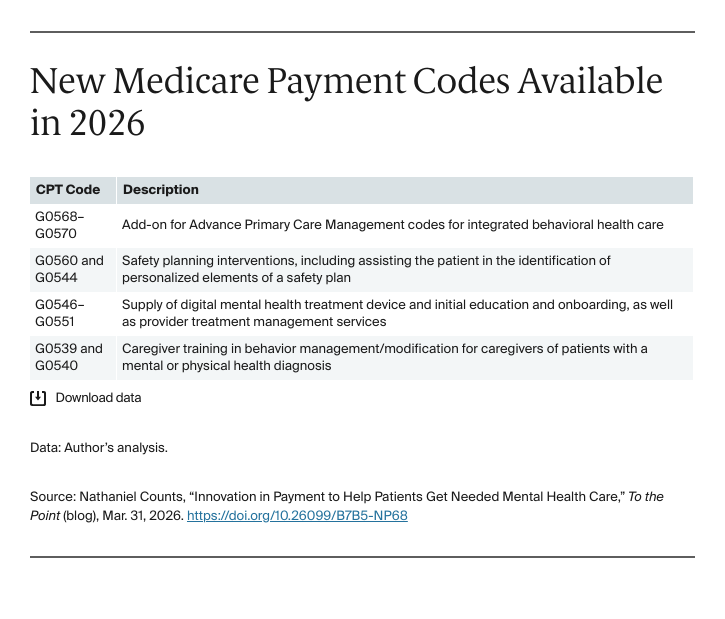
Medicare has continued to focus on integrated behavioral health services. This includes primary care providers working with patients to plan, coordinate, and manage access to behavioral health services and track their progress. The policy also permits advanced consultations between providers that allow them to speak about care without patients present. The changes also make it easier for many primary care providers to bill for these services. This could address previous challenges in provider implementation.
Medicare now pays for more digital health interventions, which includes apps and other technologies; for instance, providers can now prescribe technological tools for attention-deficit/hyperactivity disorder (ADHD). In addition, caregivers can receive additional services to help them support the recovery of their loved ones. And providers have more tools to help patients they feel may be at risk for suicide, using a set of strategies to address future crises.
CMS also put out requests for information on digital mental health and prevention, possibly signaling interest in expanding coverage for these services. In the past, CMS has found it difficult to design a payment approach for digital health services.
The following are the new payment codes available in 2026 for expanded services under traditional Medicare:
Broader Application
Medicare coverage influences commercial insurance and Medicaid. Many commercial insurers follow Medicare’s coverage decisions; in some cases, mental health parity laws may also require coverage. For the new codes to be included in Medicaid plans, states would need to change their state Medicaid design.
New Models at the Innovation Center
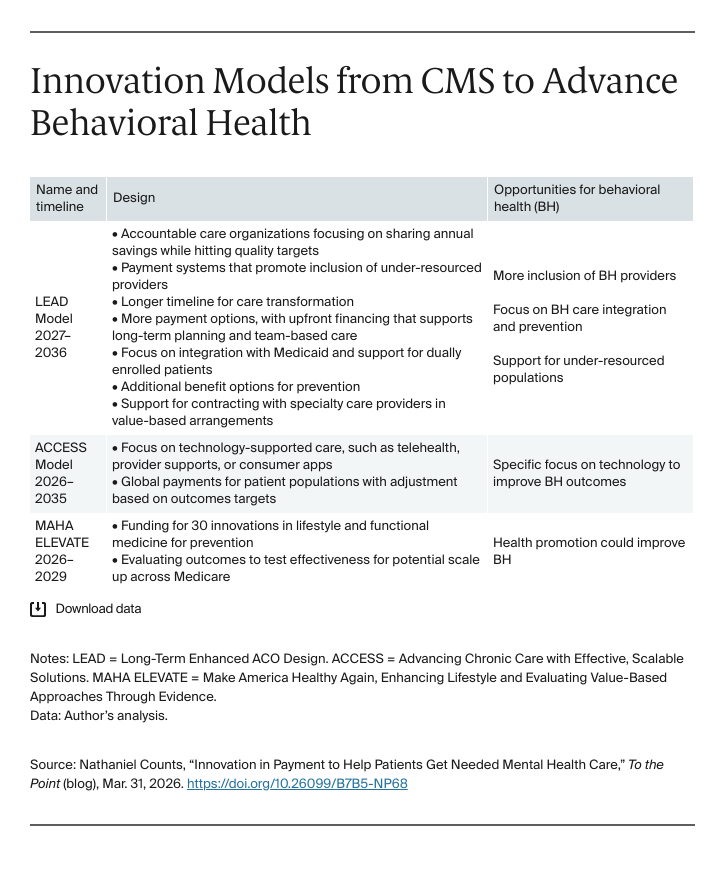
The Innovation Center announced a suite of new care and payment models at the end of 2025 that could expand patients’ access to health care services. While each has a different focus, they are all intended to advance the Center’s strategic direction, which includes promoting evidence-based prevention, empowering people to achieve their health goals, and driving choice and competition.
Some of the new models focus on improving care integration for better prevention and management of chronic conditions. They emphasize engaging more primary care providers and different kinds of specialists to work together more closely. Better integrated care is essential to better behavioral health outcomes but has traditionally faced challenges with financing. The models also try to align financial incentives with reducing costs from poorly managed chronic health conditions, for instance, from hospitalizations and emergency events.
Other models focus on testing a range of innovations to see what might be most effective without increasing costs. For example, one model focuses on promoting innovation in lifestyle interventions, such as counseling for nutrition and physical activity, that might prevent and manage chronic conditions and improve behavioral health. Another tests a range of digital health tools, including tools for therapy, provider coordination, and patient education. Overall, digital tools have been an underused resource for addressing unmet behavioral health needs, in large part because of challenges in payment. Across all models, providers offering Medicare Part B services are eligible to participate.
Opportunities Ahead
For the traditional Medicare reforms, providers may need education and implementation support. Often uptake of new billing opportunities is slow because providers are not aware of the services or do not know how to integrate them into their work. Additional copayments can pose a cost burden on patients. States and commercial insurers will need to align their public and private health insurance programs with these billing changes and ensure compliance with parity laws. CMS will need support in continuing to build on these changes. A new public comment period for Medicare payment at CMS will open this summer.
For the Innovation Center models, providers will need education and support to fully leverage the opportunities. Small and under-resourced providers will need technical assistance from CMS, their provider associations, and advocates; behavioral health specialists will need to build relationships with primary care providers and health systems. Stakeholder engagement, including people with lived experience from different backgrounds, will be central to ensuring the models’ effectiveness.
These policy changes can act as important drivers of change across the health insurance system. The reforms can influence the landscape of behavioral health care and improve access for patients. Continuing reforms will be necessary to address our nation’s behavioral health crisis.


