Advanced Search

Advanced Search

Current Filters

Filter your query

Publication Types

Other

to

Blog

/

Consumers Still Face Surprise Bills for Ground Ambulances — States Are Trying to Protect Them

Ambulance

A fire and EMS ambulance unit drives to a call in the rain in Washington, D.C. Each year, about 3 million people with private insurance rely on ground ambulance transport in emergencies — in circumstances when they typically have no ability to choose a provider. Photo: Kevin Carter via Getty Images

A fire and EMS ambulance unit drives to a call in the rain in Washington, D.C. Each year, about 3 million people with private insurance rely on ground ambulance transport in emergencies — in circumstances when they typically have no ability to choose a provider. Photo: Kevin Carter via Getty Images

Authors
  • Madison Harden
    Madison Harden-Stein

    Assistant Research Professor, Center on Health Insurance Reforms, Health Policy Institute, McCourt School of Public Policy, Georgetown University

  • Jack Hoadley_headshot
    Jack Hoadley

    Research Professor Emeritus, Health Policy Institute, McCourt School of Public Policy, Georgetown University

Authors
  • Madison Harden
    Madison Harden-Stein

    Assistant Research Professor, Center on Health Insurance Reforms, Health Policy Institute, McCourt School of Public Policy, Georgetown University

  • Jack Hoadley_headshot
    Jack Hoadley

    Research Professor Emeritus, Health Policy Institute, McCourt School of Public Policy, Georgetown University

Toplines
  • People facing medical emergencies can encounter large, unexpected bills when the ground ambulance that takes them to the hospital is out of network

  • In the absence of federal action, some states have taken steps to protect consumers from these surprise bills, but their efforts represent a piecemeal approach to the problem

While the federal No Surprises Act does much to shield consumers from surprise medical bills, the law has a significant gap: consumers can still face large, unexpected bills in medical emergencies when the ambulance that took them to the hospital was out of network. Each year, about 3 million people with private insurance rely on ground ambulance transport in emergencies — in circumstances when they typically have no ability to choose a provider. More than one of four of those privately insured ambulance trips may result in a surprise bill, leaving patients owing hundreds of dollars out of pocket. In 2021, the average ground ambulance bill for those with commercial insurance was $1,093.

In 2024, the Advisory Committee on Ground Ambulance and Patient Billing (GAPB) issued recommendations for federal reforms to address the problem. To date, federal action has stalled, but states have taken the lead in protecting consumers from ground ambulance surprise billing. This year saw new laws in five states, each experimenting with different payment methodologies, service scopes, enforcement, and consumer protections. People in 22 states now have some protection from surprise bills for ground ambulance services.

However, federal action remains important to ensure comprehensive protection, because states have authority to regulate only certain types of health insurance. Notably, states lack jurisdiction to regulate self-funded employer-sponsored health plans, which cover most U.S. workers.

States Are Stepping Up to Protect Their Residents

In 2025, five states acted to protect consumers with state-regulated health plans. Four states added new protections; Illinois revamped existing protections.

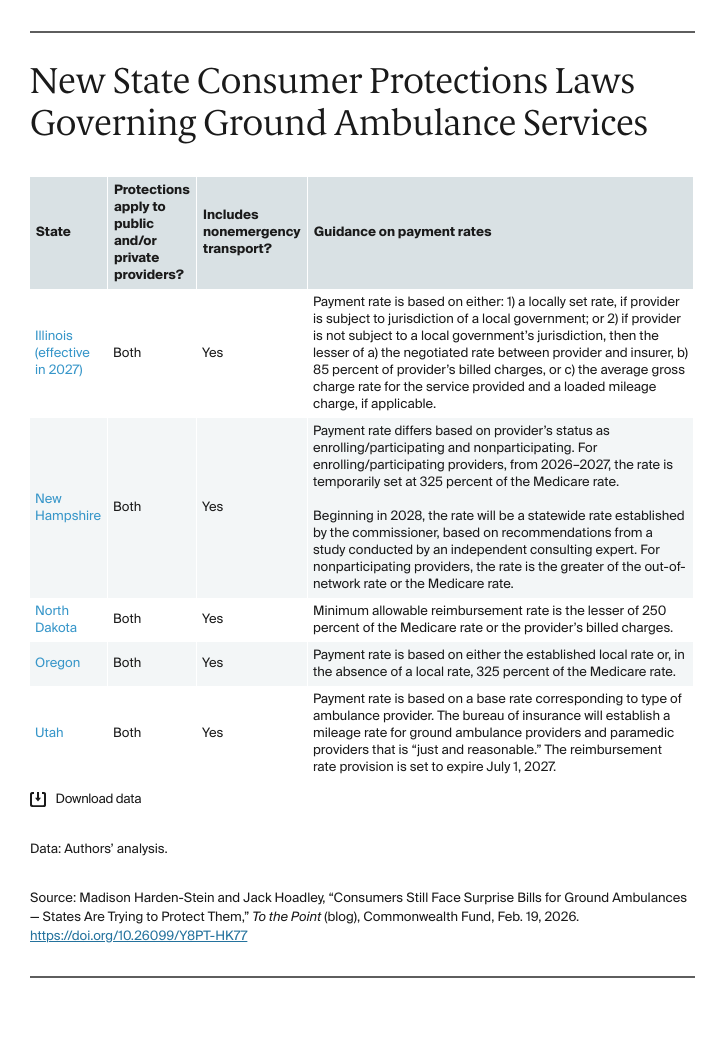
Table: New State Consumer Protections Laws Governing Ground Ambulance Services

In addition, Texas, where ground ambulance protections were set to expire in September 2025, extended its law’s sunset date to September 1, 2027.

Payment methodologies. Four of the five new laws adopted unique payment methodologies. North Dakota limits charges to 250 percent of the Medicare rate, which is significantly lower than many states’ benchmarks. Utah’s fee-schedule requirement means that insurers must pay the full rate set by the state, protecting patients from bills for any remaining balance between provider charges and what the insurer pays.

New Hampshire is exploring an all-payer model, where private insurers and public programs pay the same rate for ground ambulance services — a potential model for other states if it’s implemented successfully.

Oregon relies on rates determined by local governments that manage ground ambulance services in their jurisdiction. This has been done in other states, but Oregon will require local jurisdictions to justify their rates publicly, which is intended to prevent arbitrary or inflated local rate-setting and ensure transparency. Transparency in local rate-setting is a federal Advisory Committee recommendation.

Consumer protections. Illinois set a hard ceiling on patient cost sharing. Consumers pay the lesser of their normal copayment or 10 percent of the service cost. This directly lowers out-of-pocket costs and shields patients, even when billed charges or insurer payments are high.

Scope of protections. Three new laws protect patients against surprise billing for both emergency and nonemergency ground ambulance services. In New Hampshire, interfacility transport and behavioral health facility transport are covered. Oregon’s law covers interfacility transport and treatment without transport— in situations where the patient is treated in the field and not taken to a hospital. In Illinois, urgent care services, defined as services deemed medically necessary by a health care professional, are covered.

These provisions showcase a growing trend toward covering nonemergency services. Of the 22 states with ground ambulance surprise billing protections, 13 cover nonemergency transportation in addition to emergency services. These states are showing the importance of defining ground ambulance services broadly, including interfacility transport and treatment without transport, to provide consumers with the broadest possible protection.

Opt-in provisions. Oregon included an opt-in provision for ERISA plans, Public Employee’s Benefit Board plans, and Educators Benefit Board plans. Some states have adopted general opt-in provisions for surprise billing protections for other services, but Oregon is one of the first to have a provision specific to ground ambulance surprise billing; Washington acted similarly in 2024 to establish an opt-in provision for non-state-regulated plans.

Enforcement and oversight. Oregon and New Hampshire have emphasized oversight and enforcement. Oregon focuses on transparency and deterrence in its oversight system by including fines for repeat violations, public rate justification, and reporting requirements. New Hampshire penalizes noncompliance by reducing rates for providers that do not comply with reporting requirements. North Dakota acknowledged provider concerns about delayed insurer payments by initiating a study to consider a system to reimburse providers for unpaid bills.

Looking Forward

These new laws are significant. Not only do they add protections for consumers, but they also take new approaches to addressing payment, coverage scope, and enforcement.

Still, state laws remain at best a piecemeal approach to protecting consumers from surprise ground ambulance bills. Only a federal law can guarantee that all consumers are protected. Should Congress choose to act, federal policymakers will need to look at the advisory committee’s recommendations and should consider the various state approaches in filling any gaps.

Congress has not shown interest in taking up this issue, however. In the absence of federal action, responsibility will remain with the states to implement protections within their authority.


Publication Details

Date

Contact

Madison Harden-Stein, Assistant Research Professor, Center on Health Insurance Reforms, Health Policy Institute, McCourt School of Public Policy, Georgetown University

madison.harden@georgetown.edu

Citation

Madison Harden-Stein and Jack Hoadley, “Consumers Still Face Surprise Bills for Ground Ambulances — States Are Trying to Protect Them,” To the Point (blog), Commonwealth Fund, Feb. 18, 2026. https://doi.org/10.26099/Y8PT-HK77