Advanced Search

Advanced Search

Current Filters

Filter your query

Publication Types

Other

to

Indonesia’s national health insurance program, Jaminan Kesehatan Nasional, was launched in 2014 to improve access to health services and provide people with better financial protection from health care costs. As of 2024, it covered 97.6 percent of the population, offering basic medical services, with a focus on underserved and remote areas. Private insurance is uncommon, partly due to the accessibility and affordability of Jaminan Kesehatan Nasional. Funding is through government subsidies, employer contributions, and individual premiums.1

Indonesia’s health care expenditure is lower than the averages for the region and for upper-middle-income countries, yet the nation has made progress in reducing maternal and child mortality rates. Maternal mortality, however, remains relatively high, and there are persistent inequities in health care access between urban and rural areas, infrastructure limitations, and health care workforce shortages. The population also experiences long wait times for services and a lack of information about what they are entitled to under the Jaminan Kesehatan Nasional.2

Indonesia’s national health insurance program (Jaminan Kesehatan Nasional, or JKN) is intended to improve access to health care services and provide financial protection. The program is available to citizens, permanent residents, and foreigners who have lived in the country for at least six months.

  • Public insurance coverage: 97.6% of population

  • Private insurance coverage: 0.8% of population
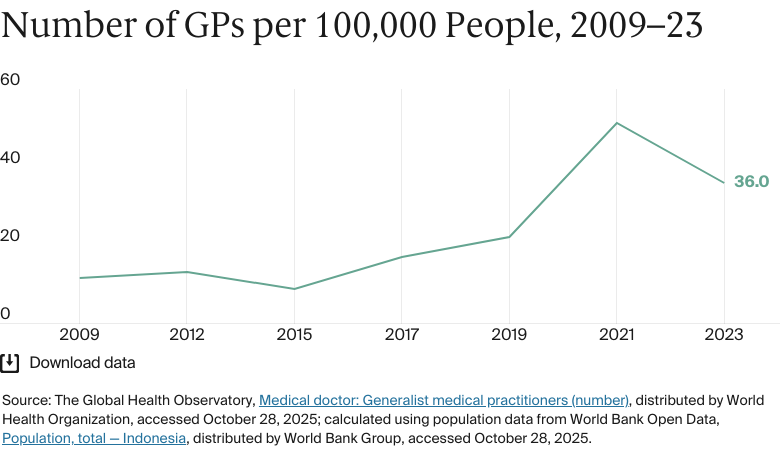
  • Primary care physicians: 36 per 100,000 people
  • Specialist physicians: 16 per 100,000 people

Total health care spending in 2022 breaks down as follows: government, 49.4 percent; patient out of pocket, 32.4 percent; prepaid private, 13.6 percent; and development assistance, 4.7 percent. Health spending per capita was USD 129, with USD 64 from government sources.

  • Pharmaceutical spending: 25.7% of total health care budget

  • Out of pocket spending: 31% of total health care spend

People living in rural and remote areas are particularly disadvantaged because they lack the health care infrastructure and services of urban centers. 

The availability and quality of health services in the West Papua region are particularly low after decades of conflict. Challenges are especially acute among internally displaced people fleeing conflict zones in West Papua. There are health inequities across the country, with western provinces performing better than eastern ones. Healthy life expectancy was found to differ by 8.5 years between Bali and North Kalimantan.

Coverage and Access

Background and History

In the 1940s, the newly independent Indonesian state inherited a fragmented and weak health system. It also faced the challenge of building a system that would cover the residents of the more than 17,000 islands that make up the country.3 Post-independence, the government focused on nationalizing private hospitals but struggled to adequately fund them. After President Suharto came to power in 1966, his New Order regime focused on development through market-oriented economic growth and introduced social insurance programs for civil servants, military personnel, and formal workers.4

Community health centers (puskesmas) were introduced in 1968, improving access to health care, and by the 1970s, every subdistrict or area with a population of 30,000 to 50,000 had one. In 1979, smaller centers (pustu) were established at the village level — by 2013, these centers served populations of up to 3,000.5

Although the government expanded public infrastructure — such as by building puskesmas — health care received limited operational funding. Public hospitals and health centers often lacked resources, and wealthier individuals turned to paid services at public hospitals. In 1986, the government legalized for-profit hospitals, further reinforcing the role of the private sector.6

The 1997 financial crisis led to economic instability, prompting the government to launch the social safety net program (Jaring Pengaman Sosial Bidang Kesehatan), the first nationwide insurance for the poor. In 2004, the National Social Security Law (Sistem Jaminan Sosial Nasional) laid the foundation for universal health coverage through a greater focus on social welfare and equitable health care access.7

In 2014, the government introduced its national health insurance program (Jaminan Kesehatan Nasional, or JKN), administered by the Social Security Agency on Health (Badan Penyelenggara Jaminan Sosial Kesehatan, or BPJS Kesehatan). JKN is intended to improve access to health care services and provide financial protection. BPJS Kesehatan manages contributions, claims, and provider networks.8

The Role of Public Health Insurance 

As of 2024, 97.6 percent of the population was covered under JKN.9 The program is available to citizens, permanent residents, and foreigners who have lived in the country for at least six months.10 JKN is funded through government budgets, employer and employee contributions based on salaries, and flat-rate premiums from informal and nonsalaried workers.11

Under JKN, individuals employed in the formal sector are automatically registered by their employers. Although JKN is mandatory, integrating the informal sector, which employs a large proportion of Indonesia’s working-age population, remains difficult. Unlike formal sector employees and recipients of subsidized contributions, informal workers must voluntarily enroll in JKN, obtain membership cards, and pay their monthly contribution fees.12

JKN previously divided inpatient care into three classes based on premium levels. These classes determined hospital ward amenities rather than the medical services provided.13 In 2024, the government began phasing in a new standardized inpatient class (KRIS) system and dismantling the previous system.14 The government aims to implement KRIS in nearly every hospital by summer 2025 to help all JKN patients receive the same quality of care.15

Services Covered by Public Health Insurance

The following services are fully covered under public health insurance:16

  • Preventive care
  • Inpatient care
  • Outpatient care
  • Maternity care
  • Primary care
  • Mental health care
  • Palliative care
  • Eye care
  • Rehabilitative care.

Services that are partially covered:17

  • Dental care (advanced and cosmetic procedures are not covered)
  • Long-term care (a public nursing program offers home care for the elderly through puskesmas, but this isn’t universally available).

JKN includes coverage with specific upper limits on value or quantity for certain medical devices:

  • Eyeglasses are covered up to IDR 150,000 (USD 9) for third-class ward beneficiaries and IDR 300,000 (USD 18) for first-class ward beneficiaries for every two-year period.18
  • Hearing aids are covered up to a maximum of IDR 1 million (USD 60) for every five-year period.19
  • Medical assistive devices, such as wheelchairs and canes, are covered up to a maximum of IDR 2.5 million (USD 151) for every five-year period.20

In accordance with Minister of Health Regulation No. 40/2012, the government prohibits copayments for services eligible under JKN and doesn’t impose an upper limit on treatment costs as long as they adhere to established clinical protocols. This regulation aims for all beneficiaries to receive necessary medical care at no additional cost beyond mandatory contributions to JKN.21

Safety Nets

Some health care safety nets are designed to ensure access for all citizens. To improve accessibility to JKN, for instance, the government subsidizes premiums for people with low income.22

The Family Hope Program (Program Kluarga Harapan) aims to improve child health and education outcomes and provides financial assistance to low-income families.23

Beyond these government initiatives, many charitable clinics provide free medical services on a nonprofit basis. Some of these are supported by religious organizations.24 For example, a major Islamic non-governmental organization, the Muhammadiyah Society (Persyarikatan Muhammadiyah), currently has 125 hospitals across Indonesia.25

The Role of Private Health Insurance

Private health insurance is uncommon in Indonesia, in part owing to the accessibility and affordability of JKN. Comprehensive private coverage demands high premiums, and there are multiple products with varying benefits.26 In 2021, only about 0.8 percent of Indonesia’s population used private health insurance.27

Private health insurance is regulated by the Ministry of Finance (Kementerian Keuangan). BPJS Kesehatan has integrated programs from leading private insurers with public health insurance benefits, allowing middle- and high-income JKN members to access a top-up option.28 Private hospitals in Indonesia promise shorter wait times and better patient outcomes.29

The Role of Government

The government organizes, plans, and regulates the health system, with responsibilities distributed among the central, provincial, and district governments.30

At the central level, the Ministry of Health (Kementerian Kesehatan, or Kemenkes) is responsible for strategic planning, standard-setting, regulation, and resource allocation. It enacts laws and policies that guide the system but does not have authority over provincial or district health provision. Instead, it operates some programs that function at both the provincial and district levels, such as immunization programs.31

At the provincial level, provincial health offices coordinate health services across districts and oversee provincial hospitals. They implement national policies within their jurisdictions and work to ensure the quality and accessibility of health care. Provincial health offices report directly to the provincial governor and align regional health services with national priorities while supporting district-level health care management.32

At the district level, district health offices oversee district hospitals and manage the primary health services provided by puskesmas and their networks. District health offices implement health programs at the local level but don’t function under the authority of provincial health offices. Instead, they report to their district or municipal governments.33

Multiple government agencies collaborate in the health sector beyond Kemenkes and BPJS Kesehatan. The Food and Drug Control Agency (Badan Pengawas Obat dan Makanan) regulates food and pharmaceutical safety, the National Population and Family Planning Board (Badan Kependudukan dan Keluarga Berencana Nasional) manages reproductive health initiatives, and the National Disaster Management Authority (Badan Nasional Penanggulangan Bencana) addresses emergency health care responses.34

Integration and Care Coordination

Indonesia faces challenges in harmonizing its decentralized health administration and improving services. Strengthening regulatory enforcement, enhancing intergovernmental coordination, and expanding universal health coverage are all priorities for the government.35

As of August 2024, 10,000 puskesmas had adopted the Integrated Primary Health Care (Integrasi Layanan Primer) program, which aims to unify fragmented health services at the primary care level. There is also a referral system that encourages patients to first seek care at puskesmas before being referred to hospitals.36

Care is integrated through puskesmas and integrated health posts (posyandu). Puskesmas provide essential medical services, while posyandu, supported by volunteers, bring together a wide range of preventive care and health promotion activities, including mother and child health and nutrition37 (see Primary Care and Long-Term Care and Social Support).

Private primary care providers must collaborate with puskesmas on tasks such as communicable disease surveillance and government programs, such as immunization and family planning.38

Operations and Resources

Overview of the Delivery System

Indonesia’s health care system has three tiers:

  • Primary care focuses on essential health services, including preventive care and the treatment of minor illnesses and injuries. It is mainly provided through puskesmas and private clinics.39
  • Secondary care offers more specialized medical services, such as surgical procedures, obstetric care, and emergency treatment. These services are typically provided by district hospitals and private health care facilities.40
  • Tertiary care includes advanced and highly specialized treatments, such as organ transplants and cancer management. These services are typically available at referral hospitals and specialized private hospitals.41

Primary health care providers are remunerated through a capitation system that covers outpatient services for 155 diagnoses, including diabetes, typhoid fever, and pneumonia. Treatment for some infectious diseases is instead covered by direct funding from Kemenkes.42

Hospital reimbursements are determined by the Indonesian Case-Based Groups payment system, which groups similar diagnoses and procedures based on clinical and resource requirements.43

Primary Care 

The primary health care structure revolves around puskesmas, which provide vital services, such as vaccinations, health education, maternal and child health care, and chronic disease management. They are generally staffed by general practitioners (GPs), nurses, dentists, public health specialists, and midwives. However, in some rural areas, they are only staffed by nurses and midwives.44

The health facilities that support puskesmas include pustu, which are mostly run by nurses and village health posts (poskesdes), which should have one nurse and one midwife. Posyandu are run by volunteers who promote health and focus on preventive care.45

Each puskesmas is responsible for public health activities in its area and is supported by a diverse team of professionals.46 Some offer emergency services only during opening hours, but the ones with inpatient facilities provide 24/7 emergency care.47

Primary care facilities are responsible for referring patients to secondary or tertiary care, ensuring that puskesmas focus on routine and preventive care to reduce burdens on hospitals.48

Individual GPs, nurses, and midwives also run private primary health care clinics, often alongside their work in the public system. The World Bank estimates that there are about 9,000 private primary care clinics in Indonesia and 7,000 individual GPs operating privately.49

A 2024 study revealed that 17.3 percent of JKN participants accessed primary care regularly (more than twice in a six-month period) and only 19.7 percent of fully subsidized members.50

In 2023, there were 52.4 doctors for every 100,000 people, lower than the average across Southeast Asia in 2022 (77).51

There are no data available for the proportion of doctors who are employed privately versus publicly.

Line chart: Number of GPs per 100,000 People, 2009–23

Outpatient/Specialist Care

Typically, Indonesians access outpatient or specialist care by first obtaining a referral from a primary provider, such as a puskesmas or a general practitioner. Patients can use their JKN membership card at participating facilities.52 In emergencies, patients can skip the referral process and go directly to a hospital emergency department.53

In 2023, there were 16 specialist medical practitioners for every 100,000 people.54

Physician Education and the Workforce

In 2020, there were 88 medical schools, both public and private.55

The undergraduate medical program requires at least 3.5 years of preclinical studies followed by two years of clinical training. Since 2010, graduates must complete a one-year internship after passing the national examination, then proceed to a two-year primary care physician program.56

Annual tuition fees for medical school in Indonesia range from USD 3,000 to USD 6,100, on average.57 The University of Indonesia lists tuition fees of IDR 11 million (USD 656) to IDR 22 million (USD 1,313) per semester or IDR 44 million (USD 2,627) per semester for international students.58

Specialist doctors are in short supply owing to the high costs of training and the relatively low pay.59 The distribution of medical workers is uneven: while Daerah Khusus Ibukota Jakarta has 0.6 doctors for every 1,000 people, East Nusa Tenggara has just 0.1 for every 1,000 people.60

To address disparities and workforce challenges, the government has implemented a mandatory internship program after graduation that requires trainees to work in both rural and urban areas.61

There are no data available for the percentage of doctors recruited from overseas or for those who choose to work overseas.

According to Diah Satyani Saminarsih, founder and CEO of the Center for Indonesia’s Strategic Development Initiatives, it’s crucial for volunteer community health workers to be formally integrated into the health workforce.

“Community health workers are not yet paid, so they’re seen as volunteers,” says Diah. “They haven’t reached the level of competency they should have because the district health [offices don’t] have the training material to make sure they can reach the level of proficiency required. We need to include them in the health workforce and stop seeing them as volunteers.”

Hospitals

BY THE NUMBERS

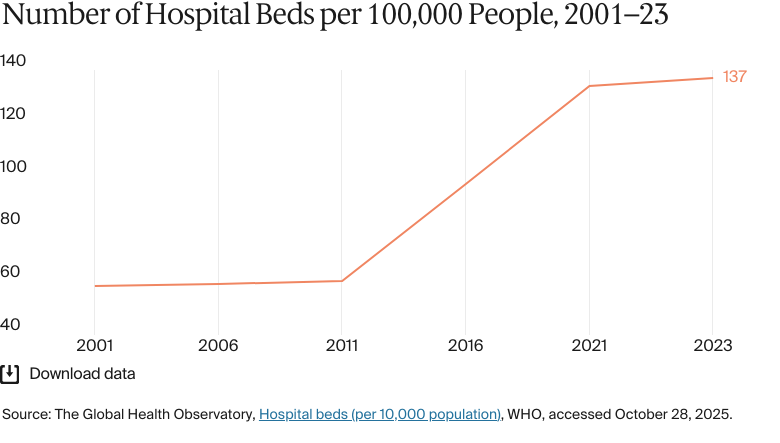
  • In 2023, there were 137 hospital beds per 100,000 people.62
  • In 2023, there were 324 nurses per 100,000 people (compared with an average of 206 in Southeast Asian countries).63

Public hospitals, which are managed at the national, provincial, or district level, adhere to government policies and receive funding from state budgets and the JKN. Private hospitals are owned by individuals, corporations, or nonprofits. Foreign investment in private hospitals has increased since policy changes in 2021 allowed 100 percent foreign ownership.64

Licensing and accreditation are overseen by Kemenkes. The 2020 Omnibus Law and other reforms introduced a risk-based licensing system and eased investment restrictions in order to enhance hospital efficiency and service delivery.65

As of 2023, there were 3,155 hospitals, a 9.7 percent increase from 2019, following both government and foreign investment. Of these, 2,636 are general hospitals and 519 are special hospitals. Hospitals are further classified as A, B, C, and D based on service capacity, infrastructure, and staffing. Class C hospitals make up 53 percent of the total.66 The number of hospital beds has remained consistently at least one bed for every 1,000 people, reaching a high of 1.4 in 2023.67 However, this is still one of the lowest rates among Association of Southeast Asian Nations (ASEAN) countries.68

There is a disparity in payment rates between private and public hospitals, with the former receiving 3 percent higher rates for outpatient services and 5 percent higher rates for inpatient services. Sixty-four percent of hospitals participating in the JKN program are private facilities from both the for-profit and nonprofit sectors.69

Line chart: Number of Hospital Beds per 100,000 People, 2001–23

Mental Health Care 

BY THE NUMBERS

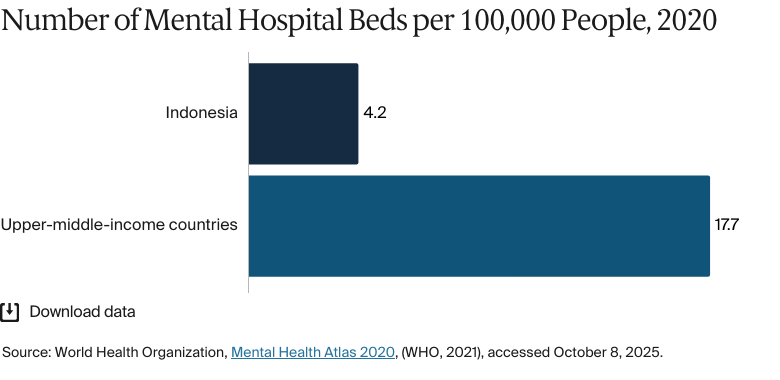
  • In 2020, there were 4 mental hospital beds per 100,000 people, well below the average of 18 in upper-middle-income countries.70
  • In 2020, there were 0.4 psychiatrists per 100,000 people, lower than the average of 2 in upper-middle-income countries.71
  • In 2020, there were three mental health professionals per 100,000 people, lower than the average of 15 in upper-middle-income countries.72

Services are available through the puskesmas, district hospitals, provincial hospitals, psychiatric hospitals, and private clinics, but a shortage of professionals, geographic disparities, and persistent stigma all pose challenges to access. Of individuals with mental health disorders in Indonesia, 91 percent were not receiving treatment in 2018.73 Low levels of government spending on mental health are also an issue. Just 2 percent of total government health expenditure went toward mental health in 2020, 66 percent of which was spent on mental health hospitals.74 There were just 0.1 community-based mental health facilities for every 100,000 people in 2020, compared with 0.3 on average in upper-middle-income countries.75

JKN covers routine mental health consultations and treatment, but patients often pay out of pocket for psychotherapy and medication.76

Stigma around mental health conditions also poses an issue. The restraint of those with mental health conditions (pasung) in home or community settings has been illegal in Indonesia since 1977, but it continues, especially among populations with limited access to mental health care.

Bar chart: Number of Mental Hospital Beds per 100,000 People, 2020

Long-Term Care and Social Support 

Long-term care is predominantly provided at home by family members.77 However, this practice is becoming less common as people increasingly move away from their families for work, and there has been a gradual shift from extended families living together to only nuclear families living together.78 As of 2021, there were no financial assistance programs to support unpaid carers.79

Indonesia has a number of programs that provide care for the elderly in some form, but these primarily focus on delivering meals and supplies rather than on personal care, and they cover only a tiny fraction of the elderly population (in 2025, Indonesia had over 34 million people over age 60).80

Over 100,000 Posyandu Lansia (integrated health centers for the elderly) throughout Indonesia undertake health outreach, provide testing services, and make referrals for over 2.5 million elderly people.81 Posyandu Lansia are staffed in part by volunteers (kader). However, many communities struggle to recruit kader, and training is inconsistent. Kader also largely do not provide home visits, limiting care for elderly people with more serious needs.82 Private services offering long-term care are scarce.83

As of 2021, there were about 277 residential long-term care facilities (both government and private) in Indonesia: 189 were private, three were run by the central government, and 71 were run by local governments.84

Cost and Affordability

Health Care Spending Overview

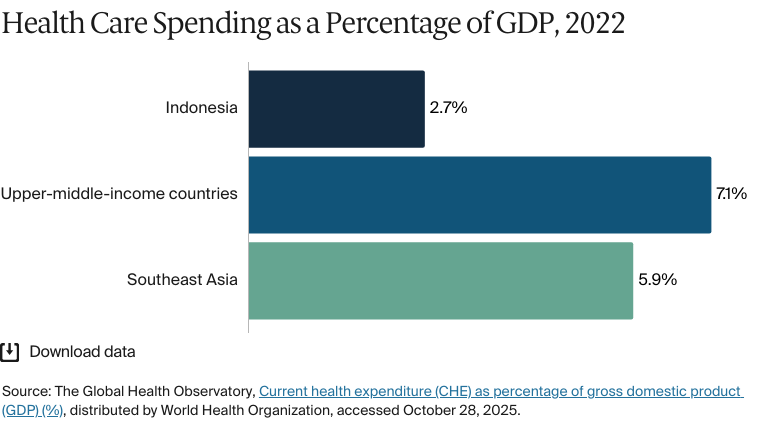
In 2022, health expenditure was 2.7 percent of gross domestic product (GDP), down from 3.7 percent in 2021 and 3.4 percent in 2020. This is also lower than the average of 7.2 percent for upper-middle-income countries.85

Total health care spending in 2022 breaks down as follows: government, 49.4 percent; patient out of pocket, 32.4 percent; prepaid private, 13.6 percent; and development assistance, 4.7 percent.86 Health spending per capita was USD 129, with USD 64 from government sources.87

Central, provincial, and district governments all have a role in the financing framework for public health. At the national level, the bulk of funds is funneled to BPJS Kesehatan, hospitals managed by Kemenkes, salaries, and various health programs. BPJS Kesehatan’s budget is allocated to mechanisms such as capitation, Indonesian Case-Based Group payments, and fee-for-service reimbursements to health care providers.88

Premium contributions constitute 23 percent of health expenditure. Employed people pay a payroll tax of 5 percent of their monthly salary, split between employers (4%) and employees (1%), capped at a monthly payroll of IDR 12 million (USD 716).89

Informal workers pay between IDR 35,000 (USD 2) and IDR 150,000 (USD 9) per month, depending on their chosen hospital ward class.90

As of 2021, 59 percent of JKN members did not have to make contributions (Penerima Bantuan Iuran — PBI) as of 2021. PBI members’ premiums are subsidized by central and local government — a source of funding that makes up 42 percent of the JKN budget.91

Bar chart: Health Care Spending as a Percentage of GDP, 2022

Pharmaceutical Spending

In 2021, 25.7 percent of the health care budget was spent on pharmaceuticals, with an average per capita spend of IDR 640 (USD 0.03).92

While the prices of many medicines fell in the years following the implementation of the JKN in 2014, they remain high compared to prices in neighboring countries.93 Indonesia has a competitive domestic pharmaceutical market, with 174 pharmaceutical companies based in the country in 2018, but the majority of raw materials must be imported, which pushes up prices.94 In 2024, some medicines cost four times more in Indonesia than in Malaysia.95 In an effort to reduce prices, the government lifted restrictions on the foreign ownership of pharmaceutical manufacturing companies in 2021, allowing 100 percent foreign ownership.96

Cost Sharing and Out-of-Pocket Spending 

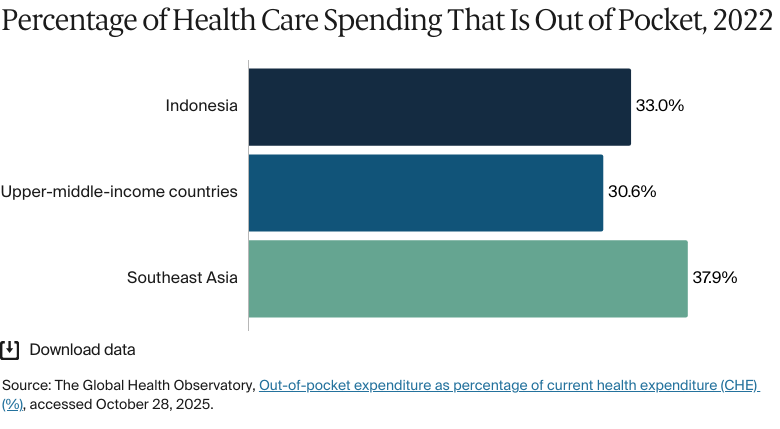
In 2023, 31 percent of current health care spending was out of pocket — a steep decrease from 2010, when it accounted for 60.6 percent.97 The percentage of people facing financial hardship due to high out-of-pocket payments (defined as spending more than 10% of income) dropped from 4.5 percent in 2017 to 2 percent in 2021.98 The drop most likely resulted from the implementation of JKN, which helped shield the poorest members from the cost burden of out-of-pocket spending.99

Still, many health care services require copayments or other out-of-pocket spending. JKN covers basic medications, but some medical procedures exceed the Indonesia Case-Based Group rates, resulting in additional costs. Specialized treatments and surgeries not covered by JKN also result in significant out-of-pocket expenses.100 There are no out-of-pocket caps for beneficiaries under JKN.101

Bar chart: Percentage of Health Care Spending That Is Out of Pocket, 2022

How Are Costs Contained?

JKN covers many expensive surgeries and treatments and pays for primary care through capitation. As a result, the service has run in a deficit since its creation. There have been efforts to increase premiums to reduce the deficit, but these have been controversial. An attempt to nearly double premiums in 2020, for instance, was struck down by the constitutional court as violating the right to health.102

JKN uses a case-mix system, Indonesia Case-Based Groups, that sets varying tariff rates for public secondary, public tertiary, and private hospitals. Public secondary and private hospitals receive higher rates to help regulate hospital health care costs.103

Kemenkes also tried to implement health technology assessments (HTAs) to inform coverage decisions about medical technologies.104 In 2014, Kemenkes established the Indonesian Health Technology Assessment Committee (Komite Penilaian Teknologi Kesehatan, or Komite PTK). In 2017, Komite PTK released guidelines for Indonesian HTAs so that stakeholders, including the Kemenkes, universities, and hospitals, could conduct evaluations. It updated these guidelines in 2022.105

Quality and Outcomes

Health Outcomes

BY THE NUMBERS

  • Life expectancy was 74.2 years in 2024, compared with 68.4 years in Southeast Asia in 2021:
    • Life expectancy for women was 76.7 years in 2024, compared with 70.3 years in Southeast Asia in 2021.
    • Life expectancy for men was 71.8 years in 2024, compared with 66.6 years in Southeast Asia in 2021.106
  • In 2021, the top three causes of death were: 
    • COVID-19: 210 per 100,000 people
    • Stroke: 141 per 100,000 people
    • Ischemic heart disease: 90 per 100,000 people.107
  • The maternal mortality rate was 140 deaths per 100,000 live births in 2023 (compared with 96 deaths per 100,000 live births in Southeast Asia).108
  • The infant mortality rate was 17 deaths per 1,000 live births in 2023 (compared with 23 on average across Southeast Asian countries).109
  • In 2021, the share of the population with mental health disorders was 12 percent (compared with 14% in upper-middle-income countries).110
  • In 2023, the suicide rate was 2 per 100,000 people (compared with seven across upper-middle-income countries).111
  • The gun death rate was 0.1 deaths per 100,000 people in 2023.112
  • 11 percent of adults were affected by obesity in 2022 (compared with an average of 8% in Southeast Asia).113

Geographical disparities, underinvestment, and workforce shortages are serious challenges for Indonesian health care. Rural areas lack sufficient infrastructure, creating an urban–rural divide in access to services. A shortage of skilled health care workers affects care quality and availability, and marginalized groups experience significant barriers to health care access.114

In 2024, average life expectancy was 74.2 years, the same as the average for upper-middle-income countries in 2021. There was a five-year difference in life expectancy between men (71.8 years) and women (76.7 years).115

Addressing Health Inequities

Many groups in Indonesia encounter significant barriers to care. People living in rural and remote areas are particularly disadvantaged because they lack the health care infrastructure and services of urban centers.

The availability and quality of health services in the West Papua region are particularly low after decades of conflict.116 Public hospitals across the region regularly experience closures and strikes and face severe shortages of medical staff and supplies. Challenges are especially acute among internally displaced people fleeing conflict zones in West Papua.117

In 2025, 5 percent of Indonesians reported an unmet health care need, with the proportion slightly higher in rural areas (6%).118 An analysis of the burden of disease in Indonesia between 1990 and 2019 found substantial health inequities across the country, with western provinces performing better than eastern ones. Healthy life expectancy was found to differ by 8.5 years between Bali and North Kalimantan.119

According to Diah, from the Center for Indonesia’s Strategic Development Initiatives, differences in the preferences of rural and urban populations for formal and nonformal health care affect outcomes.

In rural areas, women often prefer to go to the nonformal sector of health care, such as a shaman, or the semiformal [sector], such as a traditional midwife, while women in urban areas prefer formal health centers. We might think that nonformal health care is not health care, but these women see it as formal health care.

Diah Satyani Saminarsih

Founder and CEO
Center for Indonesia’s Strategic Development Initiatives

Mobile health initiatives, such as the Hibiscus clinic, are helping those who struggle to reach health centres by bringing essential services directly to communities.120

The introduction of the JKN and mandatory health spending helped reduce disparities by improving access to health care and reducing out-of-pocket expenses. However, there are concerns that the 2023 abolition of mandatory health spending could reverse that progress by reducing funding for health care services in disadvantaged remote areas.121

Innovation and Reform

Health Care Innovation

Significant innovations and reforms focused on preventive care, workforce development, and digital transformation have aimed to enhance the quality of health care.

Preventive Care

An extensive free health screening initiative was launched in February 2025 with a budget of about IDR 3 trillion (USD 184 million). The program offers annual birthday health checks, initially for children under age 6 and adults age 18 and over. Screening includes assessments for blood pressure, heart disease and stroke risks; eye tests; and mental health evaluations for depression and anxiety. The program was rolled out at more than 20,000 health centers and clinics in 2025, with the goal of screening 100 million people within the year.122

Health Care Workforce Reform 

The Health Law of 2023 relaxed licensing requirements for overseas-trained health care professionals to practice in Indonesia. Indonesian professionals who have practiced abroad for at least two years, as well as foreign professionals with at least five years of experience in specific medical fields, are now exempt from competency tests. This reform aims to address the overburdened health care industry, attract medical tourists, and increase foreign investment and collaboration between international and domestic health care providers.123

Health Care Technology

Digital Transformation Strategy 

In 2021, the Kemenkes Digital Transformation Office was established to focus on three strands of digital health transformation: the implementation of electronic medical records, the simplification of health service applications, and the provision of regulatory support for the health innovation ecosystem.124

The 2021–24 Health Technology Transformation Roadmap also sought to further Indonesia’s digital transformation in health. The roadmap prioritized the integration and development of health data systems, the development of health application systems, and the development of health technology.125

Electronic Medical Records

As of 2022, Kemenkes requires all health service facilities to implement electronic medical records.126 By 2023, 768 hospitals had implemented electronic medical records, but eight provinces had not.127 While there has been progress, only 13 percent of hospitals have fully implemented electronic medical records owing to significant variations in the software and financial resources available to them. One of the benefits of electronic medical records is that patients can access their medical records using the SATUSEHAT app, which was widely used during the COVID-19 pandemic for vaccine information and check-ins.128

Health care facilities are required to connect to SATUSEHAT, which combines applications from various health industry providers.129 The platform standardizes health data exchange, reducing the need for physical records and streamlining referrals. The integration is being implemented in phases, covering patient registration, medical procedures, prescriptions, and diagnostics.130 As of 2022, many health care facilities were testing the SATUSEHAT platform.131

This profile reflects data as of January 2026. New or updated information may have become available since its release.

Notes

Country Profile Details

Date

Citation

International Health Care System Profiles: Indonesia (Commonwealth Fund, May 2026).

https://doi.org/10.26099/9NYQ-BE62

Compare Countries

Explore how countries compare on key health system characteristics including health care coverage and spending, the health workforce, health outcomes, and more.

Learn more →

Related Content